
Newsmax’s Youngest Columnist | Bold Commentary on Policy & Government
Trump Was Right to Strike Iran
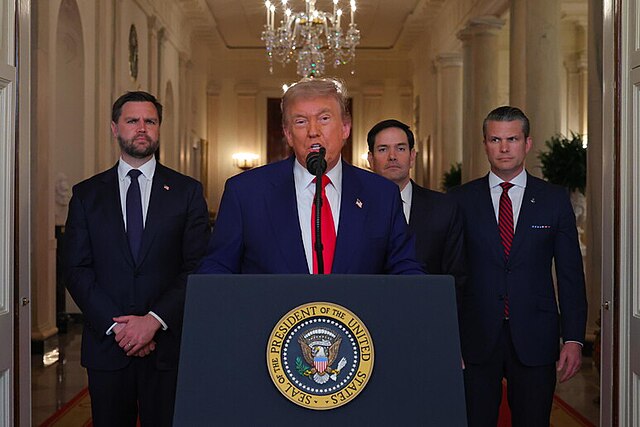
President Trump delivers a national address following a successful U.S. strike on Iranian nuclear facilities.
For the first time in years, the Iranian regime encountered not symbolic disapproval, but real and immediate consequences
For over four decades, the Islamic Republic of Iran has challenged the United States and its allies through terrorism, nuclear defiance, and the destabilization of neighboring countries. Successive American administrations—Republican and Democrat alike—often responded with diplomatic caution, financial sanctions, or rhetorical condemnation. These measures never changed Iran’s behavior. Instead, the regime interpreted them as evidence that the United States would not act decisively.
President Trump’s recent military strike on Iranian nuclear weapons infrastructure marked a significant departure from that pattern. For the first time in years, the regime encountered not symbolic disapproval, but real and immediate consequences. As someone who reports on U.S. policy and the Middle East, I’ve interviewed Iranian dissidents, U.S. officials, and policy experts who agree: this moment may prove to be a turning point.
The Islamic Republic’s current vulnerability is internal. Iran is undergoing the worst economic collapse in its post-revolutionary history. Inflation is estimated at over 50%, and the Iranian rial has lost more than 80% of its value in the past five years. Widespread strikes among oil workers, transportation employees, and educators have intensified. Protests led by students and women have taken root in both major cities and more conservative provinces. The population is not calling for incremental reform—it is demanding the end of clerical rule altogether.
I spoke with one Iranian expert, who told me the regime is facing “a legitimacy crisis it cannot solve with violence alone.” He described how even members of the security forces are becoming reluctant to suppress demonstrations, as growing numbers of Iranians reject the regime’s ideology and its brutality.
This wave of internal pressure comes at a time when Iran’s external aggression has sharply escalated. Tehran continues to fund and arm terror proxies, including Hezbollah in Lebanon and the Houthis in Yemen. It has directed drone and missile attacks on U.S. positions in Iraq and Syria and intensified coordination with groups targeting Israeli civilians. These actions are part of a broader strategic goal: to project Iranian influence across the region and to intimidate any opposition into silence.
For years, Iran’s leadership operated under the assumption that the United States would never push back with force. Under the Obama administration, the Joint Comprehensive Plan of Action (JCPOA) allowed Iran to access more than $180 billion in frozen assets and reintegrate into global markets. In exchange, the regime agreed to temporary nuclear limits—limits which Iran blatantly violated.
The Trump administration rejected this approach and adopted a strategy of maximum pressure. Over 1,500 targeted sanctions were imposed on Iran’s banking, energy, defense, and intelligence sectors. These measures helped to cripple the regime’s ability to fund external militancy and accelerated the economic deterioration already underway. But sanctions alone, while necessary, were not sufficient. When the regime crossed another red line, President Trump acted.
The strike on nuclear infrastructure reestablished a boundary that had long been blurred. A senior U.S. official I interviewed told me that “credibility is built by consistency,” and for years, that consistency was missing. Now, after this strike, the regime can no longer rely on past American hesitation.
I spoke with Congressman Mike Lawler regarding Israeli-Saudi cooperation, who noted that joint missile defense coordination—once politically unthinkable—is now becoming a reality. These relationships are not forming in isolation. They reflect a shared understanding that Iran’s ambitions threaten all who seek peace and stability.
Some argue that President Trump’s strike on Iran risked dragging the United States into another war. In truth, however, Iran had been escalating its aggression for years without facing meaningful consequences. A policy of restraint did nothing to stop attacks on American bases, the transfer of missiles to terrorist proxies, or the brutal crackdown on Iranian protesters. A credible show of force was long overdue.
Related Topics
Related Posts