
Newsmax’s Youngest Columnist | Bold Commentary on Policy & Government
Trump’s Education Reforms Signal a Structural Shift Toward Parental Control
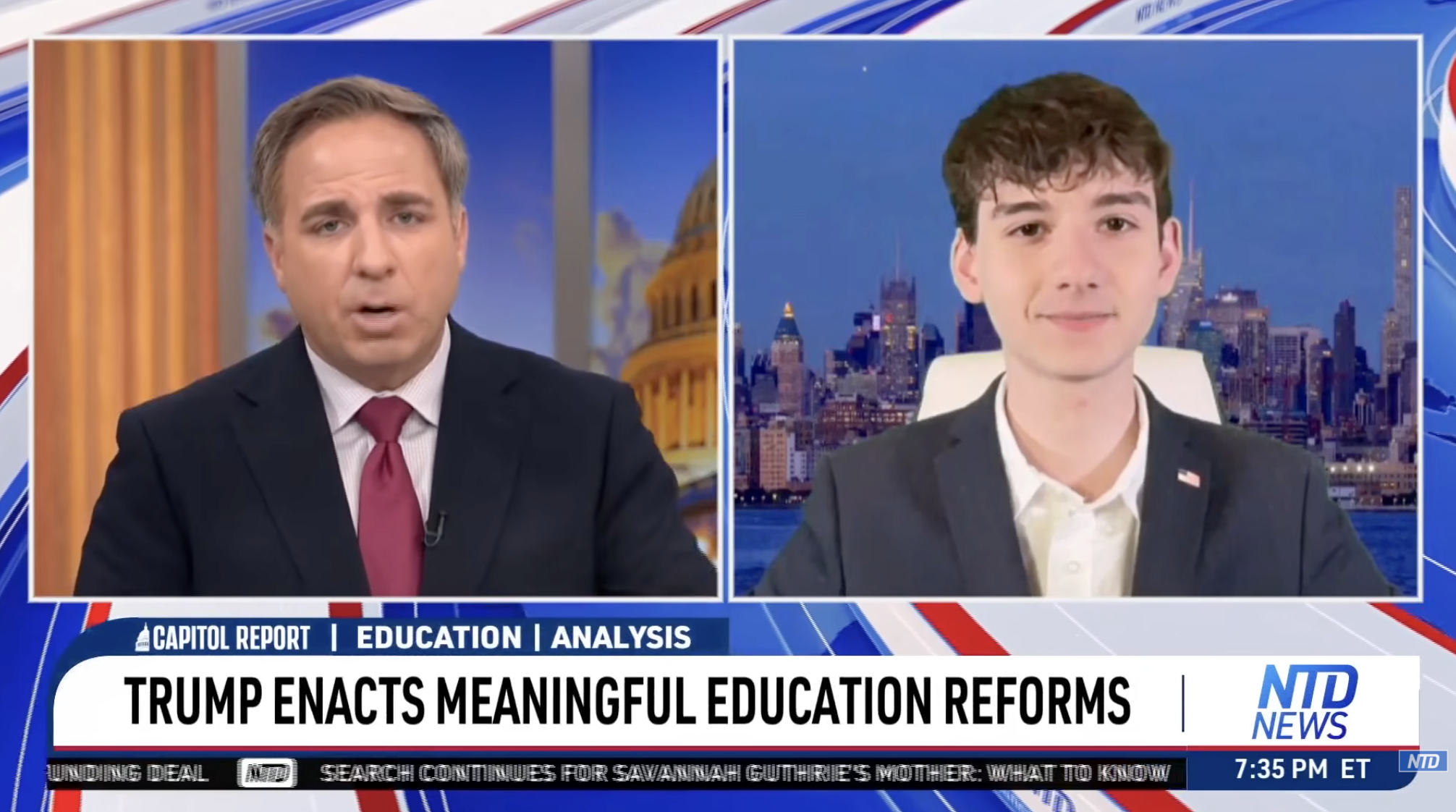
In a recent television interview, I outlined what I view as one of the most consequential shifts in American education policy in decades: a deliberate movement away from federal bureaucracy and toward parental control. The discussion centered on President Donald Trump’s second-term education agenda, which reflects not just a series of reforms, but a structural reorientation of how education decisions are made in the United States.
The core of these reforms can be summarized clearly: authority over education is being returned to families. For decades, federal agencies and institutional actors—particularly large bureaucracies and teachers’ unions—have played a dominant role in shaping curriculum, funding priorities, and school governance. That structure has often limited the role of parents and students in decisions that directly affect educational outcomes.
One of the most tangible examples is the expansion of 529 savings accounts. Previously limited to college expenses, these tax-advantaged accounts now cover K–12 costs, including private school tuition, charter school enrollment, and specialized services such as therapy. This change allows families to make decisions based on what works best for their children, rather than being constrained by a one-size-fits-all public system.
Another key component involves reducing the scope of the federal Department of Education. The department has grown into a large administrative structure with limited direct impact on K–12 classrooms. Billions of dollars are allocated annually to maintain the bureaucracy itself, raising serious questions about efficiency. Shifting resources away from administrative overhead and toward students and local communities represents both a fiscal and structural correction.
The implications extend beyond policy design and into civic education. Drawing from personal experience as a high school student, I have seen the difference between classrooms that encourage open discussion and those that do not. In environments where students are allowed to engage in structured debate, outcomes are stronger and understanding is deeper. In contrast, systems that discourage discourse often produce students who are less informed and more susceptible to shallow political messaging.
That gap in civic education has real consequences. When students leave high school without a clear understanding of government, economics, or constitutional structure, their political decisions are shaped by the first ideas that capture attention rather than by informed analysis. The result is not simply disagreement, but a broader decline in the quality of civic participation.
These reforms are designed to address that problem at its root. By returning authority to parents, expanding educational options, and reducing federal overreach, the current approach aims to create a system that is more responsive, more accountable, and more aligned with the needs of students.
Whether every element succeeds will depend on implementation, but the direction is clear. Education policy is shifting away from centralized control and toward a model built on family choice and local responsibility. That shift represents a meaningful departure from the status quo and has the potential to reshape the long-term trajectory of American education.
Related Topics
Related Posts