
A Midwestern Jewish Politico
Trump’s ‘Perhaps Violently’ Quip Is a Dangerous Bluff with Global Consequences
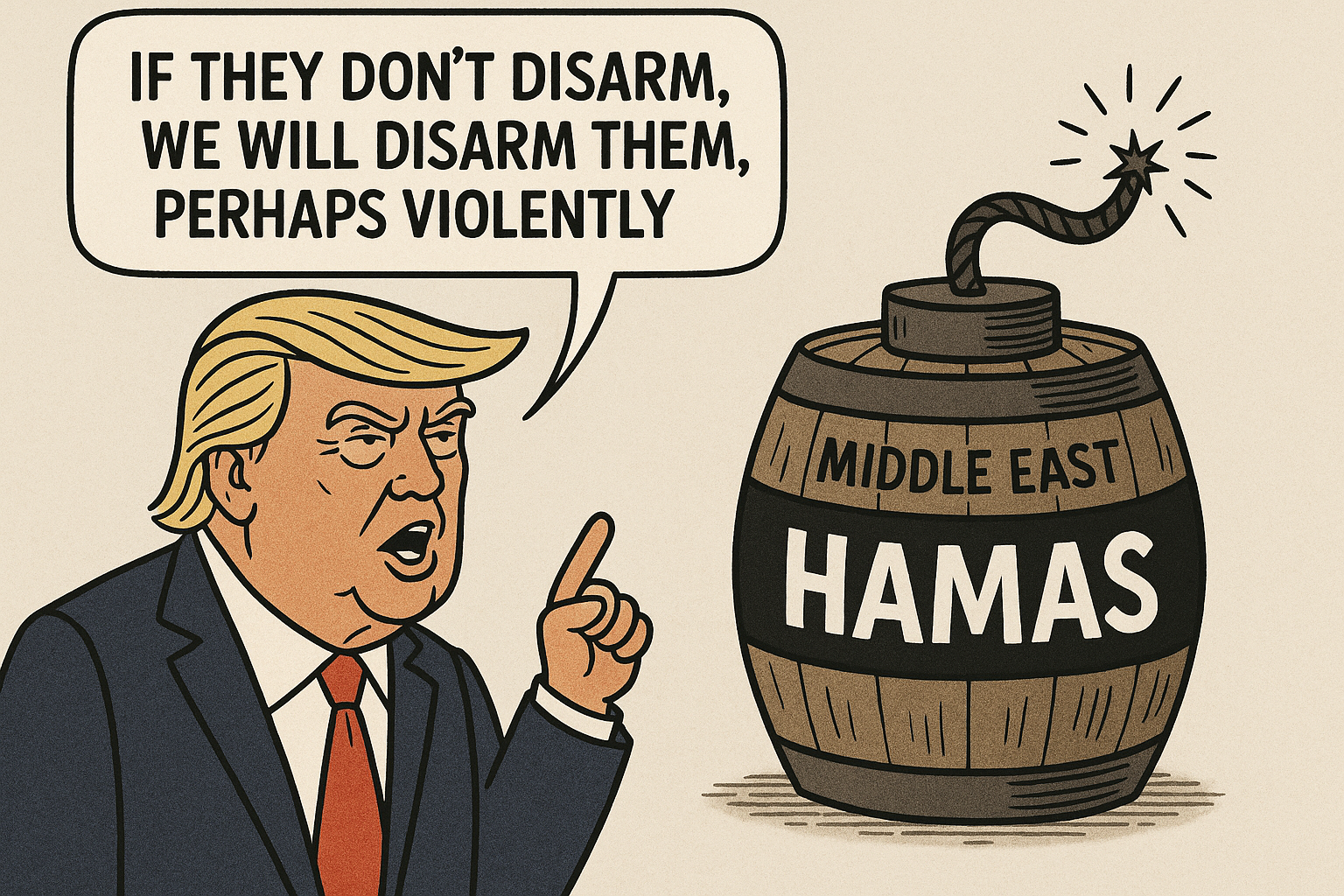
Image: Author/AI
Donald Trump’s recent remark — “If they don’t disarm, we will disarm them, and it will happen quickly and perhaps violently” — isn’t strength. It’s recklessness dressed in bravado.
That single sentence, delivered with the casual menace of a man who sees the world as a TV plotline, hints at something dark: the idea that the United States could, or should, insert itself militarily into the already-volatile heart of Gaza. And that’s not just a bad idea. It’s the absolute last thing that the US, Israel, or the world needs right now.
To talk about “disarming” Hamas as though it’s a simple, surgical operation is to fundamentally misunderstand what Gaza is — a dense, urban maze of civilians, infrastructure, and trauma.
Disarmament is not a police raid; it’s a political and humanitarian process. It requires legitimacy, oversight, and the kind of painstaking trust-building that unfortunately takes time. Reducing it to a threat — “we will disarm them, perhaps violently” — treats human lives like background noise in a power fantasy. It’s the language of dominance, not diplomacy, and it tells the millions of innocent Palestinians caught in the crossfire that their suffering is secondary to someone else’s sense of control.
Let’s be brutally honest: a forcible “disarmament” of Hamas at the order of Trump would mean boots on the ground. It would mean US soldiers, raids, checkpoints, and detentions — all the ingredients of a long, grinding occupation. We’ve seen this movie before. Iraq. Afghanistan. Syria. You can topple a regime, you can decapitate a militia, but you cannot bomb ideology out of existence.
Every missile that lands on Gaza soil creates more resentment, more chaos, and more fuel for extremism. It has for the last two years when Israel did the bombing. It will continue with any future missile.
Diplomacy dies when force becomes the default. The current ceasefire — fragile, tense, and imperfect — exists because of painstaking diplomacy and an emerging framework involving international oversight and phased transitions. That’s not idealism; that’s realism.
But when an American president says, “We’ll handle it violently if needed,” he doesn’t just threaten Hamas. He undermines every international partner, Arab intermediary, and Israeli official who’s been trying to find a path forward that doesn’t involve more funerals. This kind of talk fractures alliances. It sends the message that the United States prefers muscle over mediation — and that’s exactly how we lose both moral authority and regional cooperation.
Anyone who thinks a US strike in Gaza would be “quick” should read a map. Gaza is not isolated. It’s tethered by proxy and ideology to Iran, Hezbollah, and countless other actors eager for a pretext. One rash move — one drone strike, one air raid, one “perhaps violent” act by the United States military— and the fuse will once again get lit across the region. Lebanon, Syria, Iraq, and even Jordan would be pulled into the gravitational chaos. Israel, already strained and divided, tired after two years of brutal war in Gaza would face the nightmare of a multi-front war. In that light, Trump’s tough-talking sentence isn’t a show of strength. It’s an accelerant.
The United States cannot claim to be a champion of peace and human rights while casually floating threats of unilateral violence. “Perhaps violently” is not a diplomatic footnote — it’s a crack in the façade of American restraint. That phrase signals to every democracy watching that the rule of law is optional when the speaker finds it inconvenient. It teaches the world that America’s patience is paper-thin — and that’s not deterrence. That’s instability.
Trump’s supporters will say it’s just talk — that he’s sending a message. But words like these don’t live in isolation. They shape policy. They box in advisors, alienate allies, and embolden extremists who want to draw the US into another Middle Eastern quagmire.
Even a limited deployment — “advisors” or “support units” — risks becoming the first step down a road with no off-ramp.
If America truly wants to lead, it should double down on the boring, unglamorous work of diplomacy: enforcing the ceasefire, funding humanitarian relief, backing international monitoring, and supporting gradual demilitarization under Arab and multilateral supervision. Peace isn’t forged with a hammer. It’s built with patience.
Because here’s the reality: the world doesn’t need an American crusade. Israel doesn’t need another regional firestorm. And the Palestinian people — trapped between an extremist movement and a cynical political spectacle — deserve something better than another “perhaps violent” promise.
When leaders start using the language of war to sound strong, it’s up to the rest of us to remind them that true strength is the ability to stop a war before it starts.
Related Topics
Related Posts