
Author and Global Affairs Commentator
Trump’s Pressure Campaign Comes for Iran
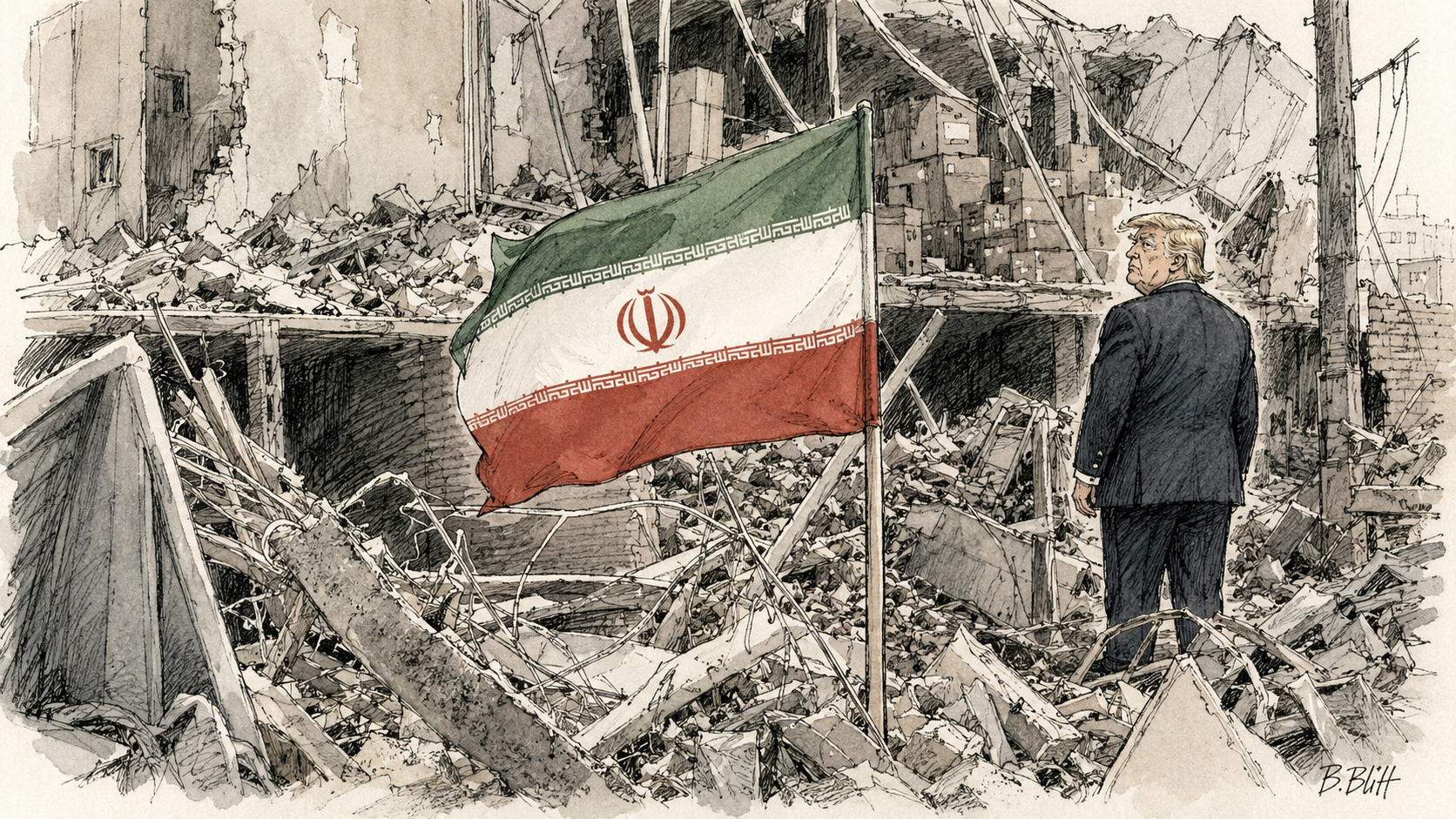
Washington must demonstrate that economic pressure is intended to produce a political outcome rather than become an end in itself. (ChatGPT AI generated image of Donald Trump looking back at the flag of Iran amidst rubble in Tehran. Trump is moving beyond degrading Iran's nuclear ambitions or targeting the IRGC. The emerging objective is to weaken the regime's capacity to govern.)
Can Washington force Tehran back to the negotiating table by making continued economic engagement with Iran increasingly costly for the rest of the world?
When President Donald Trump announced a new escalation of economic pressure on Iran, critics portrayed the move as evidence that military action had failed to achieve Washington’s objectives. But the Trump administration’s strategy rests on a different proposition: military pressure and economic coercion are complementary instruments. The former can weaken Iran’s strategic capabilities; the latter can limit its ability to rebuild them and compel Tehran to negotiate.
That logic has defined Trump’s approach to Iran since his first term. Between 2019 and 2021, his administration pursued what became known as the “maximum pressure” campaign, seeking to deprive Tehran of the resources needed to finance its nuclear ambitions, military programs and network of regional proxies.
The results demonstrated the potential power of economic leverage. Iran’s oil exports fell dramatically, inflation surged and its accessible foreign-currency reserves contracted sharply. The broader lesson for Washington was straightforward: when countries must choose between access to the American financial system and commercial ties with Iran, the United States possesses considerable structural leverage.
The Biden administration took a different approach, seeking negotiations while easing some enforcement of existing sanctions. Iran benefited economically, with oil exports recovering and access to foreign currency improving. Yet the anticipated diplomatic breakthrough did not materialize. Tehran continued to expand its military capabilities and nuclear program while supporting armed groups across the Middle East.
By the time Trump returned to office in 2025, the strategic environment had deteriorated further. Iran had backed Hamas following the October 7, 2023, attacks on Israel and had made significant progress toward the nuclear threshold. The administration therefore moved rapidly to restore maximum pressure.
Iran’s underlying economic weaknesses made the renewed campaign more consequential. Inflation had reached extremely high levels, the rial had suffered a dramatic decline against the dollar, and parts of the banking system were under severe strain. Military confrontation subsequently compounded those pressures by damaging important energy and industrial infrastructure.
The most consequential development, however, has been Washington’s effort to restrict Iran’s ability to export energy through the Strait of Hormuz. The economic consequences for Tehran have been substantial. Iran estimates that its economy could contract by roughly 10 percent, while the rial has approached record lows and inflation has continued to erode purchasing power.
The significance extends beyond Iran itself. Washington is effectively asking governments and companies to calculate the cost of maintaining commercial relationships with Tehran against the value of continued access to the American economy and financial system.
That is a powerful form of U.S. leverage because the dollar-centered financial system gives Washington influence well beyond its own borders. Sanctions can therefore function not merely as restrictions on Iranian entities but as a mechanism for persuading third parties that continued business with Tehran carries unacceptable costs.
The latest measures announced by Treasury Secretary Scott Bessent represent an escalation of that strategy. Iranian airlines face restrictions, bank branches are targeted, and foreign entities that continue significant dealings with the Iranian regime risk losing access to the U.S. financial system.
For Washington’s allies and commercial partners, the message is consequential even where it is not formally framed as an ultimatum: engagement with Iran increasingly carries a strategic price.
That approach also reflects a broader principle of American statecraft. The United States does not need to prevent every country from trading with Iran to exert influence over Tehran. It needs to make the economic consequences of supporting the Iranian regime sufficiently substantial that governments and companies conclude that alternative arrangements are in their interests.
Yet economic pressure has limits. Sanctions can impose extraordinary costs, but they cannot by themselves determine whether a government capitulates, negotiates or chooses further confrontation. Tehran can also attempt to exploit divisions among U.S. allies, develop alternative trading arrangements and portray sanctions as evidence of American hostility.
The ultimate test, therefore, is diplomatic. Washington must demonstrate that economic pressure is intended to produce a political outcome rather than become an end in itself.
For Iran, the potential alternative remains significant. A country with Iran’s population, resources and geographic position could play a much larger role in the regional and global economy if its government reduced tensions with its neighbors, abandoned efforts to acquire a nuclear weapon and curtailed support for armed proxies.
That possibility gives the pressure campaign a second dimension. The United States is not simply attempting to punish Iran; it is attempting to alter the strategic calculations that have made confrontation attractive to Tehran.
Whether that succeeds will depend on Iran’s willingness to negotiate and on Washington’s ability to maintain international support for its policy. But the basic calculation behind the campaign is clear. American economic power remains one of Washington’s most formidable instruments of statecraft, and the Trump administration is betting that sustained pressure can convert that economic advantage into diplomatic leverage.
For Tehran, the question is increasingly whether continued confrontation with Washington is worth the economic price. For the rest of the world, it is whether commercial ties with Iran are worth risking access to the American financial system.
That is the strategic choice Washington has placed before the international community—and it illustrates just how much leverage the United States continues to possess when it chooses to use it.
Related Topics
Related Posts