The views expressed herein are solely mine.
Trump’s Venezuela Delay: Ukraine Comes First
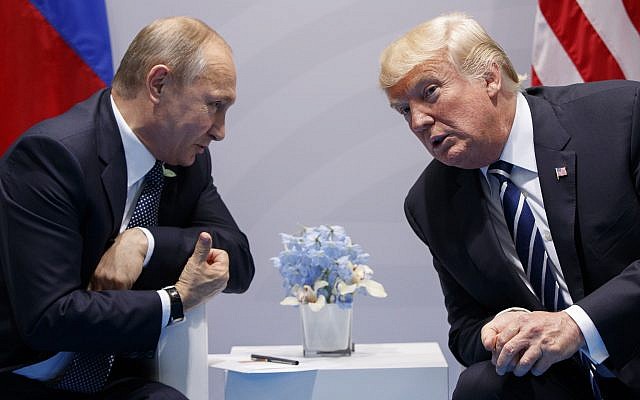
US President Donald Trump (right) meets with Russian President Vladimir Putin at the G-20 Summit in Hamburg, July 7, 2017. (AP Photo/ Evan Vucci)
In geopolitics, timing is policy. And if we want to understand why President Trump will not move decisively on Venezuela yet, we need to stop treating Caracas as a standalone crisis. Venezuela is not an isolated Latin American problem; it is a downstream theater, derivative of a much larger great-power settlement that must be resolved first. But, Ukraine is the keystone. Hence, until that file is closed, Venezuela remains frozen.
From a reasonable analytical perspective, the logic is brutal but coherent: Ukraine first, Venezuela second.
Any premature American move against Dictator and Drug Cartel Leader, Nicolas Maduro, while Russia still views Ukraine as existential would only harden Moscow’s incentives to keep Venezuela alive as a pressure point—sanctions evasion, intelligence friction, asymmetric signaling, and proof that the United States cannot even dominate its own hemisphere.
Doubtlessly, once Ukraine is “resolved” on Russian terms, that incentive disappears.
In my opinion, what President Putin ultimately seeks is not peace but strategic geometry. A viable end state for Moscow would lock in Russian control over parts of eastern Ukraine, secure access around Zaporizhzhia, guarantee commercial and maritime depth tied to Odesa (concerns dating back to the time of ‘Catherine the Great’), and—above all—formally bar Ukraine from ever entering NATO.
On this point, there is no ambiguity. NATO expansion is the red line. By contrast, Russian leadership could plausibly tolerate Ukraine’s entry into the European Union, provided that integration remains economic rather than military. Markets can be managed. Missiles cannot.
Even if such an outcome is deeply uncomfortable for the Baltic states—particularly Estonia and Latvia, where sizable Russian-speaking minorities could be instrumentalized by Putin as pretexts for future pressure or even aggression, and Lithuania, whose exposure is compounded by geography and the Suwałki corridor—the uncomfortable truth is that this may still be the only viable ground solution to halt Russia’s permanent, slow-motion expansion in eastern Ukraine.
Evidently, postponing an imperfect settlement risks something far worse, especially given Europe’s demonstrated passivity, Russia’s deployment of nuclear weapons in southern Belarus, the erosion of Zelensky’s domestic standing driven partly by sustained Russian propaganda and partly by corruption cases around his leadership circle, and a broader strategic environment in which delay no longer buys stability but actively compounds risk.
Simultaneously, the Crimean Peninsula sits at the center of this equation. Historically, Crimea has not “always” been Russian; it was annexed by the Russian Empire in 1783 after centuries under the Crimean Khanate.
Yet geopolitically, Crimea is non-negotiable for Moscow. It anchors Russia’s Black Sea posture, carries immense symbolic weight, and functions as a strategic military platform. Any settlement Putin accepts will require Crimea to be recognized as Russian in practice, if not formally.
That said, it is also important to be precise about the Soviet transfer of Crimea. The peninsula was moved from the Russian SFSR to the Ukrainian SSR in 1954, after Stalin’s death, during the Khrushchev era.
While the transfer is sometimes described as compensation for past atrocities, including those surrounding the Holodomor famine of 1932–33—a catastrophe directly linked to Stalinist collectivization and repression—the archival record shows that the transfer was justified officially on administrative, economic, and symbolic grounds rather than as explicit reparations. The famine itself, however, was real, devastating, and foundational to Ukrainian historical memory.
Returning to the central argument, the larger pattern to watch here is Syria. Russia’s behavior there reveals how it treats clients once core interests are secured.
When the Assad regime weakened beyond repair and alternative arrangements emerged that preserved Russia’s Mediterranean access—particularly the naval and air facilities at Tartus and Latakia—Moscow showed that loyalty is disposable.
In late 2024, Al-Assad fell and a new Syrian leadership under Ahmed al-Sharaa took power. Russia immediately pivoted to negotiations with the new authorities, focusing not on ideology or friendship but on base access and continuity of influence. The lesson is simple and unsentimental: Russia does not defend regimes; it defends assets.
Apply that logic to Venezuela. Caracas survives not because of internal legitimacy but because external veto players shield it. Remove those vetoes and the regime collapses under its own weight. Thence, if Russia secures its Ukrainian objectives, Venezuela loses its value as a strategic irritant. Moscow no longer needs to subsidize instability in the Western Hemisphere once it has banked a European settlement.
On the other hand, China’s role is even more transactional. Beijing’s interest in Venezuela is not revolutionary solidarity but debt and predictability. Venezuela owes China on the order of $60 billion. Therefore, a credible democratic transition that commits to honoring those obligations would instantly change Beijing’s calculus. China can tolerate ideology, but it prioritizes repayment. Maduro is expendable if the ledger can be stabilized.
And this is why Washington waits. Acting too early would unify Moscow and Beijing behind Caracas. Acting after a Ukraine settlement fractures that alignment. Russia steps back because it has already won what it cares about. China hedges toward repayment and stability. At that moment, U.S. leverage spikes dramatically.
Then Maduro’s vulnerability becomes acute. Without great-power cover, his exposure to U.S. criminal cases—particularly those tied to narcotics trafficking and the Cartel de los Soles—moves from abstraction to operational reality. Extradition stops being a fantasy and becomes a logistical question. Elite defections accelerate. The regime’s internal contradictions finally matter.
Unambiguously, this is not a romantic regime change. It is sequencing, arithmetic, and power politics. Ukraine resolves Russia’s veto. Debt repayment neutralizes China’s. Venezuela is the downstream consequence. Trump’s restraint is not weakness; it is timing.
Ergo, first comes the European settlement, and only then the hemispheric reckoning. Only after the great powers have priced their exits does Caracas lose its external protectors—and only then does democratic restoration become possible through decisive U.S.-led action aimed at dismantling the world’s most entrenched narco-authoritarian regime.
Unequivocally, the collapse of Maduro’s dictatorship would not only terminate a central hub of transnational narcotrafficking and regional destabilization, but also restore institutional legitimacy to the Venezuelan state, unlock economic reconstruction, and create the conditions for the return of the more than 8 million Venezuelans forced into exile.
In strategic terms, it would stabilize northern South America, relieve immense migratory pressure across the hemisphere, weaken criminal networks that span from the Andes to the Caribbean, and reassert the principle that sovereignty cannot be indefinitely sustained by repression, foreign patronage, and criminal enterprise.
Related Topics
Related Posts