
The views expressed herein are solely mine.
Trump’s Zero Aid Ends the Client State Myth
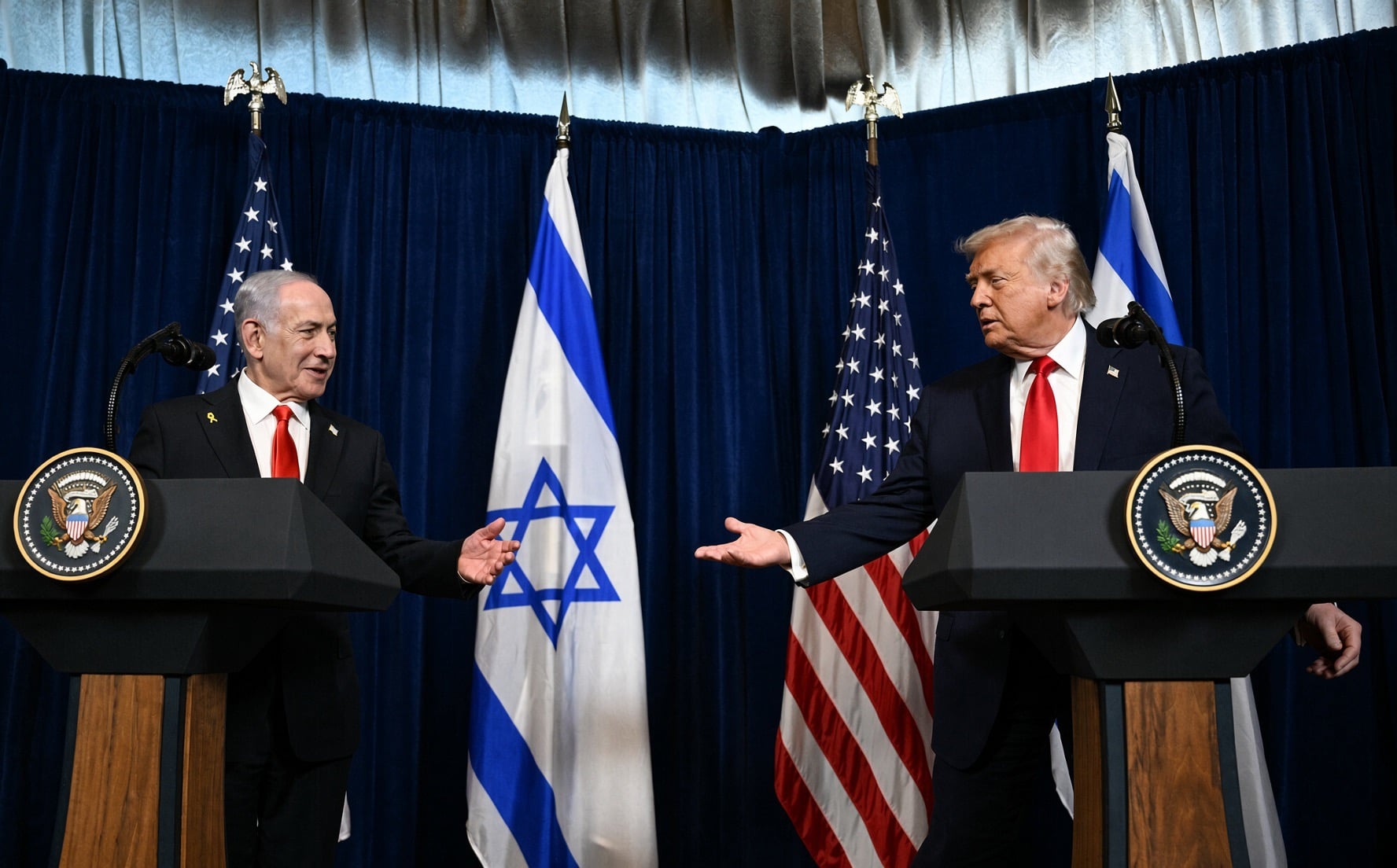
US President Donald Trump (R) and Prime Minister Benjamin Netanyahu speak to journalists during a joint press conference at Trump's Mar-a-Lago residence in Palm Beach, Florida, on December 29, 2025. (Jim WATSON / AFP/ File).
President Donald Trump’s announcement on this week’s midterm Election Day that the United States will halt roughly $4 billion in annual assistance to Israel by year’s end—citing a prior understanding with Prime Minister Benjamin Netanyahu—marks a tectonic shift in the modern alliance between Washington and Jerusalem. This sudden declaration collides directly with an existing, congressionally appropriated instrument that does not expire for two more years. Unsurprisingly, Israeli finance and defense officials expressed immediate shock and confirmed that they have not yet negotiated a formal replacement for the current memorandum.
To appreciate the magnitude of this rupture, one must look back to the origin of the aid regime itself. The geostrategic imperative between the United States and the State of Israel began in the middle of a crisis when President Richard Nixon ordered Operation Nickel Grass on October 13, 1973, after Egyptian and Syrian forces attacked the Jewish state on Yom Kippur. U.S. C-5 Galaxy and C-141 Starlifter aircraft subsequently delivered 22,325 tons of hardware across 567 sorties—a logistical miracle made possible only because Portuguese authorities opened Lajes Field as a critical staging base.
Decades later, the American and Israeli governments formalized this asymmetric scheme through the 1981 strategic Memorandum of Understanding and successive multi-year agreements. Culminating in the 2016 Obama-era framework, the current 10-year pact commits $3.8 billion annually through fiscal year 2028 while fundamentally reshaping bilateral defense spending. The agreement systematically dismantles the 26.3% offshore procurement provision that historically subsidized Israel’s domestic arms industry, enforcing a structural transition to ensure 100% of the funding goes directly to U.S. defense contractors by 2028. However, the administration is exploiting sound long-term statesmanship for immediate electoral gain; timing the announcement for Election Day betrays polling desperation rather than achieving strategic foresight. By cutting the cord, Trump can now frame the policy as a final, cost-free blow against Iran wrapped in populist, America-first rhetoric. This maneuver simultaneously neutralizes a principal Democratic talking point, secures his isolationist flank, and satisfies a base weary of foreign expenditures without compromising Israeli security.
Predictably, since progressive Democrats and isolationist Republicans will lose their chief economic grievance, a rapid political pivot remains inevitable. Partisan critics are poised to adopt the same boilerplate rhetoric Washington once wielded against Turkey or Egypt over non-NATO hardware. Future opposition will almost certainly decry any Israeli acquisition of independent, non-U.S. platforms as a self-inflicted threat to allied interoperability and technological security. To counter this political warfare, Jerusalem must recognize that Israel’s qualitative military edge still rests heavily on American systems. Diversification becomes rational only when U.S. price tags, export controls, or political conditionalities render them prohibitive, or when domestic production cannot meet surge demand.
Rather than panicking over political theater, Washington and Jerusalem must weaponize this rupture to build a harder-edged, self-sustaining security matrix. First, strategic consistency requires Washington to apply a uniform Strategic Reciprocity Doctrine. Given that Ukraine continues to draw tens of billions—roughly $200 billion since 2014–, Egypt draws roughly $1.3 billion in military financing, and Jordan receives about $1.6 billion under its own multi-year memorandum, a zero-aid logic applied selectively to Israel remains mere political theater.
Furthermore, the Jewish state’s $19.2 billion in defense exports last year—led by cutting-edge missile, rocket, and air-defense systems—proves an industrial maturity that can generate mutual strategic interests. Instead of one-way grants, the alliance should transition to a Mutual Vulnerability Pact. By embedding non-substitutable Israeli algorithms, sensors, and interceptors directly inside U.S. force structure, the two nations can build genuine structural interdependence rather than a cycle of charity.
Finally, this economic burden need not fall on Israeli taxpayers through abrupt tax hikes or painful domestic draw-downs. Instead, a Sovereign Export Escrow and Royalty Trust can sequester a fixed percentage of export revenues from joint systems and global sales of co-developed platforms into a dedicated procurement vehicle. Consequently, royalties from U.S. incorporation of Israeli-origin technology, paired with equity stakes in dual-use ventures, should cover American purchases without requiring new domestic taxation.
Netanyahu’s assumption that personal legacy could substitute for institutional American goodwill proved delusional; current realities have violently erased that complacency. Yet Trump’s announcement is no fatal rupture. Instead, it forces a long-overdue correction, forging the first genuine partnership of equals since the 1973 airlift birthed the modern alliance.
Related Topics
Related Posts