
President and CEO of Netzach Educational Network
Trust between Haredim and Israel’s police force
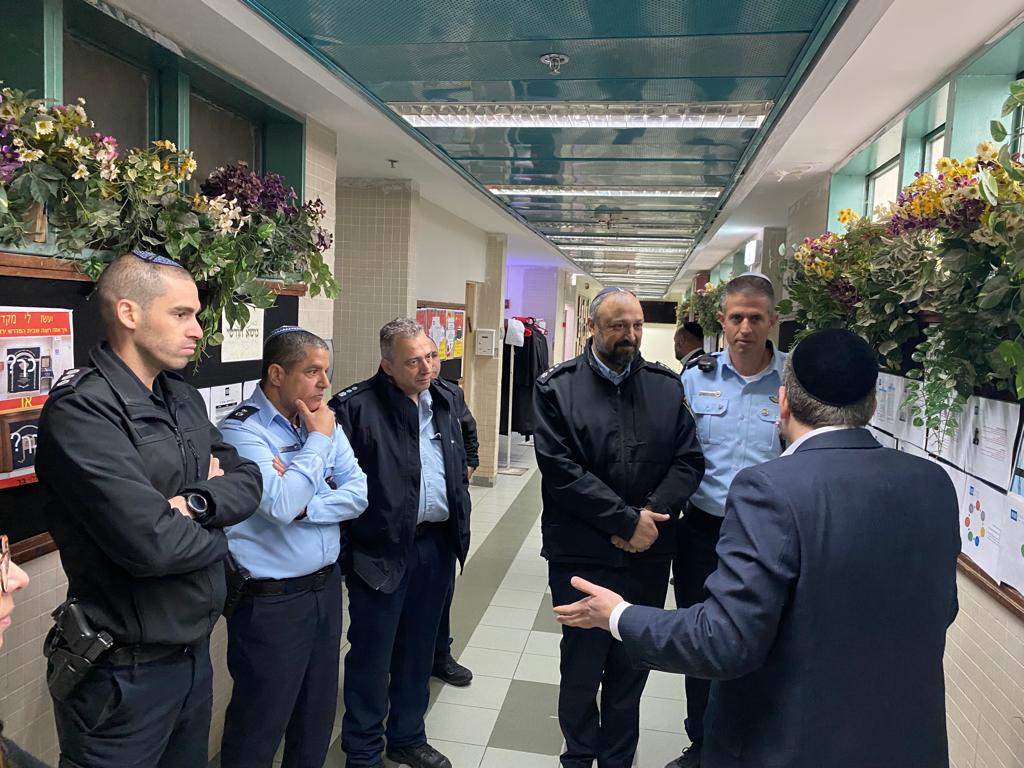
(courtesy)
Yesterday, senior police officials came to our midrasha (school) in Beitar Illit. No, none of the boys was in trouble. It was a fact-finding, bridge-building visit. Perhaps a few hearts beat faster when people saw police cars parked outside our school, but the students enjoyed some interesting and positive conversations with senior police officers from Jerusalem and Beitar, and the rabbi of Israel’s police force, Rav Rami Rachamim Berachiyo.
As I understand it, it is quite normal for police officers and firefighters to visit schools and pre-schools in Israel and around the world, but they do not generally receive invitations to visit Haredi institutions. In Israel, sadly, the police and other authorities are generally viewed with suspicion and mistrust in the Haredi world. Much of the prejudice dates back to “der Heim” where the “poritz” and his deputies were known to be antisemitic and often violent towards Jews. The language that one hears on the Haredi street often reflects that deep-rooted mistrust.
Despite the existence of a mostly-Jewish police force in the State of Israel, most Haredim have continued to avoid encounters with the authorities. Interventions by police and social workers in domestic problems are viewed with hostility. Haredi demonstrations often lead to violent confrontations. In fact, encounters between young men in Jerusalem and Bnei Brak and the police are likely to be negative.
During the COVID pandemic, enforcement of the national lockdown was viewed with suspicion in Haredi neighborhoods. Following an initial “honeymoon period” in 2020, when the residents of Bnei Brak went out of their way to offer food and drink to the officers patrolling their streets, people began to resent the restrictions and their enforcers.
There was a perception – not entirely misplaced – that the police were unfairly targeting Haredim during the second and third lockdowns. Violence erupted on the streets of Bnai Brak in January 2021, with horrific examples of young men attacking police officers and even setting fire to a bus. Relationships between the police and the Haredi community hit an all-time low, and since then, we have been trying to organize community meetings and rebuild trust.
At the Midrasha Hachassidit, and at our other Netzach schools in Jerusalem, Beit Shemesh and Beitar, we are working hard to educate the next generation of Haredi youth to think differently about the world. Positive encounters with the Israeli authorities and engagement with civic society are important elements of our educational messaging. We want our young people to respect the men and women in uniform who are charged with serving and protecting our community, including the Israel Defense Forces and the police.
At the same time, we need to work with the police and other authorities to help them understand the traditions and prejudices found within our community. They need to understand how to approach Haredi women, and how men will react to an approach from a female officer. The police that I have met have a very respectful attitude to religious traditions, but they don’t always understand the social nuances.
The conversations that we initiated between the visiting police chiefs and our students were extremely interesting. We often see that the easiest way to break down prejudices is to sit together and talk about our shared values. It is always easier to talk with moderates than with extremists, and our students are not the type to be found blocking roads or hurling eggs.
It will take time to overcome the resentment of authority that has built up over many generations, but I am an optimist. I hope that we will soon see police officers visiting Haredi pre-schools, and Cheder children dressing up once again in blue and green uniforms on Purim. Maybe some of our Haredi students will one day enlist in the Israeli police force, to protect and serve their own community with honor.
Related Topics