Truth Is Like the Sun – You Cannot Cover It with Your Hand
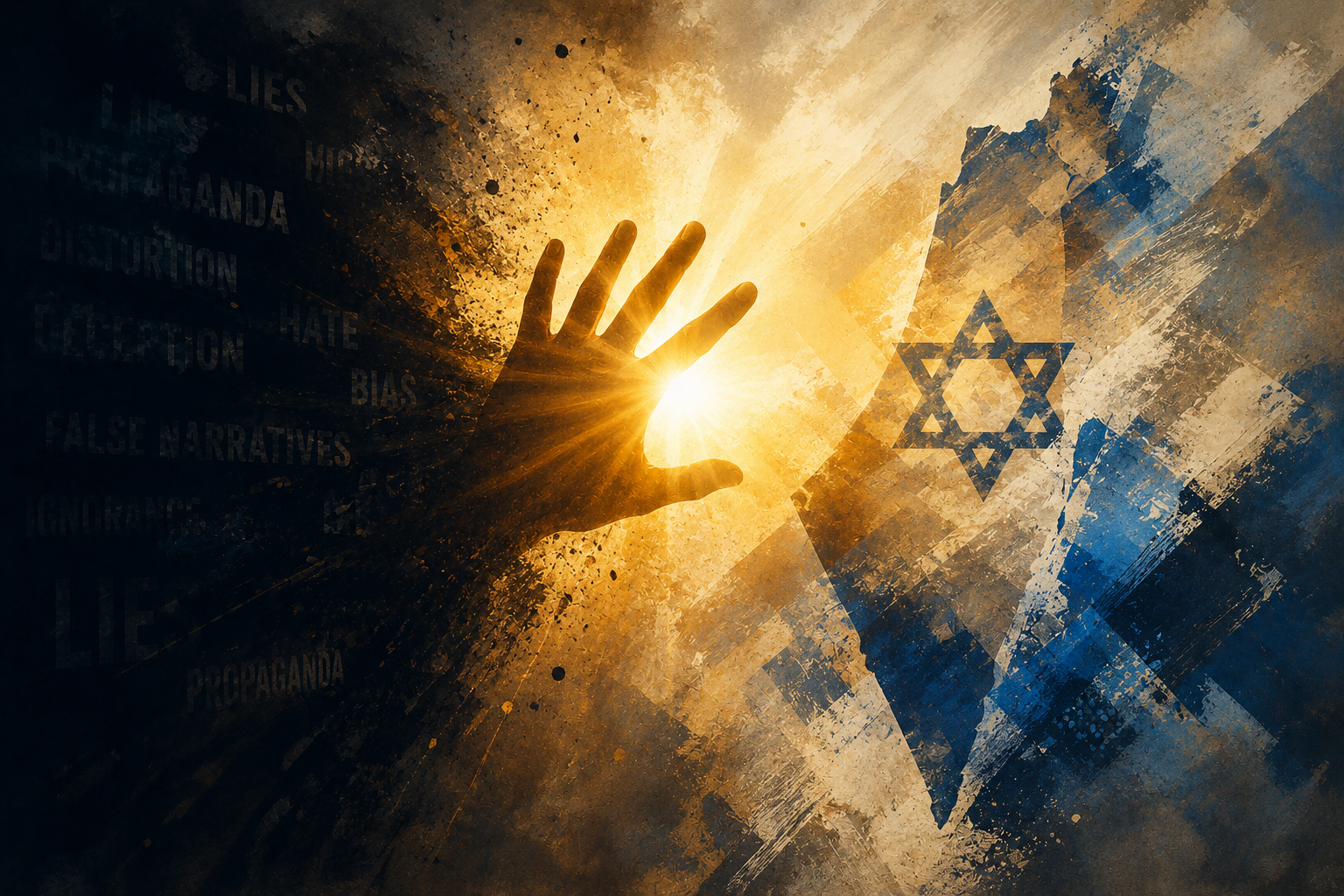
“Truth is like the sun – you cannot cover it with your hand.”
There is a second saying worth remembering alongside it: if we do not tell the truth, someone else will tell a lie, and the bigger the lie, the more people will believe it.
History has vindicated both.
Truth does not evaporate because a crowd shouts louder. It does not cease to exist because it is inconvenient, unfashionable, or politically costly. It can be ignored, distorted, buried under slogans, or rewritten by propagandists with a talent for erasure, but eventually it breaks through anyway. Like the sun, it cannot be covered by a hand forever.
I go to these gatherings knowing almost exactly what I will hear before I arrive. I go anyway, because I am working on a documentary Ashes of Identity about antisemitism and October 7, and because a filmmaker does not get to look away from the thing he is trying to document. And yet, gathering after gathering, I find myself freshly startled. I expect the slogans. I am still not prepared for how far they go.
I was reminded of this most recently while watching yet another pro-Palestinian demonstration in Boston.
What I saw was not an honest search for peace, nor a genuine reckoning with a brutally complicated history. It was a performance of certainty – slogans standing in for scholarship, outrage standing in for argument. The chants were the same ones you can hear at any such rally now: that Israel has no right to exist, that all Zionists are racists, that Israel alone bears responsibility for eight decades of conflict.
This particular gathering had a specific target: Sheba Medical Center, Israel’s largest hospital, whose ARC Innovation arm recently announced plans to launch a healthcare startup accelerator in Massachusetts. The demonstrators called this a “Trojan horse” – a front, in their telling, built to launder the reputation of a genocide. A hospital’s research-and-innovation partnership, treated as camouflage for invented mass murder. I have heard a great many overheated claims at these rallies. That one still stopped me, and I don’t think overheated is a strong enough word for it. It is a grotesque inversion of reality, and it says something troubling about a movement when accusing Israeli doctors of running cover for made up genocide is treated as a self-evident truth rather than the outlandish claim it plainly is.
The same demonstration demanded the release of Hussam Abu Safiya. Israel’s security services, police, and military are unambiguous about who he is: a colonel in Hamas’s Military Medical Services who ran Kamal Adwan Hospital as a Hamas terror hub, diverting humanitarian resources to terrorist operations and enabling attacks on Israeli forces and civilians. The evidence they cite is not subtle – a photograph of him in Hamas uniform beside senior Hamas commanders, an admission from the hospital’s own former director that it had been converted into a Hamas military facility, and the identification of more than 240 people at the site as terrorists, most of whom took part in the October 7 massacre. The demonstrators in Boston mentioned none of it. To them he was simply “a Palestinian hero doctor,” full stop – not a man that Israel’s own security establishment says ran a terror hub in a hospital, but a settled fact recruited for a slogan.
Facts were not merely absent. They were beside the point.
Very few of the people marching, I suspect, could tell you who wrote the Hamas charter or what it says. Very few could name the year of the Second Intifada, or explain why Israel left Gaza in 2005, or say what happened in the years immediately after it did. What they can do is hold a sign and repeat a rhyme. That is not activism. It is a well-oiled choreography, and someone else wrote the scrypt.
This is the oldest trick in the propagandist’s playbook, and it works precisely because it does not require the participant to know anything. A movement built by people who have studied a conflict for decades needs foot soldiers who haven’t. It needs bodies in a public square, cameras rolling, and slogans simple enough to fit on a poster board. The organizers understand the history in all its ugly complexity. The people they recruit mostly do not and are not meant to – their sincerity is the point, and their ignorance is the raw material. They believe they are speaking truth to power. In practice, they are speaking someone else’s script, on someone else’s schedule, in service of an agenda most of them never examined closely enough to notice they’d adopted it. As one wise Jewish observer once put it, more economically than I can: they are simply shaking the air.
That does not make every marcher a cynic. It makes most of them something more useful to the people running the campaign: useful idiots, true believers who will do, for free and with great passion, exactly what they’re told, while remaining convinced the idea was their own.
Misinformation spreads fastest exactly where people stop asking questions and a crowd that has stopped asking questions is not a grassroots movement. It is an instrument.
And an instrument that stops asking questions is a dangerous thing to be near. A crowd trained to treat “Zionist” as a synonym for “legitimate target” does not stay confined to a public square – it follows its members onto campuses, into workplaces, past the doors of synagogues, because a slogan repeated enough times stops sounding like rhetoric and starts feeling like permission. That is how “Zionists are racists” becomes harassment of a Jewish student who never claimed to be anything else. Movements built on chanted certainty rather than examined fact do not stay peaceful by default; they stay peaceful only as long as their most excitable members choose restraint, and history offers little reassurance that restraint holds indefinitely. A crowd this incurious about the facts is also incurious about the line between protest and menace—which is exactly what makes it dangerous, not despite the sincerity of the people in it, but because of it.
Consider what the chants leave out.
Israel did not choose years of war. This conflict did not begin on October 7, 2023. It did not begin in 1967, either, and not even in 1948. Jewish communities in Mandatory Palestine were targeted by organized violence years before Israel existed as a state – the 1929 Hebron massacre, the Jaffa riots of 1921, the Arab revolt of the late 1930s – pogroms carried out against Jews who had no army, no state, and no soldiers to blame, only the fact of being Jewish in the land of their ancestors. From the moment of Israel’s founding in 1948, it was invaded by neighboring Arab armies, and the decades since have brought terrorism, hijackings, suicide bombings, rocket fire, kidnappings, and massacres aimed squarely at civilians. That is not opinion. That is the documented record.
Yet at demonstration after demonstration, history seems to begin only at the moment Israel responds to violence. The decades before vanish. The terrorism vanishes. The repeated Israeli acceptance—and repeated Arab and Palestinian rejection—of peace proposals vanishes. The thousands of rockets fired into Israeli towns vanish. October 7 is presented as an isolated event, severed from everything that came before it.
Truth does not work by omission. History is cumulative. It cannot be edited like a social media caption.
For thirty years the Oslo Accords were held up as the foundation of peace, and Israel accepted enormous risk on the strength of that hope. What followed instead was the Second Intifada: buses blown apart by suicide bombers, cafés turned into crime scenes, thousands of rockets launched out of Gaza after Israel withdrew from it in 2005, and finally the massacre of October 7. These events did not happen in a vacuum, and they did not fail to leave a mark. They are the reason Israelis understand security the way they do. Ignoring them does not make them disappear – it only makes the people who ignore them harder to take seriously.
The Palestinian Authority has been dogged for years by credible charges of corruption, governmental dysfunction, and policies – including payments tied to imprisoned militants and the families of attackers – that critics say entrench the conflict rather than resolve it. Hamas has gone further still, calling openly for Israel’s destruction while building a record of terrorism aimed deliberately at civilians.
No sovereign country on earth would tolerate those threats indefinitely, and no country that did would deserve to survive the century. Israel has not merely a right but an obligation to defend its population, within the bounds of the laws of armed conflict – an obligation every other democracy on earth would claim without apology if its own citizens were the ones being targeted.
None of this requires indifference to Palestinian civilians. They deserve protection, dignity, and a life free of fear, in full measure. But compassion for civilians is not the same thing as silence about the organizations and leaders who have repeatedly chosen violence over coexistence, and it is not the same thing as moral equivalence between a democracy defending itself and a terrorist organization that hides among the people it claims to represent. Genuine concern for Palestinian lives and clear-eyed honesty about Hamas are not in tension. They are, in fact, the same position – and a movement that cannot hold both at once is not defending Palestinians. It is defending Hamas.
What, exactly, do the demonstrations accomplish?
Counter-protesters often show up with documents, maps, and citations. It rarely matters. Persuasion requires two people willing to be persuaded, and dialogue collapses the moment one side has no interest in evidence that complicates its story.
But history is patient in a way that demonstrations are not. Propaganda can dominate a headline cycle, dictate the mood of a campus, or fill a public square with a single chant repeated a thousand times. What it cannot do is rewrite the archive. The documents remain. The dates remain. The casualty figures remain. Long after the slogans fade, history asks the same plain question it always asks:
What was true?
Truth does not need a microphone, and it does not need a mob. Like the sun, it shines whether or not anyone chooses to look at it. You can cover your own eyes. You can talk others into covering theirs. You can repeat a slogan until it sounds like common sense. But you cannot extinguish the sun, and you cannot erase what happened. Just as you cannot erase Israel. If anything, every slogan shouted in its denial has done the opposite of what it intended – it has not weakened the people it targets, but reminded them why they stand together, and made that unity harder, not easier, to break.
Israel’s history, the terrorism it has endured, the peace offers rejected by its adversaries, and the Jewish people’s right to self-determination do not bend to a chant of those useful idiots. No campaign can rewrite them. No volume of noise can outlast them.
Because truth, like the sun, cannot be covered by anyone’s hand.