
Truths and Constructed Myths Regarding the Jewish Presence in Albania
The tendency to produce, package, and instrumentalize myths for specific purposes—whether individual, collective, historical, or political—is considered “normal” in the Balkan Peninsula. It suffices that such actions yield the desired effect or outcome for those who construct, package, or instrumentalize these myths. However, when abnormality becomes normalized, and myths replace scientific facts, something is amiss within a society that becomes saturated with such myths. In such cases, the need for critical self-examination and self-reflective analysis becomes urgent for the society in question—in this case, Albanian society. The discipline most adversely affected by this tendency is, unfortunately, history. Although the classical Greek historian Thucydides (460–400 B.C.E.), exactly 2,400 years ago, taught historians through his monumental work, “The History of the Peloponnesian War,” how to distinguish myth from historical investigation, this lesson has not yet been adequately internalized by our historians.
Jewish Presence in Albania: Myths vs. Facts
Let us consider, for example, the phenomenon of the Jewish presence in Albania and observe how this tendency is reflected in historical texts. Without mentioning specific colleagues, and with the intention of addressing only the phenomenon itself, we present the following passage:
“The Jewish presence in Albania dates back to the year 70 C.E., when a Roman ship carrying a group of Jews taken captive in Jerusalem was shipwrecked on the Albanian coast. Those who survived settled in Albanian territories, and their descendants founded the Jewish Community of Onchesmos (Saranda).”
In our scholarly opinion, this is simply a fabricated myth and does not hold up to scrutiny. There are two main reasons for this: 1) Firstly, there is no recorded historical evidence in Greek, Latin, or Hebrew sources regarding this episode. 2) Secondly, to our knowledge, no trace of a synagogue or Jewish archaeological artifact from the 1st–2nd centuries C.E. has yet been discovered in this region to scientifically document such a presence. Moreover, the “instrumentalization of myth” to artificially create an organic link spanning nearly three centuries between the first Jews (70 C.E.) and the Jewish Community of Onchesmos (as a factual reality of the 4th–6th centuries C.E.) is, at best, a “scientific naivety,” and at worst, a “turbo-folk oral narrative with a pedantic lecture-hall tone.” This mythical narrative has been taken, then copied and disseminated without alteration. It has been reproduced and amplified in its entirety on Jewish websites, including the “Jewish Virtual Library,” “Hadassah Magazine,” “World Jewish Congress,” and “Guide Culturel des Juifs d’Europe,” among others.
The scientific truth, as revealed by the archaeological excavations conducted by the Albanian-Jewish team in 2004, demonstrated that we can speak of the presence of the Jewish Community of Onchesmos at least from the 4th century C.E., and, at the conclusion of this expedition, the Onchesmos Synagogue was classified as belonging to the period between the 4th and 6th centuries C.E. Another piece of archaeological evidence regarding this community comes from the Catacombs of Venosa (Italy), dating to the 6th century C.E., which refers to Augusta, daughter of Yishai, head of the Jewish Community of Onchesmos. We would like to thank “La Redazione di Edipuglia Srl” for permission to use the photo, which we present here for the first time and attach to this argumentative article for illustration.
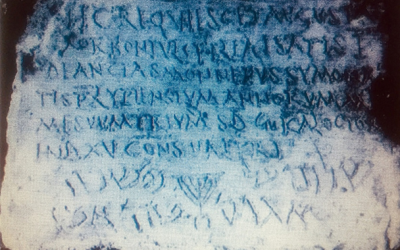
The scientific hypothesis we propose is that it is possible to speak of a substantial Jewish presence and the existence of Jewish communities in Albania at least since the 4th century C.E. This is also corroborated by letters from Roman Emperors addressed to the Praetors of the Prefecture of Illyricum, instructing them to protect the Jews and their synagogues from anti-Jewish attacks by Christians in these territories—a fact which we have elaborated upon extensively in another study and do not find it necessary to revisit here.
Secondly, another mythical-scientific tendency is the etymological use of names for specific Albanian toponyms (river, mountain, village, city, etc.) and their comparative juxtaposition based on phonetic similarity to another toponym in the Holy Land. The use of these two false premises is clearly aimed at reaching the desired conclusion that “the Jews populated Albanian territories since very early times, and, as a form of remembrance for the Holy Land they left behind, they named the territories in which they settled with the same names.” As an approach, this might serve as an intriguing starting point for a work of Magical Realism, but from a scientific standpoint, it does not hold and is entirely unfounded.
Thirdly, what is also observed in the historical literature regarding this phenomenon is the almost abusive use of the term “Jewish Community” (Kehila), ascribing a “Jewish community” to nearly every village or city in Albania. This is highly inaccurate. Before employing this term, the key question must be asked: “What constitutes a Jewish community according to Halachah (Jewish Religious Law)?” The answer comes directly from the Babylonian Talmud (Bavli):
“A rabbi or, alternatively, a Torah scholar (talmid hakham) is not permitted to reside in a city that does not contain at least these ten elements: a religious court (beit din) that deals with religious punishments, a charity fund (tzedakah) collected by two individuals and distributed by three, a synagogue (beit kneset), a ritual bath (mikveh), a restroom (sherut), a physician (rofeh), an artisan (horesh), a bloodletter (gara); in some other versions, a kosher butcher (shehitah) and a teacher (moreh)” (Sanhedrin 17b).
But do these so-called “Jewish communities” identified by our historians actually contain these ten elements? I believe not. There are two possibilities: a) either they must clarify how they define a “Jewish community,” and this definition should be as clear and concise as possible, or b) they should refrain from the indiscriminate use of this term. A “community” does not mean four Jews in city X, five others in city Y, and so on. For instance, one finds in some historical publications references to the “Jewish Community of Lezha,” the “Jewish Community of Shkodra,” etc. This is pure absurdity and a fabricated myth. The Jews themselves have refused to live in these two locations due to the pronounced religious fanaticism there and have historically not established any genuine community in these places. While it is possible, based on historical evidence, to speak of the existence of the Jewish Community of Onchesmos (Saranda), the Jewish Community of Durrës, the Jewish Communities of Vlora, the Jewish Community of Berat, and the Jewish Community of Elbasan, any other proposal lacking a factual and scholarly basis remains mere speculation.
Another ahistorical tendency, with mythic-folkloric nuances and favored by mythologizers in the guise of historians, is that of the “biographical Judaization” of certain Albanian historical figures. A classic case among several is that of Academician Aleks Buda, founder of the Academy of Sciences of Albania and its long-time director. In an article by an “Anonymous Author,” published in 2015 in the newspaper “Tirana Times,” it is written:
“A scholar and historian, Aleks Buda (1910–1993) was born in Elbasan, apparently of a merchant family of Jewish origin…”
However, upon further investigation, it emerges that this historically unsubstantiated claim was first published in the “Historical Dictionary of Albania” (2004), where the author erroneously associates our academician’s surname with the medieval name of the city of Buda (Budapest). Hungarian Jews indeed adopted the surname “Buda” or “Budai” in its Hungarian variant as a family name, but this only occurred in the 18th century, following the decree “Patent über die Judennamen” (Patent on Jewish Names) issued by Emperor Joseph II of the Austro-Hungarian Empire on July 23, 1787. The same emperor granted certain rights to Jews by means of the “Edict of Tolerance” five years earlier, in 1782, before issuing the decree on names.
To my knowledge, the Buda family is a very respected Albanian-Aromanian family of Christian Orthodox faith from the city of Elbasan, and not Jews originating from the city of Budapest. At present, there exists no genealogical document or historical fact to prove otherwise. In this sense, this “Biographical Judaization” is a historical error and an unfounded claim. Meanwhile, Albania has numerous genuine Albanian-Jewish personalities who do not require “biographical Judaization,” such as the Shvarc, Mattathia, Cohen, Jakoel, Solomon, Cikuli, Kantozi, Arditi and Malka families, among many others.
In conclusion, this article demonstrated that the narrative of a continuous and widespread Jewish presence in Albania since antiquity is largely unsupported by historical and archaeological evidence. Reliable documentation indicates that significant Jewish communities only emerged from the 4th century C.E. onward. The article also underscored the importance of adhering to rigorous scholarly standards, cautioned against the uncritical propagation of myths and the misuse of terms such as “Jewish community,” and called for a critical, fact-based approach in reconstructing the history of Jews in Albania. In Albania, we have often preoccupied ourselves—and indeed misled ourselves—with the fabrication of myths and urban legends. Nevertheless, it is essential to examine each historical period with a critical, analytical perspective. As the eminent Italian historiographer Giambattista Vico asserted: “Verum esse ipsum factum” (“Truth itself is composed only of facts!”).