Jerusalem Mixed Grill: A Slice of Life
Tunisian Holocaust survivors inspire chef’s restaurant
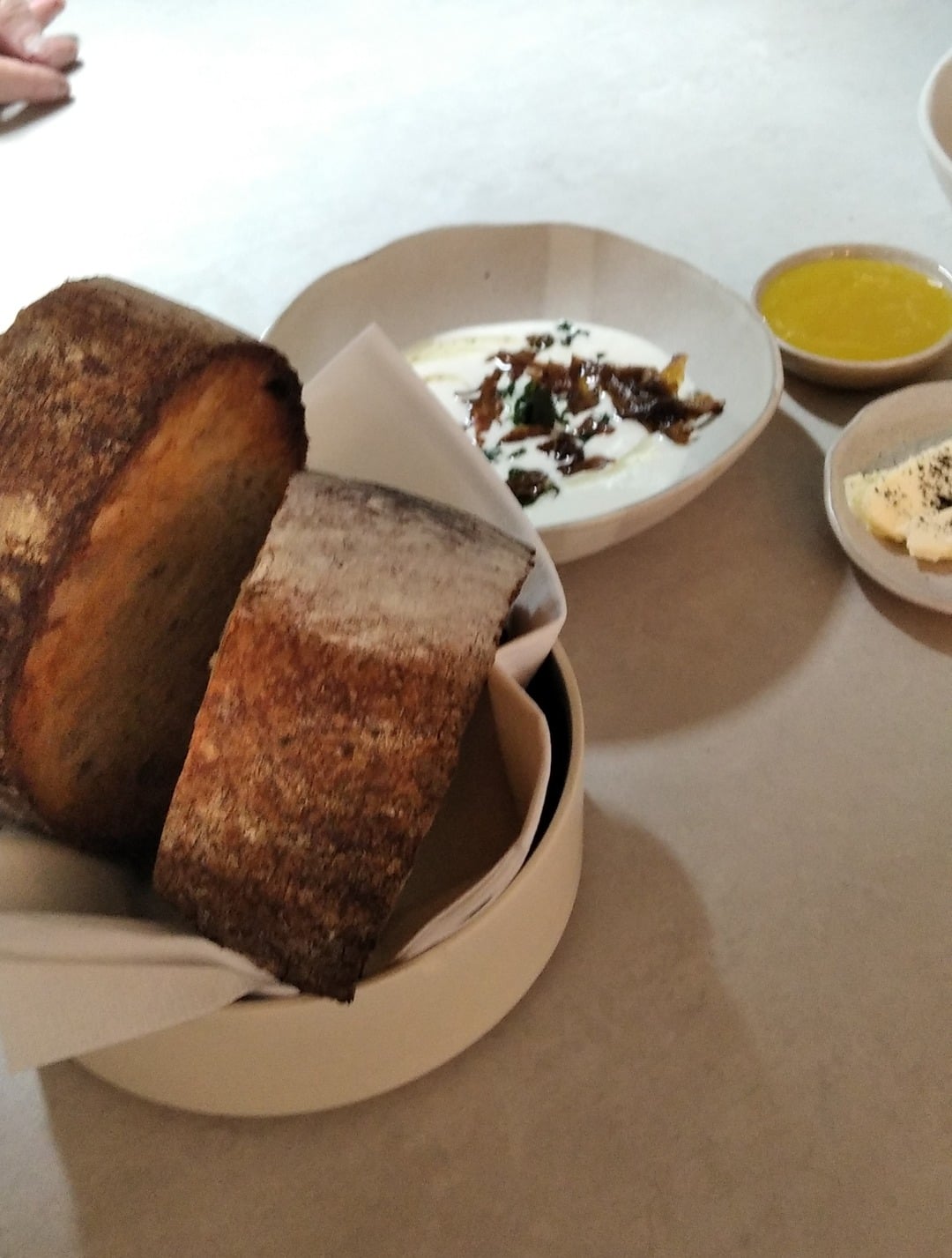
Freshly Baked Sourdough bread at Amaia Chef's restaurant
I recently ate a small family-owned and very special restaurant in the Baka area of Jerusalem. It stands out in its creativity and had the vibe both in the kinds of food one would think would be destination Michelin-style restaurants, while also imbuing a style that one could only be described as the local Jerusalemite flavor.
That is not to say that they do not have their standards. To order a table, one is told of the “dress code.” Please do not wear shorts or flip-flops. After that, it’s up to you. Even then, perhaps they will be lenient if you are from the “hood” or a repeat customer.
I was treated to this rare place as a small “date night” birthday celebration, and while I think I gave away my knowledge of the food world with my modest cocktail order, it was just a vorspeis (taste) of what was to come.
The restaurant is found in the same location as the source of the family legendary culinary memory and skill; that of the grandmother who ran a homey kitchen based on her own family’s Tunisian recipes, when it was called in Hebrew “Shel Rashel (From Rashel).” Those who remember it will find nothing that is remotely reminiscent of its current use as a fine chef’s restaurant.
The cozy and casual street-side drop-in place with its soup and sandwich offerings was gutted, refurbished, changed in its tone and certainly upgraded in its menu. Oshi (Oshrat) Hadad is a very gifted chef and highly experienced granddaughter of Rashel Hadad. Starting as a novice while in high school, she worked at an after-school job at a local fish eatery in the nearby Mamilla Mall, which only whetted her appetite to learn more.
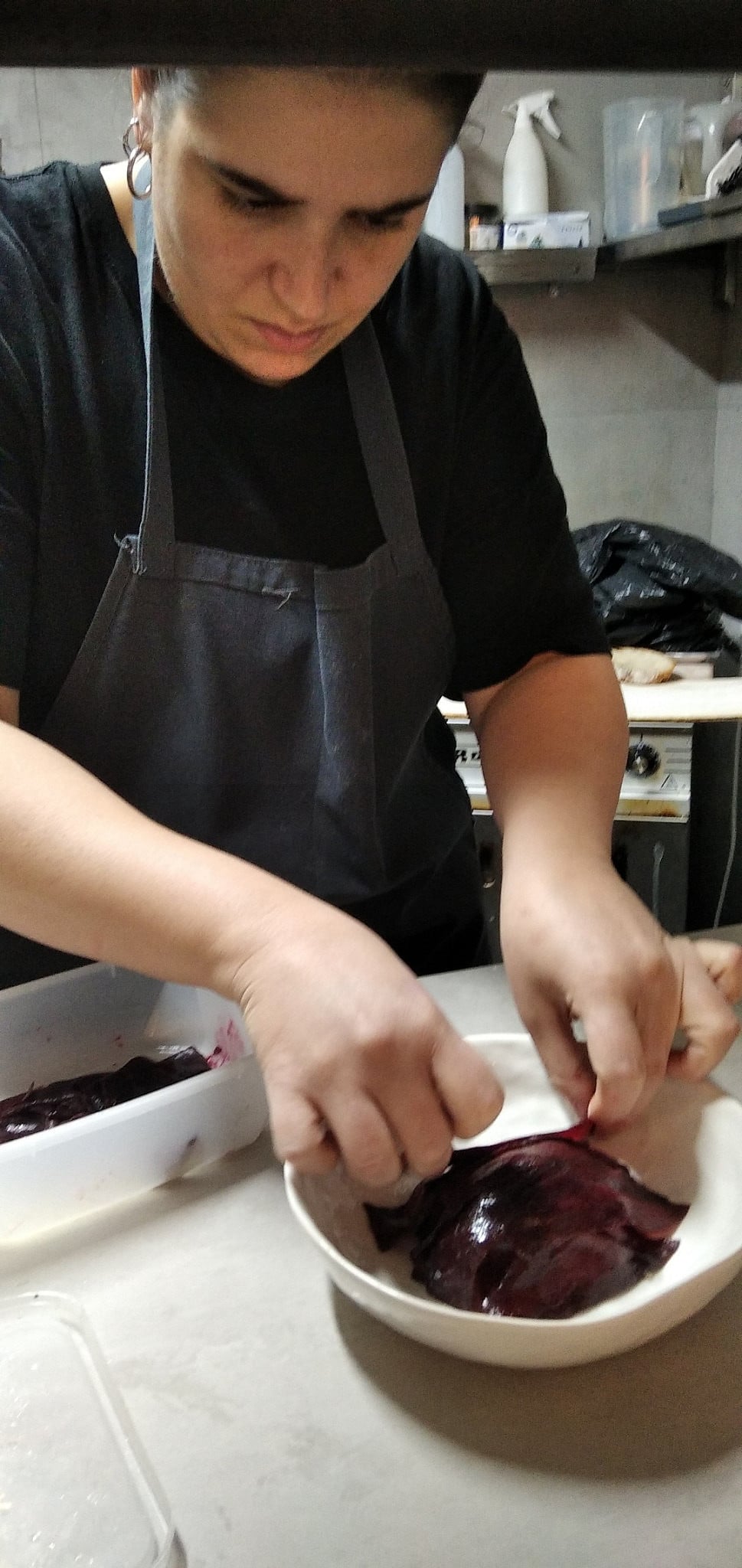
She continued to work in a series of self-styled residencies, from Toscana, and other European and Israeli hotel kitchens, continuously adding to her skill set and broadening the range of tastes she brings to this local yet also international clientele. Reservations are not so easy to get. There are those international travelers who order ahead to snag a table a month in advance timed with attending high-level conferences, while locals are known to happen by and find available seating on the sidewalk in the balmy Jerusalem transitional weather period.
Rashel and her husband Ramond Hadad were Tunisian-born, and originated from La Goulette, a resort area on the Mediterranean Sea, similar to Eilat in its vibe. They were victims of the Nazi plan to erase the Jews, and as such, were subject to deprivations much like Jews underwent during the original Nuremburg “Aryan” laws enacted throughout Europe under the German Axis regimes.
The army entered Tunisia together with an SS unit tasked with applying anti-Jewish policy. The Vichy-appointed governor of Tunisia, Admiral Jean-Pierre Estéva, delayed the implementation of the racist laws for a long time, benefiting the Jews. The anti-Jewish measures adopted by Vichy France were roundly criticized by Estéva, who neither believed them to be moral nor in the interests of Tunisia or France.
The Germans occupied Tunisia for six months, from November 1942 through May 1943. Though the German’s military policy was confused and disorganized during this time, their policy regarding the Jews was cohesive and consistent; they began to take action against the Jews of Tunisia as early as two weeks after their invasion.
First, they arrested the leaders of the Jewish community. At the same time, they ordered 3,000 Jews to be forced to work on fortifications in northern Tunisia. The SS officer in charge of the persecution of the Jews was Colonel Walther Rauff. He demanded that thousands of Jewish workers wear a yellow star on their backs so that they could be identified from a distance and shot in the event they tried to escape.
In the face of these violent incidents, the Jewish community decided to obey the Germans’ instructions. A special committee of Jewish leaders was elected, called the Comité de Recrutement de la Main-d’Oeuvre Juive, which, like the Judenrat in Europe, became a tool in the hands of the Germans.
Ultimately, almost 5,000 Jews, most of them from Tunis and from certain northern communities, were taken captive and incarcerated in 32 labor camps scattered throughout Tunisia. The biggest and most lethal of these were the camps in Bizerte and Mateur, where tens of Jewish prisoners died from disease, hard labor, punishment by the German guards, or from Allied bombings.
Fortunately, the Allied forces captured Tunisia; on May 6, 1943, the British took the capital city of Tunis, and American forces reached Bizerte. By May 13, 1943, the Axis forces in Tunisia had surrendered. The Jews of Tunisia were saved only because by early May 1943, military developments forced the German retreat. The start of Anti-Jewish policy would have ended similarly to that enacted in Europe, wherever the Nazi boots fell.
A single photo of Rashel and Raymond dancing together is hung near the entrance to Amaia. The staff and customers understand it is an homage to the great shoulders who originated this culinary destination, which they started in 1990. This, after making the move from Tunisia in 1948 and raising three children.
While Ramond’s attentions were devoted to the salads, Rashel is credited with the soups and sandwiches. She never complained about the hard work, saying that she preferred to be out of her home’s four walls and be with people.
The Tzohar food supervision service handles their Kashrut needs and they have a dairy kosher certificate including fish. The supervisor comes in twice a day and is quite knowledgeable about the menu as well. Amaia does not accept reservations on Sundays because no fresh fish is available so soon after Shabbat. Instead, it offers workshops on Sundays and on Fridays.
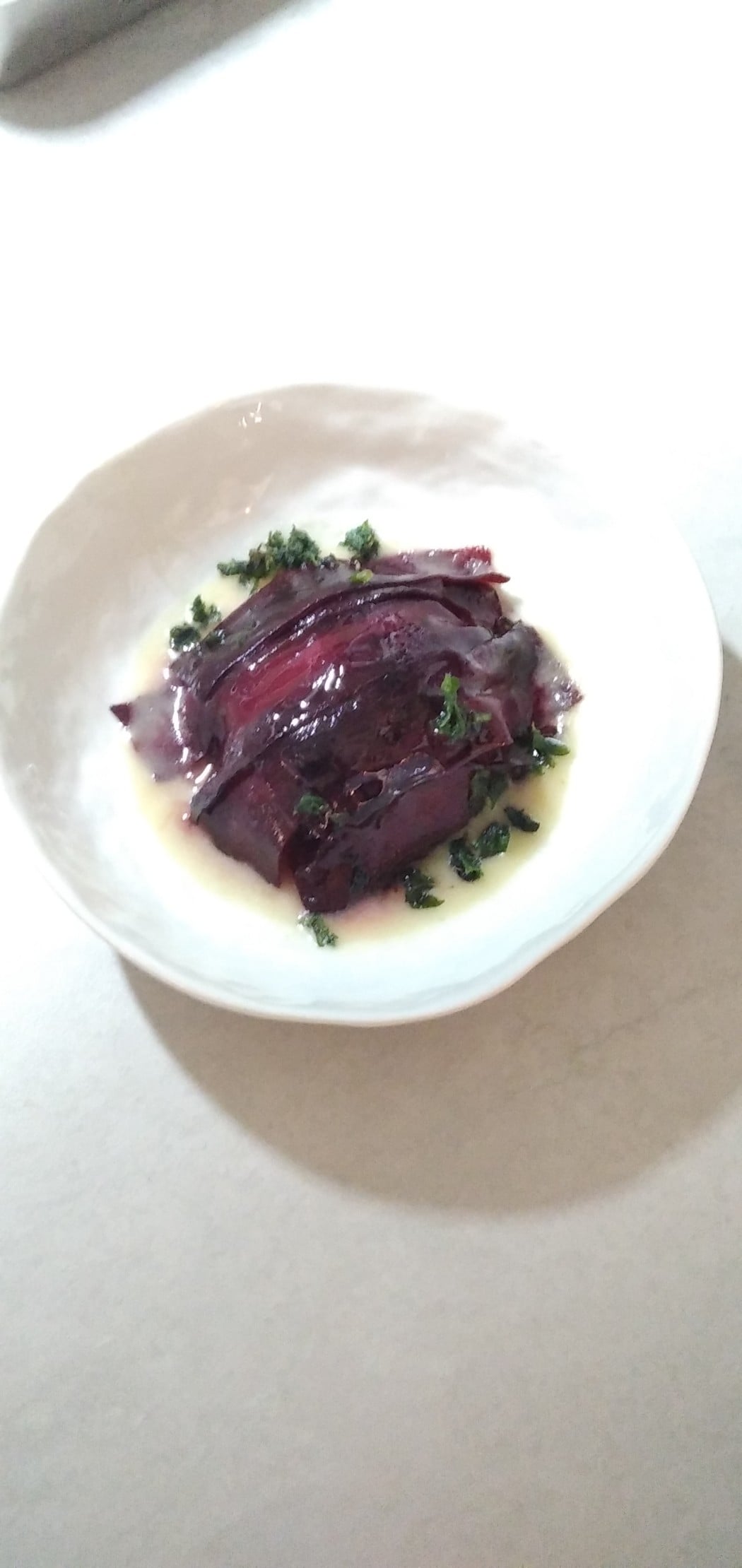
The menu consists of very inventive small dishes that are complex in their origins. The plates are presented to have wow power both visually and by the way the layers of flavors interact with each other.
Chef Oshi explains that there is a standard menu that changes seasonally and loves describing some of the elements of a specific dish that they are offering as a special. The customers may rave about a dish and encourage having it become part of the set menu.
To be forewarned, the number of tables is limited. There is outdoor seating that is popular in the transitional seasons, bar seating facing the sidewalk or the open kitchen, and two small tables downstairs as well as gallery seating at the top of the steps, with two tables that can seat five or six upstairs and also a well-positioned table for two overlooking the whole expanse, which is where we sat. When at full capacity, Amaia seats around 30 diners.
I contacted the gregarious greeter who sat us and answered our “first timer” questions the night before, Anat Hadad, mother of Chef Oshi. She filled in a lot of the blanks for me, while Chef Oshi animatedly described the sometimes lengthy steps involved in creating elements of the dishes.
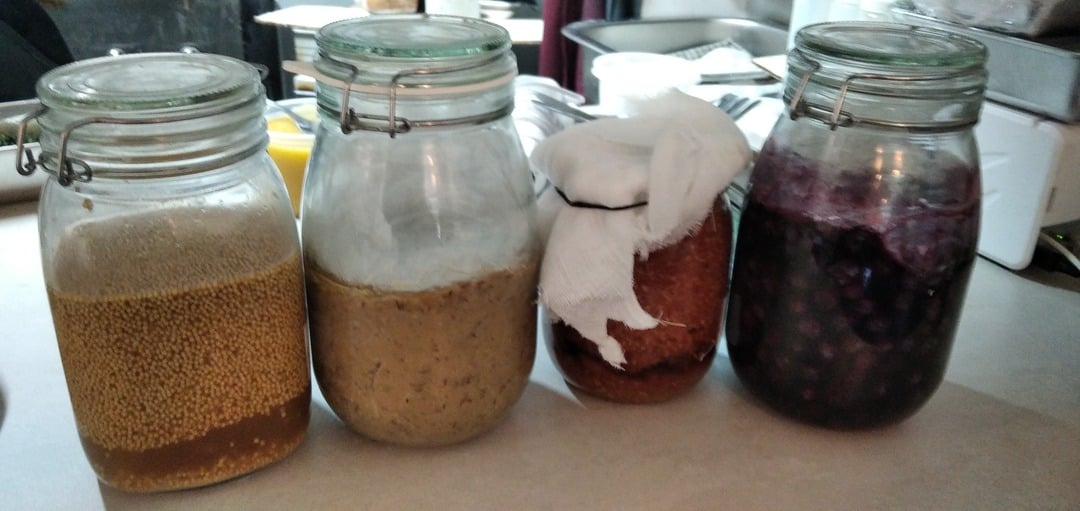
Much of the food is organic and is created in-house. One dish includes making fish gelatin squares that give a pleasant pop, while another comes from fermenting a special liquor that can take up to half a year to develop.
Since Anat had taken extra time to explain the menu to other first tmers, she kindly volunteered to compensate us with an “on the house” dessert. Not to be denied, we indulged in a rare second portion of our choosing. I still remember the layer of strong lemon in one dessert that had a sprinkle of crunchy toasted buckwheat granules. It hit the spot. All of them.
The short curated wine list includes Domaine du Castel from the Judean Hills, The Galil Mountain Winery from the Upper Galilee, Flam wines from the Judean hills and foothills as well as a French-made Chablis are available.
There is not an element that was not thought out ahead, from the beautiful ceramic dishes, to the wine glasses, to the furniture, to the playlist. Though space is tight and the steps to the gallery seating above are a bit steep, they only need to be negotiated once, so enjoy your Yerushalmi night out.
As to prices, I consider them quite fair. The Bread section had a single dish at NIS 40 with the fragrant sourdough bread, olive oil jam that leaned to the slightly sweet, and smokey butter rounding out the presentation. The Starters ranged from NIS 72-88. The Fish selections ran from NIS 105 to 135. The single Pasta dish was NIS 95.
Our bill for two climbed up to in the vicinity of NIS 700 ($218 US), which, taking into account the freshness, quality, and originality, is perfectly reasonable for a fine dining experience. We were not guests of the establishment and we hope that this special place will fill every chair in the wintery rainy season and continue the tradition of their pioneering Tunisian grandparents.
Hanukkah Sameach, Hodesh Tov and wishing all some light in the darkness. May the last of the dead hostages be returned to Israel for his final resting place and may we all soon see an end to the war, now in its 806th day.
Beit Lehem Road 17, Jerusalem, 9355309
https://www.instagram.com/amaiajlm/
https://www.facebook.com/p/Amaia-Restaurant-61577689887060/
Related Posts