
CEO of Time to Stand Up for Israel
Two Faiths, Two Paths: A Clash of Values
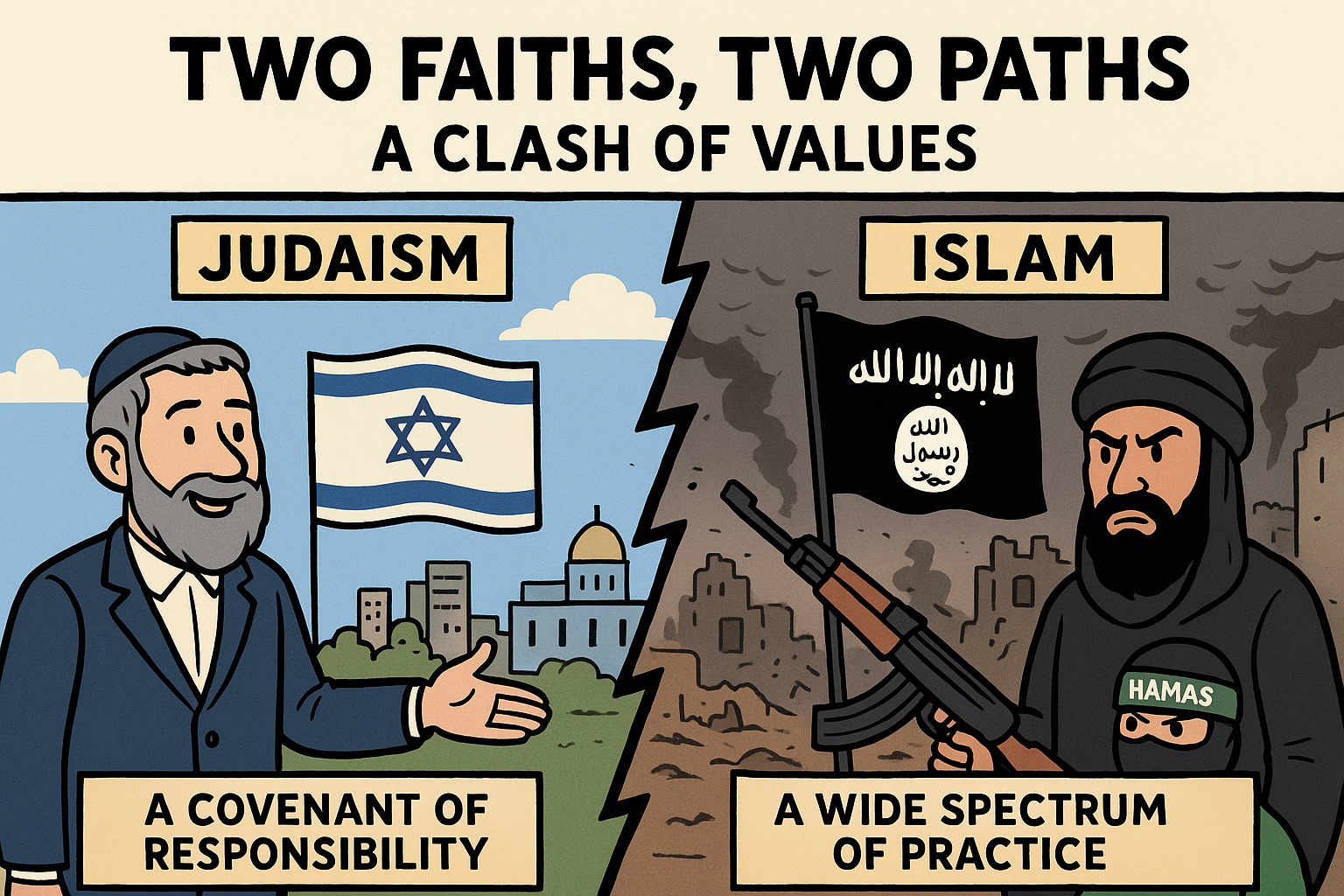
Photo Credits: Sabine Sterk(AI)
Two Faiths, Two Paths: A Clash of Values
In a world marked by religious diversity, cultural differences, and political unrest, understanding the distinctions between Judaism and Islam is essential. While both share Abrahamic roots, their historical trajectories and guiding principles have shaped societies in profoundly different ways.
Judaism: A Covenant of Responsibility
Judaism, one of the world’s oldest monotheistic faiths, has existed for over 3,000 years. It introduced the belief in one God and a moral code emphasizing justice, compassion, and personal responsibility. Central to Jewish thought is Tikkun Olam, repairing the world, zethrough acts of kindness, charity, and fairness.
Judaism has no mission to convert others; it teaches that people of all nations can live righteously without becoming Jewish. Despite centuries of persecution; from Roman oppression to the Holocaust, Judaism has remained rooted in life-affirming values.
When the State of Israel was founded in 1948, it was not the start of conquest but a return to an ancestral homeland after centuries of exile. Israel’s democracy protects religious freedom, women’s rights, and minority rights, something still rare in many parts of the Middle East.
Islam: A Wide Spectrum of Practice
Islam, founded in the 7th century, spread rapidly across continents. The faith’s teachings are interpreted differently across cultures and eras. In many Muslim-majority countries, Islam coexists with civil institutions, education, and relative freedom, examples include the United Arab Emirates and Morocco, where women hold prominent positions and religious minorities enjoy more tolerance.
However, in other nations, especially where radical interpretations dominate, life can be harsh. Afghanistan, under Taliban rule, is a tragic example, girls barred from education, women stripped of basic rights, and minorities living in fear.
Radical Islamist movements, including Al-Qaeda, ISIS, Boko Haram, and Hamas, distort Islamic teachings to justify violence, suppression, and global jihad. Their victims include not only Jews and Christians but also countless Muslims who reject extremism.
October 7: A Tragedy Rooted in Extremism
On October 7, 2023, Hamas, an Iran-backed terrorist organization, launched a calculated massacre on Israeli civilians. Over 1,200 Israelis were murdered, and many were tortured or kidnapped. This was not about land disputes but a campaign of hatred inspired by extremist ideology.
Hamas’s charter openly calls for Israel’s destruction and the killing of Jews worldwide. They use civilians as shields, place weapons in schools and mosques, and turn suffering into propaganda. This cruelty contrasts sharply with Israel’s ethos, where even during conflict, it provides medical care to Palestinians and humanitarian aid to disaster-stricken nations abroad.
A Battle of Values, Not Just Borders
Israel, though imperfect, stands for democracy, innovation, and coexistence. Many Muslim citizens in Israel serve in parliament, lead businesses, and practice their faith freely, rights they would not enjoy in countries under strict Islamist rule.
- This conflict is not between Jews and Muslims as a whole, it is between free, pluralistic societies and extremist movements seeking domination. Many Muslims worldwide, including reformers in Arab states, reject the violence of Hamas and its allies.
In the end, supporting Israel means supporting a vision of the Middle East where different faiths can live side by side, women and minorities are free, and life is valued over martyrdom.
The choice is clear: stand with those who build, not those who burn.
Related Topics