Two Generations, Two Israels
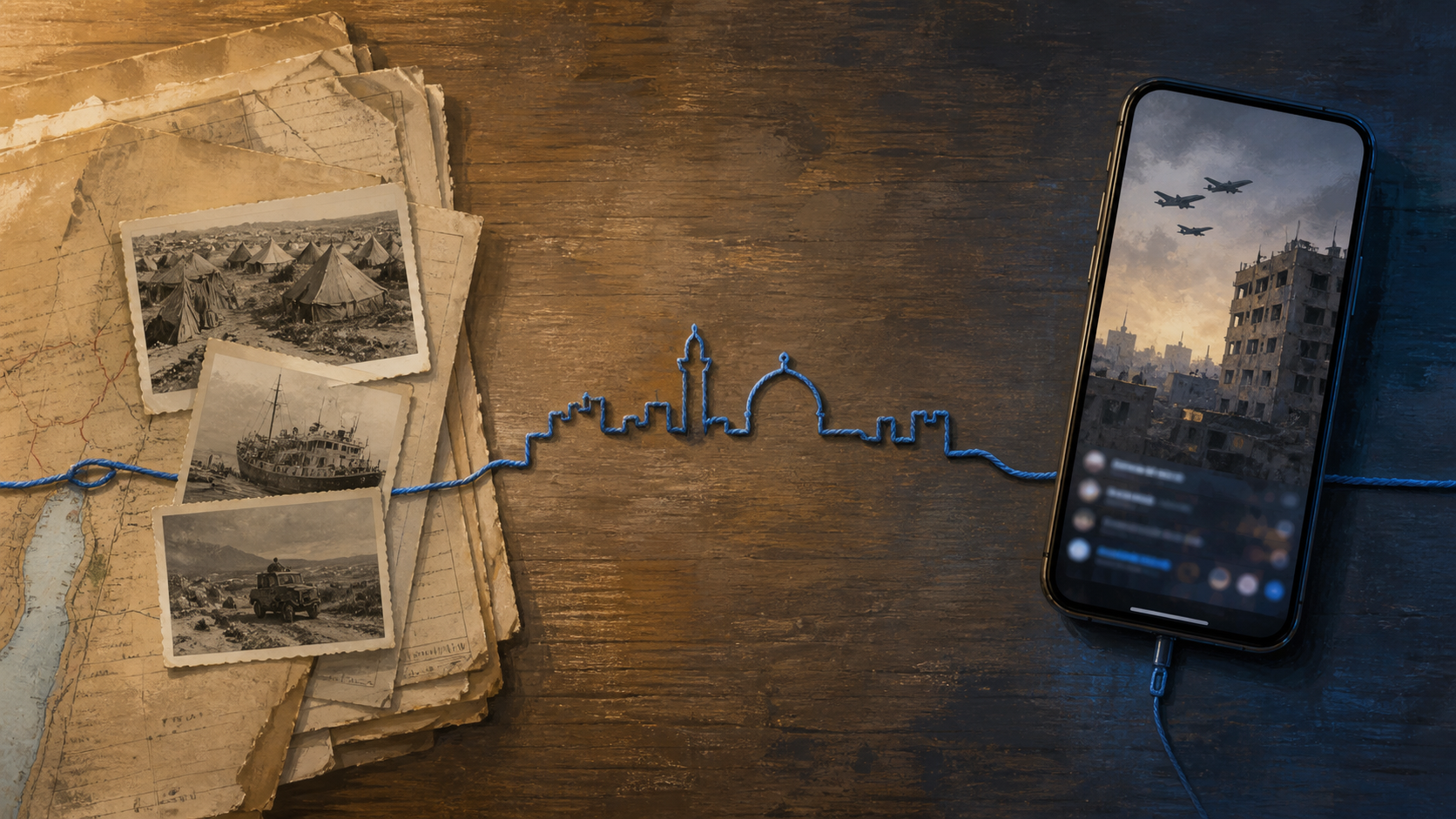
Two ways of seeing Israel—and one unfinished conversation.
A few weeks ago, a friend told me about a conversation he had with his twenty-something daughter. She was wrestling with a question that, increasingly, young Jews are being asked to confront:
What does Israel have to do with Judaism?
The comment stayed with me because I knew it was not hers alone. And there was an important truth embedded in the question. Judaism is not the Israeli government, and Jews everywhere are not responsible for its actions. But her words echoed an argument gaining currency on the progressive left: that Israel is simply another country, separate from Judaism and not central to what it means to be Jewish.
My first impulse was to answer the question myself. Israel is embedded in Jewish prayer, ritual and memory. We pray facing Jerusalem. At the Passover Seder, Jews who have never set foot in Israel say, “Next year in Jerusalem.”
And then I stopped.
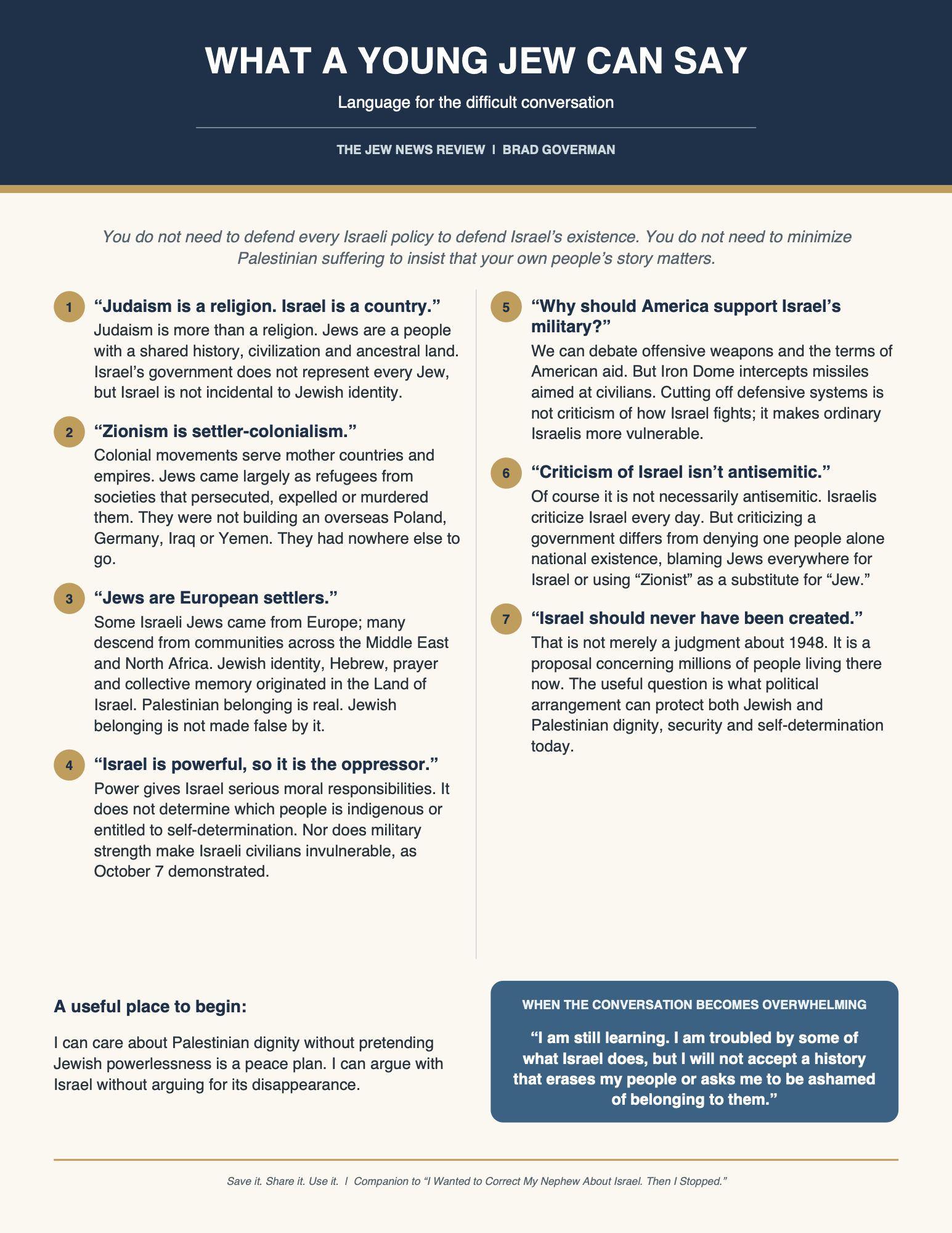
I thought about all the other daughters and sons, a generation of young Jews facing difficult questions from friends while wrestling with questions of their own. Rather than write a lecture aimed at them, I decided to write an essay for them and, at the end, offer a short guide to the difficult conversations they are already having.
The Israel We Knew, the Israel They See
Golda Meir, Moshe Dayan and the commandos at Entebbe became larger than life. They embodied the promise of a country founded only three years after Auschwitz: Jews would no longer wait for someone else to save them. That was the Israel my generation inherited—not merely a country, but an answer to Jewish powerlessness.
Young Jews of her generation grew up with a different Israel.
The Israel they see is not David but Goliath: a presumed nuclear power with an advanced military, a booming technology sector and the support of the United States. They see Israeli jets above Gaza, checkpoints in the West Bank and Palestinian families living under Israeli power. They did not watch Egyptian armies mass at Israel’s borders. They watch Palestinian buildings collapse on their phones.
Then there is the Bibi factor. For most of their politically conscious lives, Benjamin Netanyahu has been the face of Israel—arrogant, divisive and perpetually embattled. To many younger Jews, he can seem less like one chapter in Israel’s history than the whole book.
The growing estrangement from Israel is no longer confined to campuses or social-media feeds. It is acquiring political power. Primary victories by progressive figures with strong appeal among younger voters, including Zohran Mamdani and Abdul El-Sayed, show that opposition to Israel is no longer a barrier to winning Democratic primaries. And the position is hardening—from criticizing Netanyahu and conditioning offensive weapons to, in some quarters, opposing even support for defensive systems such as Iron Dome.
Young Jews are encountering Israel in a political culture that increasingly presents sympathy for Palestinians and sympathy for Israelis as competing moral commitments. Distancing oneself from Israel can therefore feel like evidence of compassion, sophistication and political courage, especially when that message is repeated by a medium built to reinforce it.
Platforms such as TikTok, YouTube and Twitch present Israel less as history than as a succession of emotionally charged images: a dead child, a destroyed building, an Israeli politician saying something appalling. The suffering they show is real, and the emotional pull on a decent young person is enormous.
Missing from the frame are wars intended to destroy Israel; the suicide bombings of the Second Intifada; years of rocket attacks and rejected peace proposals; and the ancient Jewish connection to the land. Eventually, the Jew becomes a fictional European colonist who arrived one morning with a Bible in one hand and a British land deed in the other.
When algorithms turn a fragment of truth into the whole truth, compassion can reach a moral verdict before history enters the frame. This generation inherited a different Israel, encountered through a different medium, without enough of the history needed to understand what it was seeing.
Yet their concerns should not be dismissed. We cannot ask younger Jews to ignore what Jewish power sometimes does.
But neither can they ask us to forget what Jewish powerlessness did.
Somewhere between those two moral memories lies the Israel story we must now pass on.
The Story Before the State
But it is not the beginning. As Israeli journalist Haviv Rettig Gur argues, a better starting point is the practical question that drove modern Zionism: How were Jews going to survive?
Millions of Jews in the Russian Empire endured legal restrictions and waves of pogroms. Western European emancipation promised acceptance, but the Dreyfus Affair revealed how conditional it remained. Jews tried assimilation, revolution and emigration. Yet in moments of crisis, the Jew invariably reappeared as the outsider.
Zionism was one response—not the only one or initially the most popular. But it asked what history made unavoidable: What happens to a people whose safety depends entirely upon the goodwill of others?
Europe supplied the most catastrophic answer. In the decades surrounding Israel’s creation, ancient Jewish communities across the Middle East and North Africa were also uprooted by persecution, war and state policy. Israel was built not only by Europeans, but by refugees carrying suitcases—if they were fortunate enough to have suitcases.
This does not erase the Palestinian tragedy. But casually labeling Zionism “colonialism” turns Palestinian dispossession into a moral fact and Jewish return into a moral fraud. The classic colonizer has a mother country to which he can return. The Jews who built Israel had no such place.
A Religion, a People, a Land
“Judaism is a religion and Israel is a country” is technically correct and profoundly misleading. The state does not speak for every Jew. But Judaism has never been merely a religion. Jews are a people joined by ancestry, memory, language, ritual and responsibility for one another. Many Jews do not believe in God or regularly enter a synagogue. They remain Jews.
October 7 made that sense of peoplehood visceral. For many Jews thousands of miles away, the attack was not experienced simply as a tragedy in a foreign country, but as an assault on members of an extended family.
English struggles to describe this. Hebrew does not. “Am Yisrael” means the people of Israel. “Eretz Yisrael” means the Land of Israel. “Medinat Yisrael” means the modern State of Israel. They are related, but they are not interchangeable.
The state was established in 1948; the Jewish people are thousands of years old. No Israeli government can embody Judaism or speak for every Jew. But neither can the modern state be severed from Jewish history. It arose in the Jewish ancestral homeland, made Hebrew the language of everyday life and offered refuge to a people long denied safety.
Rabbi David Wolpe calls Judaism a “3,000-year-old love affair with a land.” A love affair is not a deed of ownership. It does not erase another people’s attachment, settle a border dispute or answer every political question. But it establishes that the attachment is real.
What one cannot do honestly is reduce Judaism to a private faith and treat Israel as its political corruption. Remove Israel from Judaism and Abraham’s journey loses its destination, Jerusalem disappears from the prayers, and exile loses its meaning—because exile must be exile from somewhere.
This is the distinction we owe the next generation—not the claim that Judaism and the Israeli government are identical, but the understanding that Jewish peoplehood, Jewish civilization and the Land of Israel are parts of the same story.
Judaism and the Israeli government are not identical. But Jewish peoplehood, Jewish civilization and the Land of Israel belong to the same story.
An Israel Worth Arguing With
October 7 awakened the oldest Jewish fear: Jews could again be hunted in their homes while parts of the world watched, celebrated or explained. Any Israeli government would have responded militarily. But a justified war can still be fought unjustly. Gaza’s devastation and the rhetoric of some Israeli leaders should trouble anyone who takes Jewish moral responsibility seriously.
But moral concern becomes something else when Israel’s failures are used to deny Jewish history, excuse the slaughter of Israelis or demand the end of the country itself. There is a difference between saying “Israel must change” and “Israel must disappear”—between demanding Palestinian freedom and insisting it requires the elimination of Jewish self-determination.
Young Jews should be able to support Palestinian dignity without pretending Jewish powerlessness is a peace plan; to condemn an Israeli action without accepting that the presence of Jews is itself a crime; and to say Netanyahu is damaging Israel without accepting that Netanyahu is Israel.
The choice is not between blind loyalty and moral decency. It is between abandonment and engagement. Abandonment says: This country has disappointed me, so its story is no longer mine. Engagement says: This country is part of my story, so its failures concern me.
We should not ask young Jews to defend everything Israel does. We should ask them not to walk away from the argument.
What We Owe One Another
The next generation does not owe mine agreement. But it owes itself curiosity. My generation owes them the actual Israel—not the flawless country of fundraising dinners and Hebrew school posters, but one that is ingenious and infuriating, courageous and frightened, generous and sometimes cruel.
We owe them honesty about Palestinian suffering, a Zionism confident enough for moral scrutiny and a Judaism substantial enough for disagreement. Most of all, we owe them the story.
The feed supplies one every day: heroes and villains, victims and oppressors, a moral narrative understood in seconds. Scolding young Jews—or guilting them—will not compete with it.
We need to offer something truer: a story that acknowledges Palestinian dispossession without inventing Jewish foreignness; that recognizes Israeli power without forgetting Jewish vulnerability; that permits criticism without turning Jewish sovereignty into a crime; and in which two peoples can belong to the same land without either one disappearing.
L’dor v’dor does not mean each generation repeats the convictions of the one before it. It means the conversation continues—that memory is offered, questioned, argued over and ultimately entrusted to those who come next.
I began by wanting to explain why this young woman was wrong. I ended by realizing that before I could challenge her conclusion, I needed to understand why it felt right to her.
Because the choice is not between their conscience and our memory.
Our task is to entrust them with our memory without asking them to betray their conscience.
Three Books to Carry the Story Further:
- Noa Tishby, Israel: A Simple Guide to the Most Misunderstood Country on Earth
The accessible entry point: Israel’s history told through the experience of an Israeli family. - Oren Kessler, Palestine 1936
The historical deepening: what happened before 1948 and how the conflict assumed its present shape. - Yossi Klein Halevi, Letters to My Palestinian Neighbor
The moral conversation: what Israel means to Jews and how that story can be told without erasing Palestinians.