
Distinguished Fellow Humanities, Hebrew University
Two Hairy Goats–Sorting Out the Images of Yom Kippur!
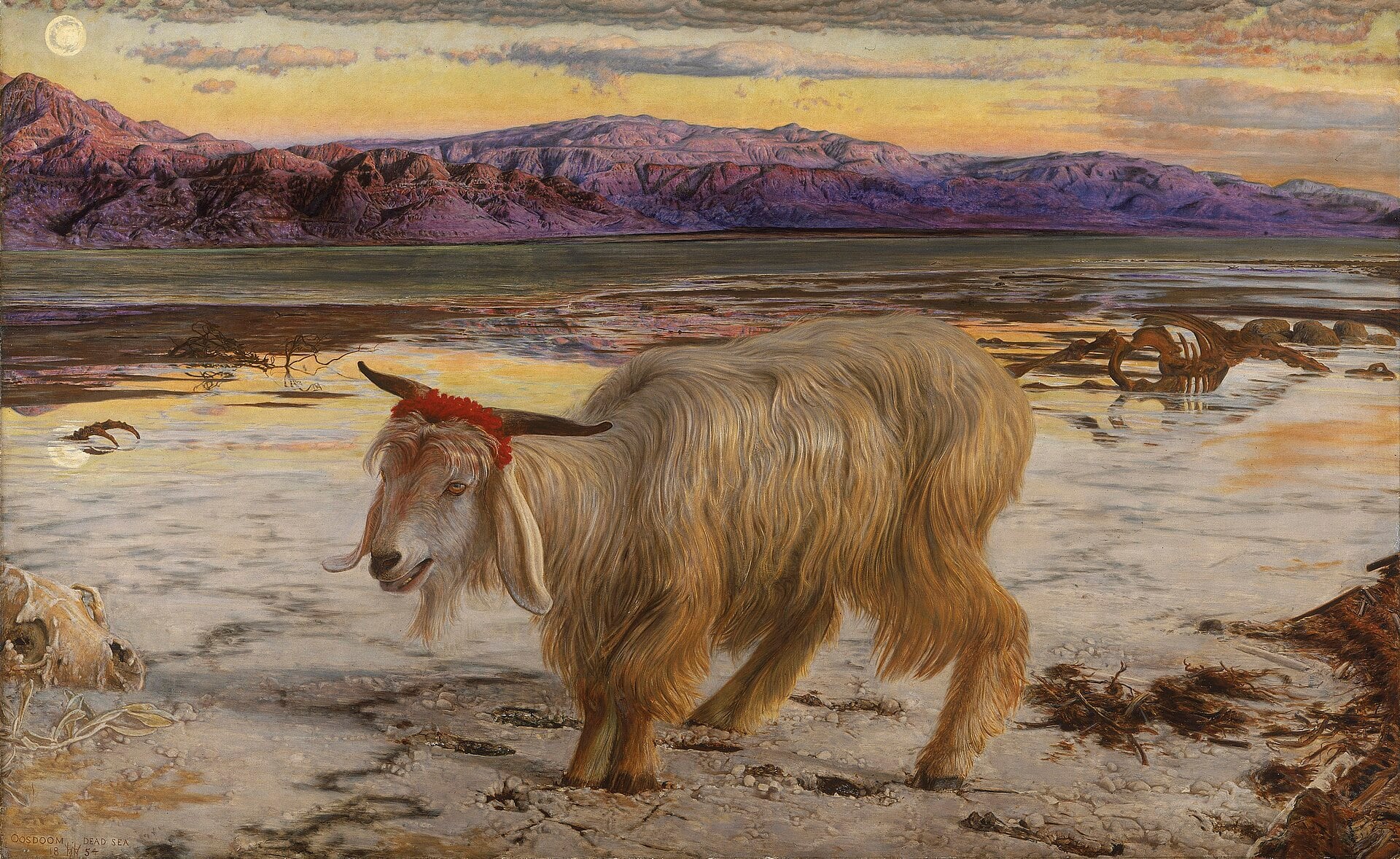
Holman Hunt Scapegoat Wikimedia Commons
This evening at sundown, all around the earth, Jews observe what has come to be considered the “holiest day of the Jewish festival year,” called Yom Kippur—or literally “day of covering.” The word “atonement” is the theological term—but the literal meaning of the Hebrew noun is “covering.” Even though I am not Jewish, I have fasted in solidarity with the Jewish people since 1965. It has become for me a very personal time of introspection.
The Jewish practice for millennia has been to fast without food or water for twenty-four hours, which marks the main observance. The fast begins tonight at sundown and ends Monday at sunset, when the “fast is broken.” It is a time for deep introspection, repentance, and self-examination. In ancient times, the 49-year Jubilee cycle ended on Yom Teru’ah, the 1st of Tishri. The year that followed marked the 50th year—and at the same time the first year of a new seven-year Sabbath cycle. On this 10th day of the seventh Jewish month, all debts were forgiven. So it also came to signify freedom and release for all “debts.”
Anciently, one of the strangest ceremonies of the Torah was carried out on Yom Kippur involving the mysterious choice of “two hairy goats.” The ritual is described in Leviticus 16 in full detail, and the day is called “Yom Kippurim,” in the plural: the “Day of Coverings.” Most scholars agree that this text, as well as the references in Leviticus 23 and Exodus 30, are from the Priestly source. None of the other texts of the Torah, including the entire book of Deuteronomy, know of this ceremony, nor the significance of the date. However, it was connected to the end—and thus the beginning—of the Jubilee cycle, and so took on various eschatological interpretations from both Jews and Christians.
Two male goats were selected for Yom Kippur: one “for YHVH” and the other “for Azazel.” Which was decided by casting lots!
Both are said to be “for a sin offering” (v. 5). One is slain and the other is sent away into the wilderness. What has been confusing to many is that both goats are spoken of as somehow providing “atonement,” or better translated as “covering.” So why the difference? Why two goats, essentially identical, rather than one?
One common interpretation makes the two goats positive and negative, and it is true that Azazel in ancient Jewish texts (1 Enoch, etc.) is the name of an “angel” who opposes YHVH. But if one is negative and one positive, how can both provide “covering”? In looking more closely at the text, one notices that the first goat, the one “for YHVH” that is slain, makes “covering for the Holy Place because of the uncleanness of the people and because of their transgressions, all their sins” (v. 16). In other words, the blood of that goat is to cleanse the Tabernacle that has become unclean because of the sins of the people, NOT to remove the sins of the people per se. In contrast, the sins of the people themselves are put on the head of the live goat. That goat is not killed, yet that goat too is called a “sin offering” (v. 5) and is said to make atonement/covering (v. 10), and it “bears all their iniquities” into a remote area (v. 22). This distinction might be an important one in trying to understand the meanings intended in this ancient ceremony.
Given Paul’s interpretation of the death of Jesus by crucifixion, early Christians were able to find in the slain goat a symbol of “Christ” dying for the forgiveness of the sins of the people. The writer of the New Testament book of Hebrews elaborates this point in great detail (Hebrews 9). But there seems to be no reference in Leviticus 16 to the blood of the slain goat as bearing on the forgiveness of the sins of the people. The second goat, the one sent away into the desert, is not dealt with at all in the interpretation given in Hebrews, and yet in the biblical text of Leviticus that goat is clearly the “sin bearer.”
The Christian overlay to this text is a significant obstacle to reading it with new eyes. One often hears a quotation from the New Testament book of Hebrews (9:22) that asserts: “without the shedding of blood there is no remission of sins”—a quotation that occurs nowhere in the Hebrew Bible or “Old Testament.” This is clearly not the case, as the example of the “live goat” shows. The goat that really “bears the sins” is the one sent away into the desert (v. 22). All the sins and iniquities and transgressions are put on the head of this live goat, and it is sent away to Azazel. The sending away of this living goat effects the removal of the sins of the people. What this implies, then, is that in this ancient ceremony the ultimate “covering” of sins that comes on Yom Kippur is not by the shedding of blood but by casting them far away from the camp of the living to the desert places where Azazel and the demons dwell. This means that the main image of “atonement” or covering on this day is not that of an animal slain for the forgiveness of sins but that of the removal of sins from the land of the living.
The rabbis seem to pick up on this in arranging the special Haftarah readings from the Prophets for Yom Kippur. First, the story of Jonah is read, which is a story of an entire city being saved from destruction because of repentance from sin. Then Micah 7:18–20 is read, where sins are cast away into the depths of the sea. So, being “washed in the blood of the lamb” has become a more appealing cultural image to our minds than “washed in the blood of the hairy goat,” but it seems that neither image, in connection with the removal or “atonement” of sins, is related to the Day of Atonement or Covering.
Related Topics
Related Posts