
Writer covering Israel–Africa, Jewish affairs, and Israel worldwide
Two Israels, One Gaza: Who Wins When the Dust Settles?
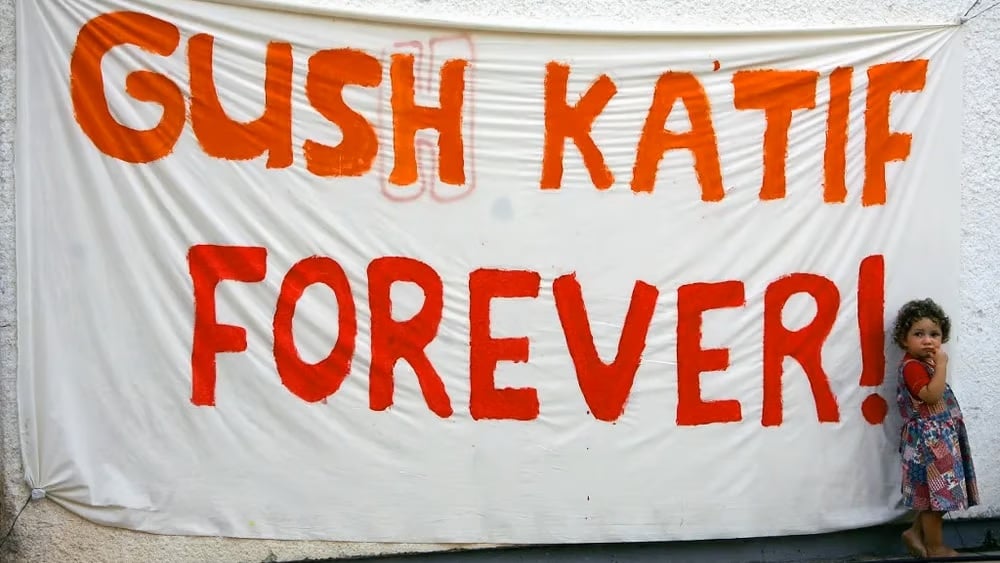
A young child stands next to a banner with the inscription 'Gush Katif Forever' at the Gaza Strip settlement of Nezer Hazani, August 17, 2005 (Photo: NICOLAS ASFOURI / AFP)
Israel’s war in Gaza was not only against Hamas, but also an ideological war within Israel itself, a tug-of-war between two Israels. One Israel wants to build, to expand, secure, and restore what it believes is divinely and historically its own. The other Israel wants to withdraw, to retreat from danger, and score an invitation to the world’s diplomatic dinner party.
After the War: Is Gaza Israel’s Next West Bank?
When Israel slipped its grasp from Gaza in 2005, it did so with both trembling hands and visionary eyes. The dream was that, freed from the weight of watchtowers, the land might blossom into a Middle Eastern Singapore, an oasis of possibility. Yet the soil yielded not petals, but iron and fire; the Strip became less a garden than a battleground, where hope and rockets shared the sky.
At the time, the policy was sold as a bold leap toward peace, a way to end Israel’s control over Gaza and perhaps restart diplomatic progress. The disengagement which involved dismantling 21 settlements and withdrawing 8,000 Israelis, a painful national surgery justified by the promise of quiet borders. In one interview I found interesting, the commander who oversaw the disengagement, tells a different story: that “every prediction of the disengagement’s opponents came true.” Instead of a model for peace, Gaza became a cautionary tale in Technicolor, rockets, tunnels, and international lectures included.
Israelis still passionately debate the meaning of “occupation,” “settlement,” and “peace.” The mood emotional, almost theatrical captures the national schizophrenia: a people both exhausted by war and unwilling to commit national suicide by idealism.
The Two Competing Israels
Today, the argument has evolved into two sharply defined camps. A recent survey showed just how split Israelis are. Roughly half believe continued settlement expansion strengthens Israel’s security and Jewish identity; the other half fears it undermines both. It’s less a political disagreement than a theological one, about destiny, survival, and the price of belonging.
However I acknowledge many Israelis view settling not as aggression but as sacred continuity, an act of stewardship in the ancestral land of Abraham and David which I overly agree with. To them, every olive tree planted in Judea and Samaria is a quiet rebuttal to history’s attempt to uproot them. But to others for reasons I find difficult to fathom, these same hills represent an unsustainable future, with the claim Israel risks governing millions who do not wish to be governed by it.
So, when the dust settles in Gaza, I think the question should not just be “what to do with Gaza?” but “what kind of Israel do Israelis want to be?” A restored and resolute Israel that plants roots wherever its history lies, or a pragmatic one that gives away land for international approval, a prize that, as history shows, often expires before the ink on the agreement dries.
Lessons from Oslo and the Mirage of Guarantees
As the Foreign Policy retrospective on the Oslo Accords reminds us, the grand peace process of the 1990s was built on the belief that concessions breed coexistence. Three decades later, even its architects admit that the process delivered more funerals than treaties. The problem wasn’t lack of sincerity but a surplus of wishful thinking, a Western import that assumed peace was a function of diplomacy rather than reality.
The New York Times’ latest review of Gaza peace proposals reveals that the world still hasn’t learned. Whether it’s an “international trusteeship,” an “Arab security force,” or “revitalized Palestinian Authority control,” every plan sounds like a bureaucratic version of “let’s just hope Hamas doesn’t come back.” It’s the same philosophy that drove disengagement, outsourcing Israeli security to goodwill and PowerPoint slides.
So which vision prevails or is most likely to?
Who will prevail: those believing in re-rooting Gaza as part of the Jewish homeland, or those who insist that peace comes from giving pieces away? In the end one will be proven right, In my opinion, I think it will be exactly the one we both imagine it will be.
I submit that Israeli politics is not necessarily a war between right and left but rather between trauma and hope, between those who have learned that security is non-negotiable and those who still believe in the redemptive power of diplomacy. Israel’s story, Is one of endless rebirth: a small people perpetually reinventing itself in the face of history’s disbelief. In that light, Gaza becomes not just a geographic challenge but a moral mirror. Do Israelis dare to trust the world again, or will they be courageous enough to trust themselves? Only time will tell.
A Closing Reflection
Perhaps the future lies somewhere between the two Israels, the one that builds dreams and the one that keeps dreaming. As Western elites endlessly urge Israel to “take risks for peace,” yet none of them live within rocket range. The real courage may not be in risking lives for a paper peace, but in reclaiming life itself, building, securing, and flourishing where others predicted failure.
Because if the past two decades seems to suggests anything, it’s that Gaza without settlements becomes Gaza without peace. And maybe, just maybe, that is where the story and the rebuilding should begin.
Perhaps between Jabotinsky’s wall of iron and Rabin’s handshake lies the crossroads where Israel stands today.
Related Topics
Related Posts