Two Lessons from a Getaway
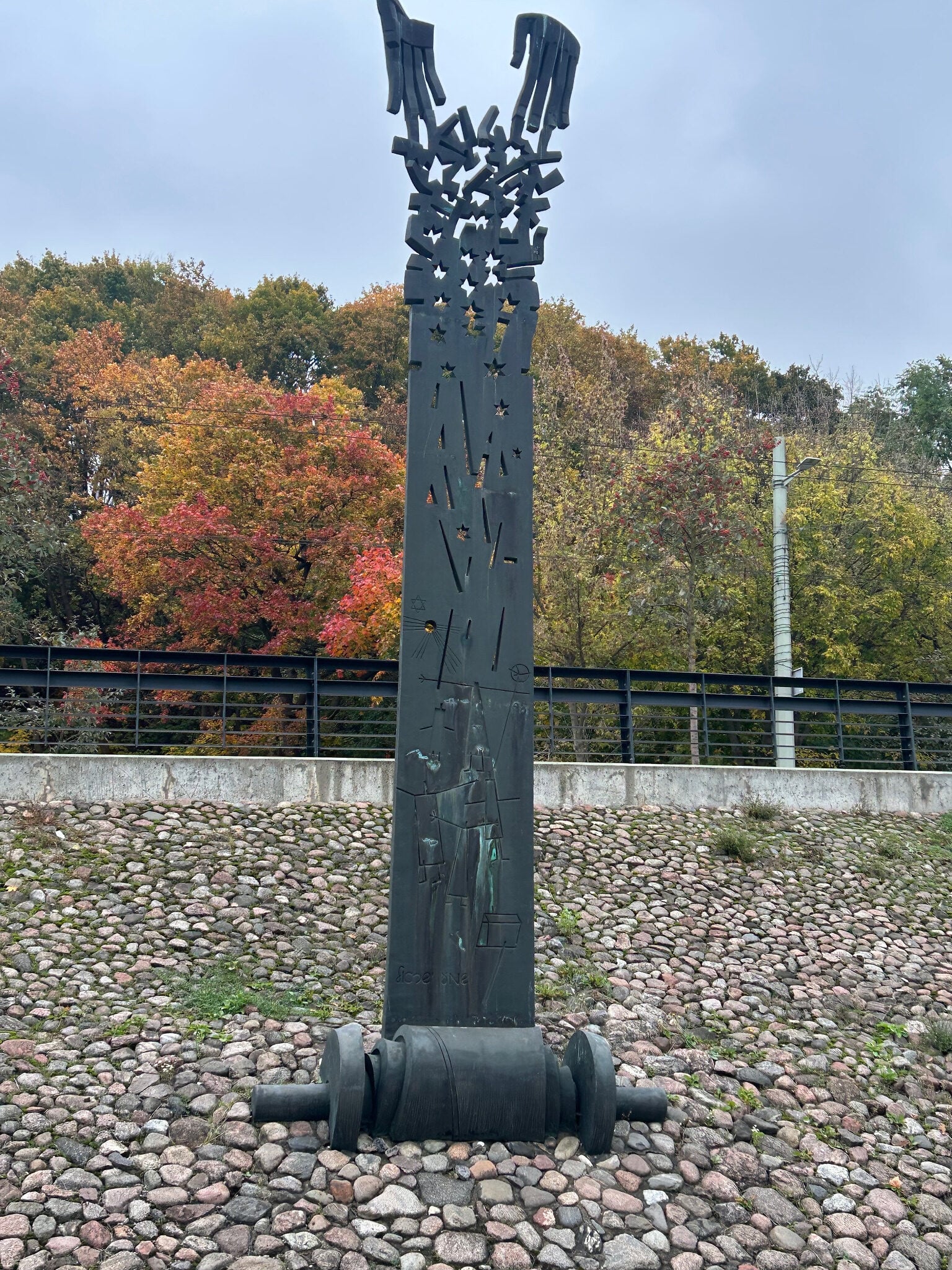
Four-day getaway: Vilnius, Lithuania. Unanticipated plaques surprisingly cite historic Jewish presence outside the capital too. References to Jews alongside other minorities at the capital’s KGB museum.
The museum, officially the Museum of Occupations and Freedom Fights, exhibits dismal history and living memories. Our elderly Bolt driver from the airport assured us life has never been so good as since the end of Soviet occupation. The young man leading our city tour the next morning noted heroism of those daring to demonstrate for independence as signs of waning Soviet power arose. Since the early 1990s end to the Soviet regime, Lithuanians continue learning trust-building, after decades fearing every neighbor a KGB agent.
Yet, boarding our return flight, an Israeli woman, born and raised in Lithuania, praised life during the Soviet period. But like her, all her relatives moved to Israel. In lieu of further inquiry, conjecture filled the blanks, recalling a woman my age discussing her privileged Latvian childhood because her father was the republic’s chief engineer.
With KGB prison conditions shown in the museum alluding to life under the Soviet regime, it’s not a period when I would have wanted to be Lithuanian. Padded cell walls prevented tortured prisoners’ outcries from being heard by other prisoners. Sanitation standards. Plaques describe methods employed by guards. Prisoners sent to labor camps. Execution room. Treatment of clergy, resistance fighters, Jews, Roma, rural villagers supporting the “wrong” side.
KGB surveillance of suspicious visitors from abroad, searches of their hotel rooms. Censored letters. Things we knew when writing to encourage Soviet Jewish refuseniks in the 1970s and 1980s.
In Vilnius, prepared to see the Vilna Gaon bust, we first identified him on a mural. Nearby, murals of other Jews mark the Small Ghetto area. Gaono Street. Zydu Street. A map of the historic Jewish area at the streetcorner. Google Maps led us to the choral synagogue, the only remaining synagogue. Limited opening hours kept us from seeing the interior. The Nazis murdered 90-95% of the city’s Jewish population of over 70,000 by 1941.
Strolling through Vilna in 2026, minimal pedestrian and automobile traffic. Modest living standards. Elderly women sitting on pavements selling flowers. Empty designer fashion boutiques. Second-hand clothing stores indistinguishable from new clothing stores where locals appear to shop.
One morning we took the train to Trakai. A sign pointed towards a Holocaust memorial. The distance deterred us. Passing the Karaite neighborhood, a plaque mounted in the ground, like plaques throughout the city with historic information, explained we reached the pre-World War II neighborhood, home to some 300 Jews, almost entirely murdered by the Nazis. The adjacent four-story, red-brick residential building was built in 1966 following demolition of the synagogue turned Soviet warehouse on the site.
The following day in Kaunas (Kovna), we located its choral synagogue, the city’s only remaining synagogue. Like the Vilna synagogue, closed. An iron sculpture of an open Torah scroll stands in the back courtyard. Attempts to call the phone numbers on the door failed. A verse over the entrance was identical to the verse over the door to the Vilna synagogue, welcoming anyone to come to prayer.
We missed the Gymnasia where Leah Goldberg studied. We crossed Old City intersecting streets: Mapu and Zamenhof. Another community. Fewer than 3,000 of over 37,000 Jews survived Nazi actions in Kovna.
Our getaway proved there’s no escape, leveraging two lessons: The Jewish people need their homeland. Denying human rights to others is a desecration of the tragedies of Jewish history.
Harriet Gimpel
October 22, 2026