‘Marginal’ Signatures

A County Chief Signed Fourteen Clauses and Ordered the Jews Handed Over by Name. Lithuania’s Genocide Centre Calls It Marginal.
On September 19, 1941, the head of Vilnius county signed an order marked “Urgent – Secret.” It opened: “In compliance with the instructions of the Gebietskommissar, I order you.” It ran to fourteen clauses. It closed with his name: Br. Draugelis, Head of the District.
Three days later, at Vėliučionys, 1,159 Jews were murdered: 468 men, 495 women and 196 children.
Lithuania’s Genocide and Resistance Research Centre has an explanation for the Lithuanian part in this. On page 40 of its 2020 volume The Holocaust in Lithuania 1941–1944, Darius Furmonavičius writes: “If there were Lithuanians who took part in these events, examination of the command structures of the SS will make it plain that their contribution was as supporting cast and thus essentially marginal.”
The Centre asks us to examine the chain of command. Here it is. It runs through a Lithuanian signature.
Fourteen clauses
Draugelis addressed every head of a civil parish in Vilnius county and the mayor of Naujoji Vilnia, with a copy to the police station captains. Every Jew was to be at Vėliučionys Manor by 6 a.m. on September 22, the first morning of Rosh Hashanah 5702. Then he set out how it was to be done.
- Every Jew was to be collected, “regardless of whether they work somewhere or not,” including those working for the German military.
- Wagons were to be provided for “sick people, little children, old people unable to walk.”
- Each Jew could take only what he could carry. Anything dropped on the road “shall not be returned to the Jews.”
- The houses were to be locked and sealed, the shutters closed, and guards posted, chosen from “reliable persons (preferably Lithuanians).” The parish head was to take the keys. The police were to supervise the guards.
- The property was to be listed “with a separate document for each former property owner.”
- The parish heads, with the local police, were to “see that not one Jew remains behind.”
- Anyone hiding a Jew or a Jew’s property was to be reported “to me for punishment.”
- At the collection point the Jews were to be handed to the chief guard “after they have been called by name from a list.” The chief guard was to sign the list, and one copy was to stay in the parish office.
- Written reports on how many Jews were transported, what happened to their property and any incidents were due on Draugelis’s desk by 11 a.m. on September 23.
- Clause 14: the parish heads and the mayor “shall be responsible for precise and strict compliance with this order.”
“Former property owner.” Draugelis wrote those words about people who were still alive in their own houses.
The men who carried it out
The same day, the Vilnius county police issued Order No. 3138. It assigned forty self-defense battalion soldiers to Naujoji Vilnia to transport and guard the Jews, and named the Nemenčinė, Mickūnai, Šumskas and Rudamina precincts as sources of prisoners for Vėliučionys. It was signed for the police chief. The published edition marks the signature illegible. I have not identified the signer.
An SS officer named Krieg signed an authorization placing the county’s police and self-defense soldiers at the disposal of the Lithuanian mayors and parish heads for the September 20–22 action. The German paper handed the armed men to Lithuanian officials.
At the forest, according to the account the Lithuanian Jewish Community published from the Lithuanian Special Archives case of Vincas Sausaitis, the 2nd Auxiliary Police Battalion held the cordon. Captain Mešlius, who commanded the guards, shot the wounded. The Lithuanian Special Squad shot at the pit; the account names Sausaitis, Balys Norvaiša and Vladas Korsakas among its men. Jews brought from Naujoji Vilnia were made to dig the pit under a false explanation. Forced labor without wages is slavery.
Draugelis’s order provided wagons for “little children.” Yad Vashem’s list of murdered Jewish children records one child from Rudamina by name: Yta Kosever, born 1933, dead at Wieluciany, the Polish name for Vėliučionys, in 1941. The list gives her age as eight.
The receipts
The county then accounted for what the murdered Jews had left. Its ledger records RM 49,562.24 from the sale of Jewish furniture and other property, remitted by Lithuanian parish and police offices, Rudamina, Šumskas and Mickūnai among them, and by the mayor of Naujoji Vilnia. RM 31,602 went to the German regional commissar’s cash office and RM 12,195.62 to his bank account. Marcelė Seibutienė, head of the county’s economic section, transferred the balance to the accountant, Jonas Paškevičius. On March 10, 1942, a gold ring, a watch, five silver teaspoons, an old shaver and two leather wallets were handed over to the commissar.
Draugelis’s name and title close both the order and the property-sale account: Br. Draugelis, Head of the Vilnius District.
The lists
Clause 10 required a list for every parish, read out name by name and signed by the chief guard, with one copy kept in the parish office. Clause 12 required written returns. Order No. 3138 required a police return by noon on September 25. Those papers could identify the people handed over at Vėliučionys and the Lithuanian officials who delivered and received them.
The order itself survives in the Lithuanian Central State Archives (f. 684, ap. 1, b. 4, l. 21). I have found no published copy of the lists or the returns. The Centre holds the state’s mandate to investigate these crimes, and it must obtain and produce them. Until then, the 1,159 remain a number in a German report, and the missing lists could identify the officials who received them.
The signature the Centre could not read
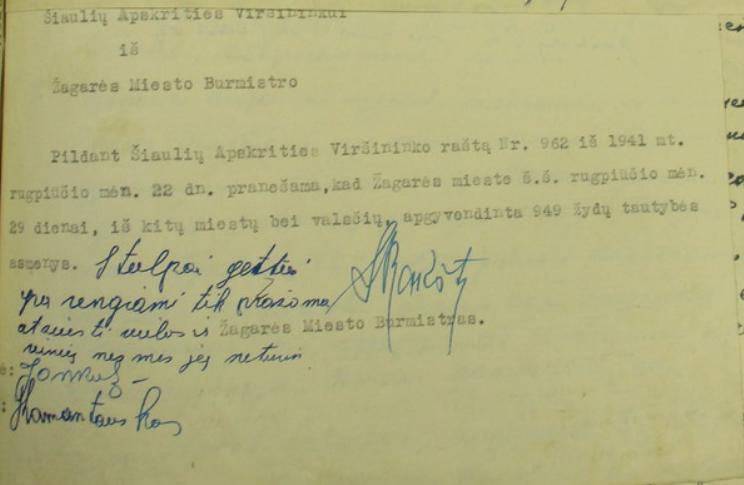
On August 22, 1941, the Šiauliai county chief, Jonas Noreika, signed Order No. 962. He wrote “Ryšium su šiuo įsakau“: in connection with this, I order. The Jews of the county’s rural districts and towns were to be moved to the Žagarė ghetto by August 29, and lists of the property they left were to be delivered to him.
His parish heads answered by number. On August 25, the Žeimelis parish government replied to the county chief “To No. 962.” It reported that 180 of the parish’s Jews had been shot on August 21, the day before Noreika’s order, and that two Jewish women who had since come to the parish “will be sent to the town of Žagarė.” On August 29, the mayor of Žagarė reported to the county chief that, “in executing the Šiauliai District Chief’s Order Nr.962 of August 22, 1941,” 949 Jews from other towns and parishes had been housed in Žagarė. The Centre’s own volume gives the same 949. On October 2, the Jews of Žagarė were murdered in the town park: 2,236 people, 496 of them children.
On February 26, 2018, the Centre answered a complaint I had brought through the Seimas Ombudsman. Its letter No. 55R-21, signed by Director General Teresė Birutė Burauskaitė, names Arūnas Bubnys at its foot as one of two officials to contact. It first describes the August 22 document as “Šiaulių apskrities viršininko J. Noreikos pasirašytas raštas”: a letter signed by Šiauliai county chief J. Noreika. Three paragraphs later it says the Centre “pagal savo kompetenciją negalėjo nustatyti, ar J. Noreika tikrai pasirašė šį raštą”: within its competence, it could not determine whether J. Noreika really signed this letter. In the same reply, citing the presumption of innocence, it said it could not claim that Noreika had been complicit in carrying out genocide. The translations are mine.
One letter called the document signed by Noreika and then said it could not tell whether he signed it. Noreika had written “I order.” The Centre called his order a letter.
Two years later the Centre’s own book named the county chief who gave the instruction. Bubnys compiled the original Lithuanian volume and co-updated the 2020 English edition, and he is now the Centre’s acting Director General. On page 260 it states that “On August 22, 1941, Šiauliai County Governor Jonas Noreika informed the mayors” that the county’s Jews had to move to Žagarė. On page 101, a chapter by Dainius Noreika says that Jonas Noreika handed the mayors an order issued by the German regional commissar, Hans Gewecke, that “He also organized the expropriation of Jewish property for the county administration,” and that “Noreika was a Nazi collaborator and participant in part of the Holocaust process.”
In 2018 the Centre could not say whether Noreika signed, or whether he was complicit. In 2020 its book said he gave the instruction, organized the expropriation and took part in the Holocaust.
Lithuanian doubt about documents has a direction. When the document was my grandfather’s Lithuanian passport, a state office answered it with an unidentified “somebody else.” I set out both cases in The Documents Name Them. Lithuania Makes Them Disappear.
Supporting cast
Page 40 says the SS chain of command makes the Lithuanian contribution plain. Draugelis cited the Gebietskommissar’s instructions in his first sentence. Noreika cited Gewecke’s. The German instruction came to them. What reached the Jews came from them: the summons, the wagons, the sealed doors, the keys, the guards “preferably Lithuanians,” the lists the chief guards were ordered to read out and sign, the threat of punishment for anyone who hid a Jew, and the receipts.
A supporting cast does not sign orders. The Centre’s own volume attributes the orders to the county chiefs: Dočkus at Kėdainiai, Noreika at Šiauliai.
On November 3, 2026, in decision 55R-1130, the Centre refused to correct page 40. It called the passage part of the author’s scholarly interpretation, reached after assessing the body of sources examined, and called my objection personal opinion. Bubnys signed the refusal. He compiled the original Lithuanian volume and co-updated the 2020 English edition, the book that attributes the Šiauliai and Kėdainiai orders to the county chiefs. I give the Centre’s authorship no evidentiary weight. What it says is assertion, and the facts here rest on the primary documents, several of which it published itself.
Which signature does the Centre call marginal? Draugelis’s, on Order No. 9 and the property-sale account? The chief guards’ signatures the order required on the lists? The illegible one on Order No. 3138? Noreika’s on Order No. 962, which the Centre called signed and doubted in the same letter, then attributed to him in its own book?
What the Centre must produce
- The parish lists required by clause 10 of Order No. 9, and the written returns due on September 23, 1941.
- The police return due under Order No. 3138 on September 25, 1941, and the name of the official who signed that order for the police chief.
- The parish property inventories, “a separate document for each former property owner,” and the sale records behind the county ledger.
- The basis for its 2018 statement that it could not determine whether Noreika signed Order No. 962, in a letter that had already described the document as signed by him: any signature comparison, any alternative signer, any record at all.
Draugelis ordered the Jews handed over by name. The Centre must obtain and produce the signed lists and the returns.