Two men of ‘peace’: Vladimir Putin and Adolf Hitler
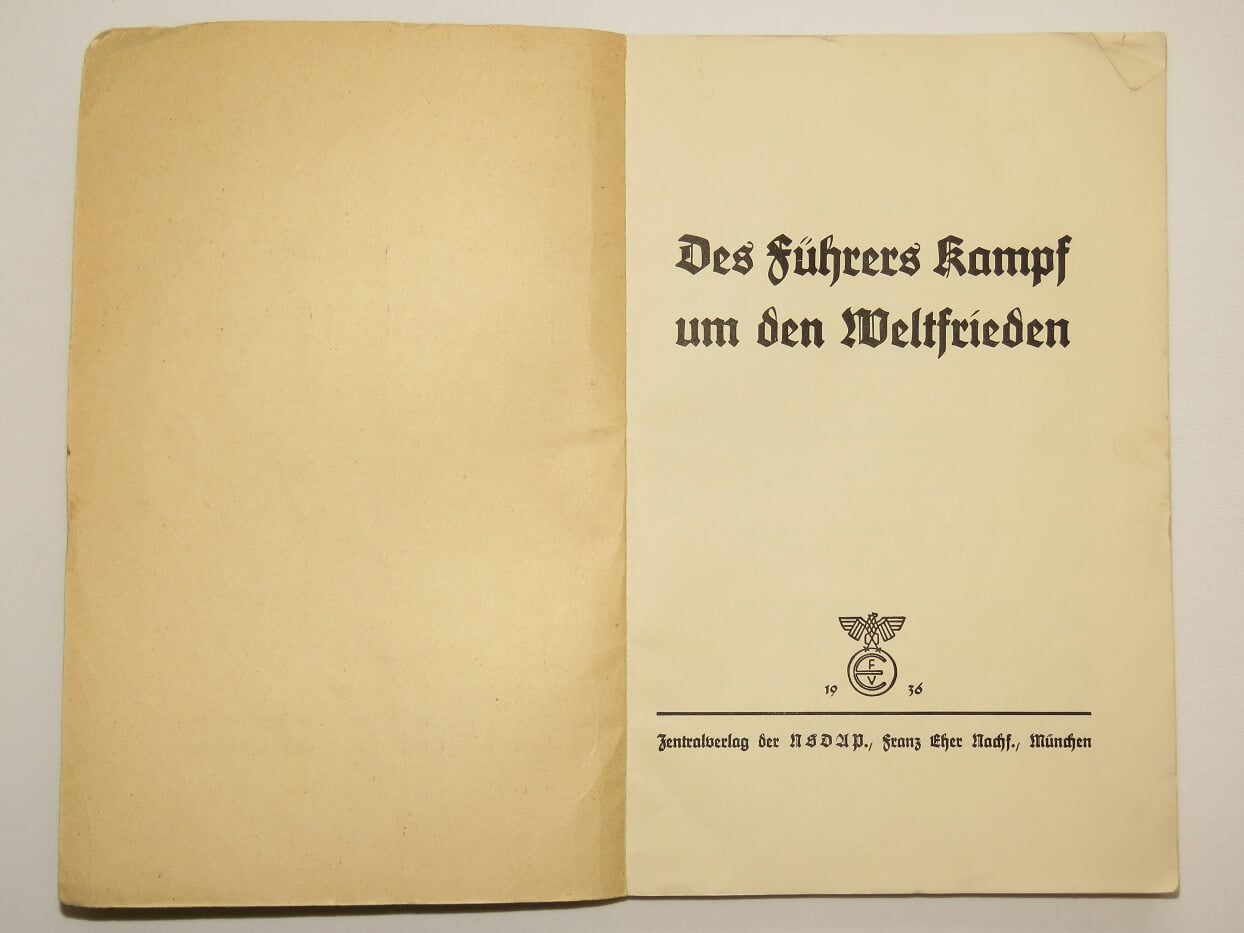
This Thursday, as the United States was celebrating Thanksgiving, Russia’s dictator Vladimir Putin gave a speech at a meeting of the Collective Security Treaty Organisation (CSTO) in Kyrgyzstan. Of course, this organisation, which is a loose alliance of fragments of the fallen Soviet empire, has no connection to any legal or moral conception of security. What is more important is what Putin chose to say:
Russia “doesn’t have any aggressive plans towards Europe“, but as for Ukraine, “If Ukrainian troops leave the occupied territories, then we will cease hostilities; if they do not leave – we will achieve it by military means.”
Rather familiar phrasing to those who know their history. For reference, a set of similar quotes from one Adolf Hitler follows below:
21 May 1935:
…It hereby most solemnly declares, however, that its respective action is confined to those points giving rise to the moral and material discrimination of the German Volk as have been disclosed. The German Reich Government shall thus unconditionally abide by the other articles governing the coexistence of the nations, including territorial provisions, and put into effect solely by means of peaceful understanding those amendments which become inevitable by virtue of the changing times…
7 March 1936:
I believe that the initial reason for our earlier withdrawal from a collective European cooperation has now ceased to exist. If we are now, therefore, once more willing to return to this cooperation, we are doing so with the sincere desire that these events and a retrospective on those years will aid us in cultivating a deeper understanding of this cooperation among other European peoples as well. We have no territorial claims to make in Europe. Above all, we are aware that all the tensions resulting either from erroneous territorial provisions or from the disproportion between the size of a population and its Lebensraum can never be solved by wars in Europe. However, we do hope that human insight will help to alleviate the painfulness of this state of affairs and relieve tensions by means of a gradual evolutionary development marked by peaceful cooperation.
26 September 1938:
And now we face the last great problem that must be resolved and that will be resolved! It is the last territorial demand I shall make in Europe. It is a demand which I shall insist upon and a demand which I will satisfy so God will!
and then:
I have little more to add. I am grateful to Mr. Chamberlain for his efforts. I have assured him that the German Volk desires nothing but peace. Yet, I have also told him that I cannot retreat behind the lines drawn by our patience.
I have assured him further that, and this I repeat here before you, once this issue has been resolved, there will no longer be any further territorial problems for Germany in Europe!
I have assured him further that I will take no more interest in the Czechoslovakian state once that country has resolved its internal problems, that is once the Czechs have dealt with the other minorities there in a peaceful manner and not by means of oppression. And I will guarantee this for him! We do not want any Czechs at all. Yet I do declare before the German Volk that my patience is at an end with regard to the Sudeten German problem! I have put forth an offer to Herr Benes, an offer that is nothing other than the realization of his promises. The decision is his now! Be it war or peace!
12 January 1939, in reply to an address by the Papal Envoy to Germany:
Your Excellency has called to our minds the day the representatives of four great powers gathered in Munich. This unique occurrence has impressed itself strongly on my recollections of the past year. It is with profound gratitude that the German nation remembers 1938 as the year which brought about the realization of its inalienable right to self-determination. That this could indeed come about without rupturing the peace in Europe for even a single day was due largely to the policy of wisdom and understanding embraced by the powers, which found its expression in the Munich Agreement.
It was in another context that I already had the opportunity in this New Year to express the gratitude the German Volk felt to those statesmen who, in the year 1938, ventured to seek and secure a way toward a peaceful resolution of those questions which allowed for no further deferment and who pursued this path in concert with Germany. To have succeeded in this, to have arrived at the peaceful resolution desired by all parties, this we owe not exclusively to the will to peace and sense of responsibility of all governments concerned.
30 January 1939:
Therefore, all of us were happy about the initiative of our friend Benito Mussolini and at the also highly appreciated readiness of Chamberlain and Daladier which allowed us to find elements for a peaceful settlement of a situation which demanded immediate attention. Moreover, this can justly be regarded as evidence of the possibility of a reasoned treatment of certain problems of vital interest and their resolution. However, without the determination to resolve this problem in one way or another, such an agreement between the great European powers could not have become a reality.
10 October 1939, more than a month after initiating the Second World War:
I have expressed our willingness for peace. Germany has no reason to do battle against the Western Powers. It was they who began this war on a threadbare pretext. In the event they decline our offer for peace, Germany stands determined to take up the fight again and to follow through on it — in one way or another!
31 December 1939:
Germany occupies a well-defined position in international politics. We stand firm and unyielding by the obligations resulting from our friendship with Fascist Italy. The realization of the historic role played by Mussolini in the preservation of peace in the past year compels us to profound gratitude. We are grateful also to those other statesmen who in this year have undertaken to search for and to find a peaceful resolution to these questions which, at the time, allowed for no further postponement.
All the quotes above were taken from the following work:
Max Domarus. Hitler: Speeches and Proclamations 1932 – 1945. The Chronicle of a Dictatorship. Wauconda, Illinois: Bolchazy-Carducci Publishers, 1990
Someone possessed of the intellectual gifts of a Mr. Steven Charles Witkoff might read the above excerpts and conclude that the United Nations lost quite the convinced man of peace when Mr. Hitler put a bullet in his own head on 30 April 1945. The rest of us would prefer if someone forces Mr. Witkoff and Mr. Daniel Patrick Driscoll, the 26th United States Secretary of the Army, to read and understand enough history so that they will stop steering the world, and unwittingly also themselves, towards a new disaster.
—
If you found what you read above interesting and substantive, do read more on my Substack, The New World Crisis.