“Two Rivers” on the Charles River: Jewish Philosophers on the State
What exactly is a state? Recently, I saw a news program exploring the topic of Palestinian Statehood. The expert guest was certainly confident about the need for and justice of such an enterprise, but when asked about what such a state would “look like”, the interviewee was stymied. The reality is, the nature, the ethos, the composition of such an entity is anything but simple!
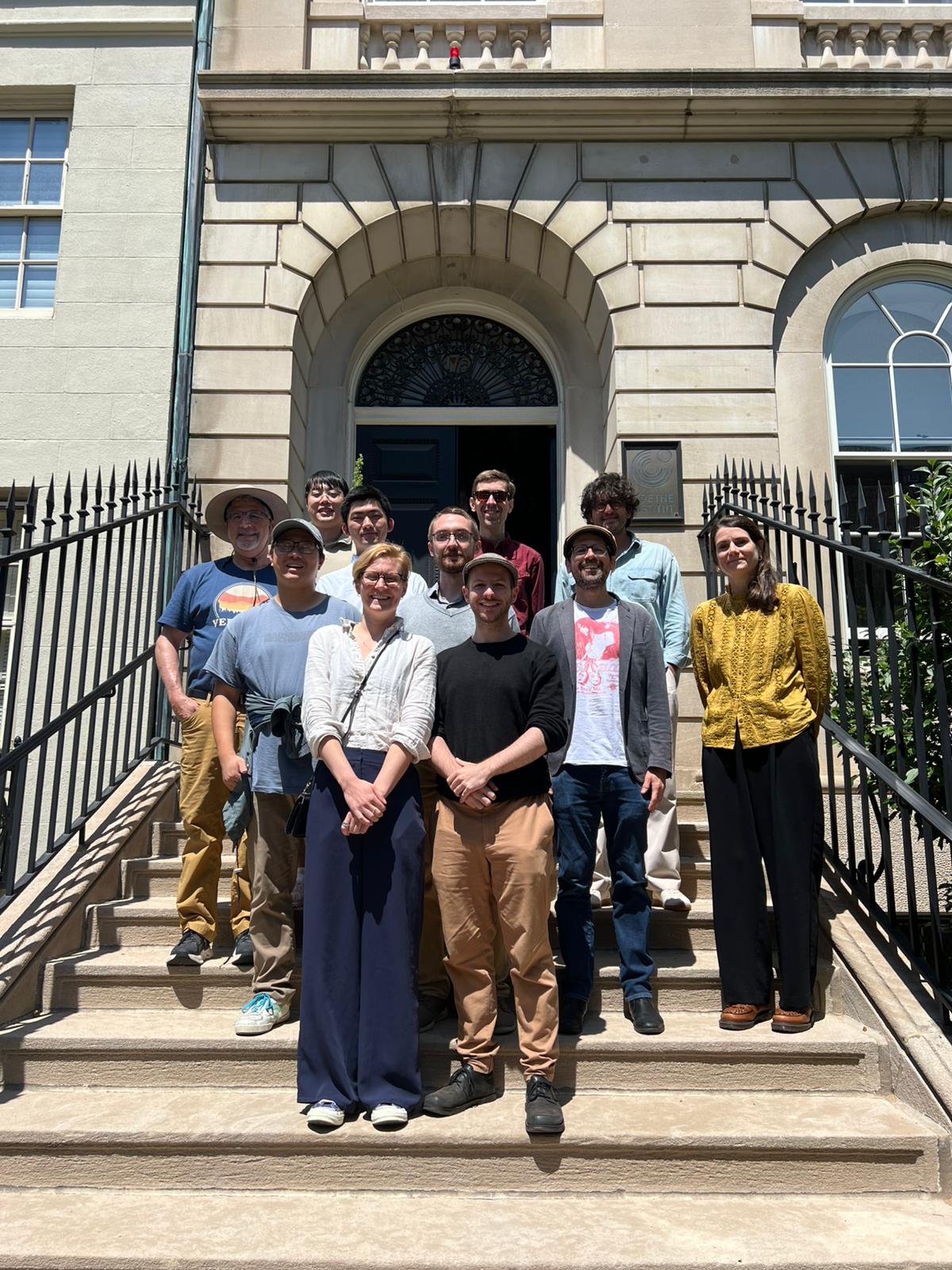
A couple of weeks ago, I attended the first Franz Rosenzweig Summer Academy hosted by the Goethe Institut in Boston and directed by Dr. Avi Bernstein-Nahar of 36 LEARNING MATTERS and co-led by Dr. David Kretz, a scholar of the history of philosophy and hermeneutics with a speciality in Hegel. In addition to my work as Rabbi-Cantor at Temple Emeth in Chestnut Hill, MA, I have the honor of co-teaching courses in the Jewish Philosophy Department at the Academy for Jewish Religion in New York. I applied to this week-long fellowship in order to enhance and deepen my understanding of Rosenzweig’s thought, which is both imagistic and conceptually complex. His classic, the Star of Redemption, is a work that many rabbis and cantors have cited as inspiration, but few have understood, due to its opaqueness and poetic style.
From nine-five Monday through Friday we came together at Boston’s Goethe Institut to engage with the thought of three philosophers: Hegel, Hermann Cohen, and his student and protegee Franz Rosenzweig. Though many are familiar with the aforementioned Star of Redemption and his work in Jewish education with fellow existentialist Martin Buber, few know that Rosenzweig’s doctoral dissertation and first book was a philosophical biography of Hegel. This work focuses specifically on the evolution of Hegel’s conception of the modern state in relation and tension with the individual and other organizations that reside and hold congress within it, including religious institutions.
What resonated most deeply with me and many of my colleagues was Hegel’s understanding of the state not as a nation, but as an evolving ideal, as a body moving through a historical process of movement toward the ethical. In this conception of the state, philosophy (reason), aesthetics (the arts), and religion form a kulturstadt, a realm that is the ground of a universal ethical spirit which embraces the worth of every human being, whatever their particulars may be. In Judaism we might call this universal reverence for the human, b’tzelem Elohim, meaning each person is made in the Divine image and thus has intrinsic worth and demands our ethical attentiveness. If we embrace Hegel’s ideal, as did Rosenzweig, how does this universal or absolute spirit of ethicality command us? For Hegel, both the family and religious institutions (albeit in his case, churches, specifically) are touchtones helping us internalize ethics, concern not only for our own, but for those who operate and move outside of our sphere of influence as well.
As a father, a Rabbi, a Cantor, and a teacher of future clergy, this suggests to me the ways in which we Jews are failing through our parochialism. The problems and shortcomings of the state, whether the deportation of undocumented immigrants in our communities and dehumanizing of trans-folk in America or settler violence against Palestinian Arabs in Israel are a breach of this Absolute or Unconditional Spirit, and should be intolerable to us.
Our exploration of Hegel’s political philosophy through the historical biography of Rosenzweig was complemented by engagement with the thinking of Rosenzweig’s mentor, Neo-Kantian of the Marburg School, Hermann Cohen. Cohen anchors his philosophy around three Absolutes: pure thinking, pure willing, and pure feeling. Pure, in this sense means not pure of all else, a sense of disconnect from reality, but rather only free “of that which disrupts its operation” [See Rosenzweig’s Introduction to the Jewish Writings of Hermann Cohen”] and whole in itself. We might say there is within Cohen’s purity, fully intentional commitment. In short, pure thinking, a higher form of reason helps us to divulge patterns within the world. In response to those patterns implicit in reality and the challenges and obstacles they present, we utilize universal reason, jurisprudence, and compassion (mitleid) to respond to these challenges, i.e pure will. Pure aesthetics or pure feeling entails creative meaning-making in dialogue with these patterns and ethical demands. Cohen’s concept of totality (Allheit) denotes the unification of these three creative realms of being, uniting thought, feeling, and will in order to respond as a humane and ethical agent toward all beings, whether they are friend or foe, innocent, guilty, or like most of us, something in-between.
We may understand personalities like Moses and Martin Luther King as embodying Allheit, what Rosenzweig calls Zweistromland, or “two- rivers-land”. This metaphor conveys the ability of the Mensch or the Tzaddik to simultaneously situate their consciousness, empathy, and action in both the pools of the particular and the universal. Martin Luther King Jr.’s final project when he was brutally assassinated was “The Poor People’s Campaign,” the aim of which was to economically uplift the condition not only of blacks but of poor whites as well. Moses demonstrated the qualifications of a prophetic leader by responding not only to his own people, the Israelites, crushed by enslavement but also to Tzipporah and her entourage, to whom Moses has no familial connection or bond of friendship or acquaintance (though he later marries her). Remarkably is a ger, a refugee in a strange land, and yet he rise up on behalf of citizens in a vulnerable position
The Rosenzweig Summer Academy’s biggest success, and there were many, was empowering the learners to bring their unique and personal particular lens to the table in order to better wrestle with the universal. We were rabbis, divinity students, undergraduate and doctoral philosophy students, scholars, professors, and post-docs. We hailed from San Francisco, China, Belgium, Ann Arbor, Austria, and Chicago among other places. We were comprised of Jews, Christians, and Agnostics. We engaged questions of primary importance through honesty, courage, and humility and shared personal stories that moved many of us to tears and inspired confidence in a shared humanity. These conversations took place not only around a table, but “walking along the way [Deuteronomy 6:7]”, in the midst of local bookstores like the Brattle, Commonwealth, and the Trident, and upon the verdant greens and beneath the leafy boughs of the Common and Public Garden.
On the last day of the program, each of us presented a capstone project, reflecting our process of engagement with these thinkers and their contemporary relevance. Mine was a philosophic poem, an homage to the poets who befriended Hegel, Goethe, Hölderin, and Schiller and to a romantic tradition in which poetry and philosophy were closely intertwined and frankly, to a similar Jewish tradition that begins works of Jewish thought with lyrical verse. The poem grapples with the challenge of the actual and the dream of the ideal of the state, both here, in the U.S. and in Israel drawing upon and responding to the thought of Hegel, Hermann Cohen, Franz Rosenzweig, and of course, the cornerstone text, the Hebrew Bible.
A Two-State Problem
By Michael McCloskey
In memory of the man, the legend, Hermann Cohen
I live in two states,
Or should I say,
my heart lives in them
I used to believe
when I was young
that I lived in a United States
I live in no states
underfoot of shambling terrors
who deem themselves
übermenschen
I am an individual
caught in the undertow
of reason-pyres
of tribe-desires
And I’ve forgotten how to swim
When my heart was young,
it lived in a castle
and I was a prince
and imagining their castles.
When I went behind the wilderness,
toward burning reason
and regarded the Good.
breaking open my crown,
I found it to be made of chains
and blood
and sugar
and Jaffa oranges,
caught between the current of the Great American Pharaoh
and a Philistine giant
who used to play sweet songs in the cafes of Spain,
Along the Rhine,
And in the courts of Judah
to quiet our spirits
In moments of madness
And yet,
I have seen state without a state,
a sabbath
an absolute and eternal breath,
An exhalation of light beyond light
before Abraham,
and Aristotle
before Plato
and Plotinus
that graces the lips of the immigrant child
powers the sigh of the trans man
that whispers round the outstretched arms of a tyrant’s daughter
an ironic smile;
She is pure will,
Relation become law.
She is the state
And those crones upon their birthstools
And those who emerge onto dry land between the
waters, two rivers made of tears
for Egyptian charioteers and firstborns
for festival goers and Gazan children
for Hebrew slaves and Midianite priestesses.
Two states live in me,
Justice and justice
For the vindicated
And the incarcerated
Two cherubim
Pointing to a totality.
menschlicher geist,
Will you run with me?