
Two Truths and a Lie
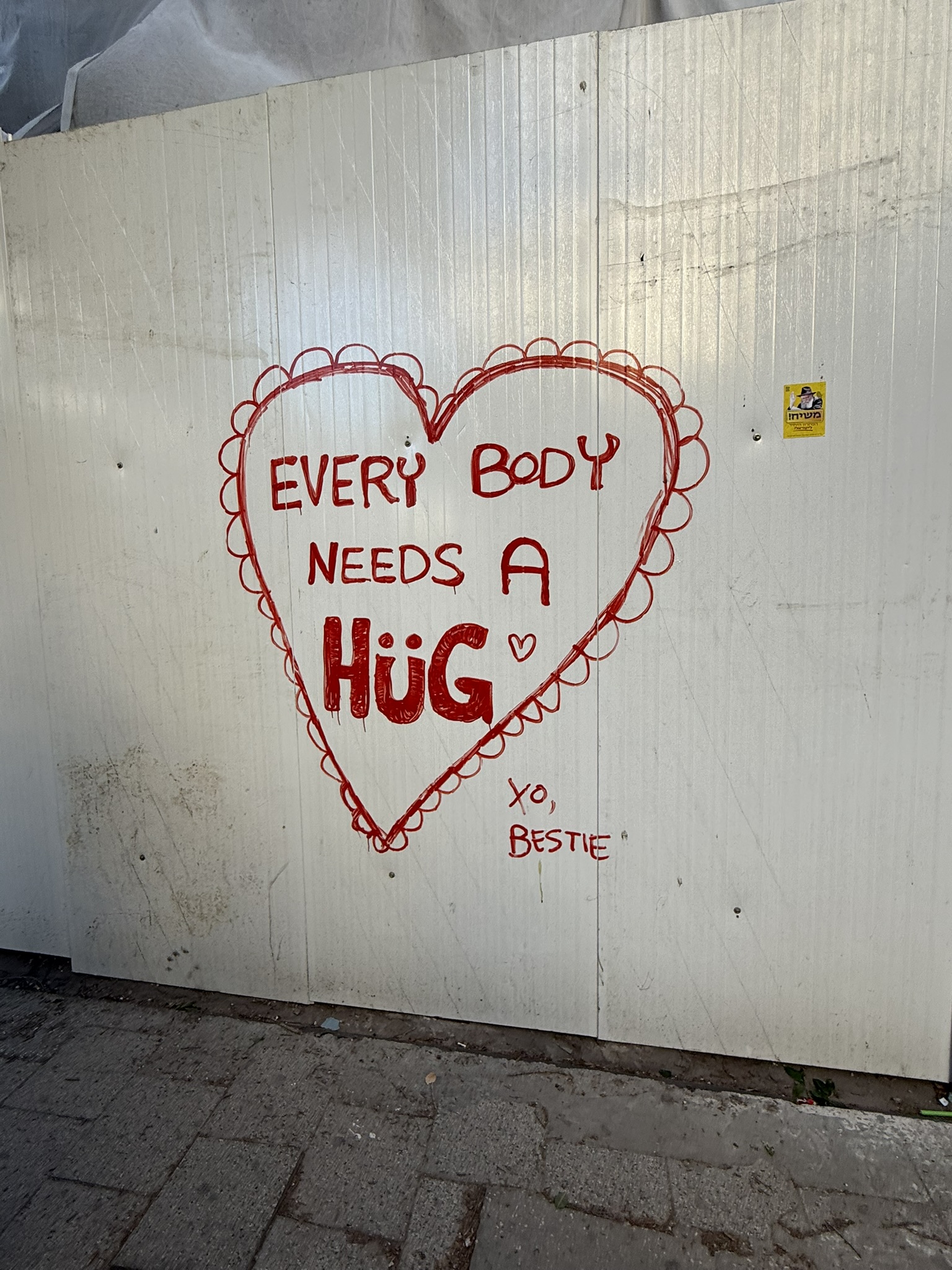
The last time we spoke was October 2013, after I staffed his Birthright Israel trip that summer. Then, two weeks ago, a message popped up out of the blue:
I was wondering if I could call sometime to chat. I haven’t really talked to any Jews about most of the events of the last few years—and definitely none who are as connected to Israel as you are. I’m sure there are things we agree on, and some we don’t. But I know you’re more connected and informed than I am.
When we finally connected, we spoke for well over an hour—about Israelis and Palestinians, fears and frustrations, and the kinds of topics so many people tiptoe around or avoid entirely. That conversation wasn’t unique—it’s become one of many I’ve had in recent months with people who feel they can’t talk about Israel openly in their own circles.
I’ve had the privilege of staffing 15+ Birthright Israel trips since 2011, leading hundreds of young adults through journeys of learning, self-reflection, and complex, often uncomfortable truths. Since October 7th, I’ve posted occasionally in my groups’ pages and threads, offering support and a safe space to share. Almost never is there a response, which is okay. Life moved on. People lost touch, started families, built careers, and for many, Israel became a past-tense experience.
But the thing about making the offer is that it’s never about how many respond right away. Someone might quietly hold onto it until the moment they need it most. Sometimes, just knowing the door is open can be a lifeline for someone who feels no one else will understand or listen without judgment—and in that moment, it reminds us why we do this work.
What I’ve always loved most about these trips is the diversity—people bringing their authentic selves and allowing themselves to wrestle with ideas and realities they’ve never encountered before. Some came with only surface-level knowledge; others were well-versed in the conflict; still others had been personally touched by it. Even the most knowledgeable often found themselves seeing things from a completely different angle—and I could see the discomfort of holding two conflicting truths at once. I’d step in as devil’s advocate, challenging assumptions, and watch as participants began to rebuild their opinions in real time.
In most of these conversations, as well as others I’ve had since October 7th, a startling trend has emerged: the inability—or refusal—to hold multiple truths at the same time.
- Gazans are starving – Hostages are starving.
- Hamas is a terrorist organization – Policies of the Israeli government are sometimes dangerous.
- Israel has a right to exist – Palestinians deserve independence.
- Zionism is the right to Jewish self-determination in the Jewish ancestral homeland – Palestinians live in the Jewish ancestral homeland
All of these statements are true—simultaneously. They are not in opposition to one another. Many of us have seen people physically tense when they realize two of these can be true at once, as if acknowledging one somehow betrays the other.
More than half of U.S. adults now get their news from social media (Pew Research Center). For them, the lie that only one truth can exist has become the whole story. Algorithms kill nuance. They trap people in echo chambers and feed them a “one-truth” reality. This has been building for years. Now, it’s almost impossible to convince people they’re seeing only a partial picture, not the full, complex set of truths.
Social media thrives on one-sided narratives, stripping away empathy and humanity. It has created a culture where people focus solely on disagreement with “the other side” rather than searching for common ground. Yes, it’s okay to have red lines—points you cannot cross without the other side moving toward you. For me, that line is agreeing that Israel has a right to exist; everything else can be a conversation. But we’ve allowed every point of contention to become a wall, shutting down dialogue entirely.
We are also being ruled by the “what abouts.”
– Say something about the hostages, and someone fires back, “What about the children in Gaza?”
– Speak about starving children in Gaza, and the reply is, “What about the hostages?”
– Call Hamas terrorists, and you hear, “What about Netanyahu—he’s a war criminal.”
– Condemn the October 7th massacre, and someone counters, “What about the decades of occupation?”
These “what abouts” create false equivalencies that lead to false truths—truths that do not actually exist (Israel Policy Forum, 2017). Sometimes, the ‘what about’ comes before I’ve even finished my sentence—as if the goal isn’t understanding, but scoring points. The IDF are not war criminals to be hunted around the world. Every Muslim woman wearing a hijab is not a terrorist who supports Hamas. If you cannot hold the complexity of the situation, you are equally unable to understand its causes—and even worse, unable to be part of a realistic solution.
People think they’re “fighting the good fight,” but in reality, they’re falling victim to a beast determined to divide us. Words are twisted, redefined, and forced into places they don’t belong—not to build understanding, but to win an argument. In this conflict, the danger isn’t only on the ground; it’s in the lie that you must choose between truths.
Nuance isn’t weakness. It’s the harder path, the one that demands listening when we want to shout, and seeking understanding when we want to win. Judaism is built on a tradition of debate—of questioning, wrestling, and challenging ideas. The Talmud preserves opposing arguments side-by-side, even when one is ultimately rejected, because both perspectives are considered vital to the pursuit of truth. As the rabbis teach, elu v’elu divrei Elohim Chayim—“these and these are the words of the living God” (Eruvin 13b). If our tradition can honor more than one truth at a time, surely we can, too.
I believe that we, those striving for nuance, are the majority, yet we often feel alone and overshadowed by the screaming from the extremes. The more we offer ourselves as a resource for conversation, the more we empower that majority—many of whom are craving a chance to talk but don’t know where to start. If we wait too long to create these openings, uncertainty and silence will push people toward one extreme or the other.
If we can practice holding multiple truths at once, we can begin to quiet the noise, bridge divides, and create space for real dialogue. That starts with becoming better active listeners, not just trying for our turn to prove someone wrong. We need to actively seek out points of agreement as the foundation for building trust, so that when debate inevitably comes, it leads to deeper understanding, mutual respect, and solutions we can stand behind together.
Now it’s on all of us to keep opening doors—asking before assuming, listening before responding, and resisting the lure of easy, single-truth answers. Sometimes, that begins with something as simple as, “I’m here if you want to talk.” Most won’t take you up on it right away, but the ones who do might need it more than you’ll ever know—and that is exactly why we do this work.