


Middle East Analyst
U.S.-Israeli Pressure Won’t Force Saudi Normalization
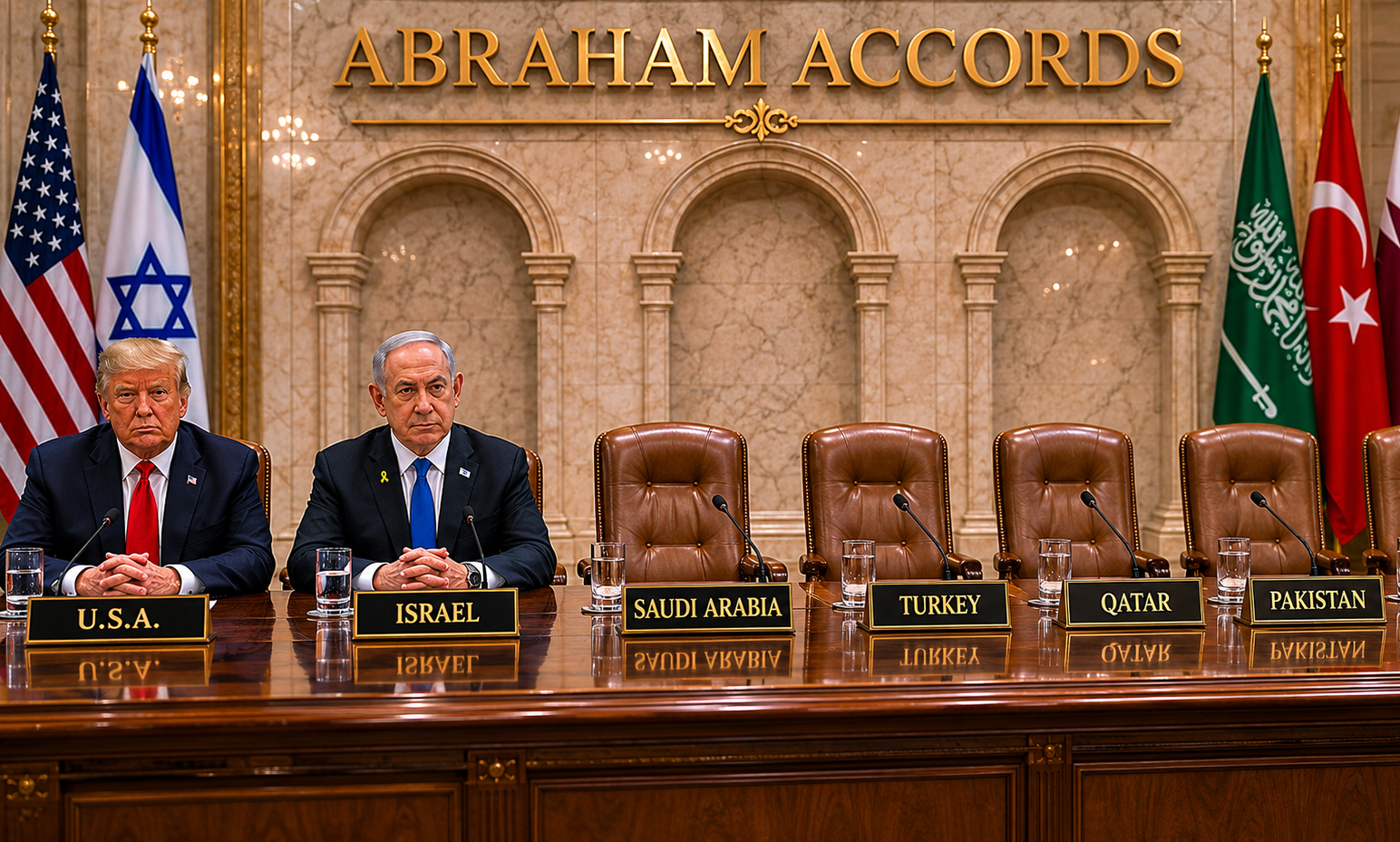
by author (AI)
The Pressure Is Real
The Trump administration’s decision to explicitly link a future Iran agreement with mandatory participation in the Abraham Accords materially changes the regional equation and should not be dismissed as symbolic rhetoric or negotiating theatrics. Saudi Arabia, Qatar, Pakistan, and Turkey all face genuine security concerns regarding Iran and continue to rely — to varying degrees — on U.S. military infrastructure, intelligence cooperation, financial systems, or broader regional stability guarantees. From Washington’s perspective, the logic is straightforward: countries that have recently faced Iranian military pressure or fear future Iranian escalation should have strong incentives to deepen strategic alignment with both the United States and Israel once an Iran framework is finalized.
In that sense, the pressure is real and the leverage is not imaginary.
The critical question, however, is not whether pressure exists. The critical question is whether that pressure is sufficient to overcome the political, strategic, and legitimacy costs associated with formal normalization with Israel absent meaningful Palestinian progress. Recent reporting suggests Washington has succeeded in increasing pressure on regional actors, but not yet in altering their publicly stated political thresholds for normalization.
Saudi Policy Has Not Changed
Indeed, reporting emerging on May 25 points in the opposite direction. Saudi sources speaking separately to multiple international outlets reiterated that Saudi policy “has not changed” and that normalization remains tied to a “clear and irreversible pathway” to Palestinian statehood. The significance of this reporting is not merely the wording itself, but the pattern: Riyadh appears to be deliberately reinforcing message discipline across multiple media channels in response to growing speculation that the Kingdom may normalize under U.S. pressure. Public optimism regarding rapid Saudi accession to the Abraham Accords continues to originate primarily from U.S. and Israeli political figures rather than from official Saudi statements themselves.
Pakistan Rejects Linking Iran Negotiations to Abraham Accords
Pakistan reportedly rejected the proposal outright — a striking rebuke given that Pakistan is mediating the ongoing U.S.-Iran negotiations. Reuters reporting from May 25 indicated that Islamabad pushed back against the linkage between the Iran framework and participation in the Abraham Accords, while no public endorsement of Trump’s proposal emerged from Saudi Arabia, Qatar, or Turkey. That asymmetry matters analytically. The burden of proof increasingly rests not on those arguing that normalization faces major obstacles, but on those claiming that these governments are quietly preparing for rapid accession despite their repeated public statements to the contrary.
The most likely near-term response from Riyadh, Doha, Islamabad, and Ankara is therefore neither outright rupture with Washington nor rapid normalization with Israel, but strategic hedging under conditions of coercive uncertainty. These states are likely to preserve tactical flexibility, maintain selective channels where interests overlap, and avoid direct confrontation with the United States while simultaneously withholding formal normalization absent a credible Palestinian political framework. Quiet coordination, indirect engagement, intelligence sharing, and deconfliction mechanisms should not be confused with political readiness to join the Abraham Accords under current conditions.
Strategic Convergence Is Not Normalization
This distinction is analytically important because many outside observers continue to conflate strategic convergence with political normalization. They are not the same thing. Saudi Arabia may continue preserving quiet security channels related to Iran, missile defense, maritime security, or intelligence cooperation without being willing to publicly normalize relations with Israel. Qatar may maintain mediation channels and indirect communications while still rejecting formal diplomatic recognition. Turkey may compartmentalize trade or regional coordination while maintaining harsh public criticism of Israeli policy. Pakistan may preserve relations with Washington and Gulf partners while continuing to reject normalization absent Palestinian statehood. These behaviors represent strategic hedging, not political realignment.
Saudi Arabia illustrates this dilemma most clearly because it sits at the center of the normalization debate and faces the greatest competing pressures. Riyadh’s public position linking normalization to Palestinian statehood has remained remarkably consistent despite repeated external pressure, regional instability, and ongoing speculation from Washington and Jerusalem that the Kingdom is quietly preparing to shift course. At the same time, Saudi Arabia has carefully avoided fully closing diplomatic space with Washington. Riyadh has preserved strategic ambiguity, avoided outright confrontation with the United States, and continued exploring broader regional frameworks that could theoretically support future normalization under different conditions.
This reflects not indecision so much as a balancing act between competing imperatives: concern regarding Iran, the desire to maintain a strong strategic relationship with Washington, economic modernization goals linked to Vision 2030, and the political risks associated with appearing to abandon the Palestinian issue during a period of intense regional anger over Gaza.
Those political risks remain substantial. A common mistake in Western analysis is to assume that Gulf monarchies can absorb unlimited public anger simply because they are authoritarian systems. In reality, Saudi legitimacy rests on more than coercive authority alone. The Kingdom’s position as custodian of Islam’s holiest sites, its claims to leadership within both the Arab and Muslim worlds, and Crown Prince Mohammed bin Salman’s broader effort to position Saudi Arabia as an independent and sovereign regional power all impose meaningful political constraints. Saudi leaders may control the domestic political environment, but they are not immune to legitimacy costs.
Abandoning the Palestinians Would Undermine Saudi Legitimacy at Home and Abroad
The Palestinian issue occupies a uniquely sensitive position within that legitimacy structure. A perception that Riyadh normalized relations with Israel under visible U.S. pressure while Palestinian conditions continued to deteriorate would not simply generate criticism among activists or on social media. It could damage Saudi Arabia’s carefully cultivated image as a defender of Arab and Islamic interests and expose the leadership to accusations of capitulation at a moment when regional public opinion remains deeply inflamed. The backlash would likely extend far beyond Saudi Arabia itself, reverberating across the broader Muslim world and strengthening narratives promoted by Iran, Islamist movements, and regional competitors seeking to challenge Saudi leadership credentials.
Saudi leaders are acutely aware of this dilemma. Indeed, this tension has arguably defined the Kingdom’s posture for much of the past year. Riyadh has demonstrated interest in preserving strategic flexibility and avoiding a complete rupture with Washington, but it has simultaneously shown little willingness to absorb the political costs associated with formal normalization absent visible Palestinian movement. The result has been a policy of calibrated ambiguity: preserving optionality while avoiding irreversible commitments.
This does not make normalization impossible. Under sufficient strategic pressure, Saudi Arabia may continue exploring phased understandings, limited confidence-building measures, or conditional frameworks tied to broader regional arrangements. The Iran conflict may have shifted the scales marginally toward greater tactical flexibility. Saudi officials almost certainly understand the benefits that improved ties with Israel could theoretically provide in areas such as advanced technology, missile defense integration, intelligence cooperation. Normalization would also ease the concerns of American lawmakers who worry that Saudi arms sales are comprising Israel’s military superiority in the region.
Riyadh Requires a Concrete Commitment to Palestinian Statehood
Recognizing the incentives for normalization is not the same thing as concluding that normalization is imminent. The evidence currently points toward caution rather than acceleration. The strongest indicators continue to be public Saudi behavior and official messaging, both of which remain tied to Palestinian conditions despite sustained external pressure. The phrase “clear and irreversible pathway” is especially significant because it implies Saudi concern that symbolic gestures, temporary pauses, or vague diplomatic assurances would be politically insufficient. Riyadh appears to be signaling that normalization cannot simply be exchanged for cosmetic promises that might later evaporate under changing political conditions.
Moreover, Washington’s coercive framing is itself likrly counterproductive. By publicly portraying normalization as “mandatory” or as a condition tied to a larger Iran framework, the administration risks transforming a sensitive diplomatic issue into a visible test of sovereignty and political independence. Leaders who might otherwise have explored gradual or quiet pathways toward engagement now face the additional problem of avoiding the appearance of capitulating under pressure. In highly centralized political systems, perceptions of weakness or externally imposed concessions can carry their own strategic risks.
The issue, therefore, is not whether regional actors will continue hedging, coordinating selectively with Israel where interests overlap, or preserving quiet communication channels. Many already do. The more consequential question is whether they are politically prepared to formalize normalization under current conditions and on Washington’s timeline. At present, the available evidence still suggests they are not.
The scales may have shifted somewhat under the pressure of the Iran conflict, but not decisively. The structural obstacles remain substantial: unresolved Palestinian grievances, heightened regional anger over Gaza and the West Bank, concerns regarding legitimacy and Islamic leadership, distrust of U.S. strategic consistency, and the absence of a credible peace architecture. These constraints do not eliminate the possibility of future normalization altogether. They do, however, make rapid normalization under coercive pressure significantly less likely than many public statements from Washington or Jerusalem currently suggest.
About the Author
William (Bill) Keenan is a Middle East analyst who served as: an Arabian Peninsula counterterrorism analyst at the Pentagon; an Arab Gulf states political/military analyst at the NATO Intelligence Fusion Centre; a counterterrorism analyst at the US European Command (EUCOM); and a professor of intelligence for the Multinational Security Transition Command - Iraq (MNSTC-I) at the Iraq Ministry of Defense Intelligence Directorate. He lived and worked in the Middle East and North Africa (MENA) for 15 years.
Related Topics
Related Posts


William Keenan