UAE Targeted, the World Responds as One
There are rare moments in international affairs when divisions blur and a clear moral line emerges. The recent missile and drone attacks on the United Arab Emirates have produced exactly that kind of moment. What could have easily been brushed off as part of the region’s ongoing tensions has instead sparked a nearly unanimous reaction—strong, clear, and united in its condemnation. The global message isn’t just about a single event; it’s about safeguarding the boundaries that prevent conflict from spiraling into chaos.
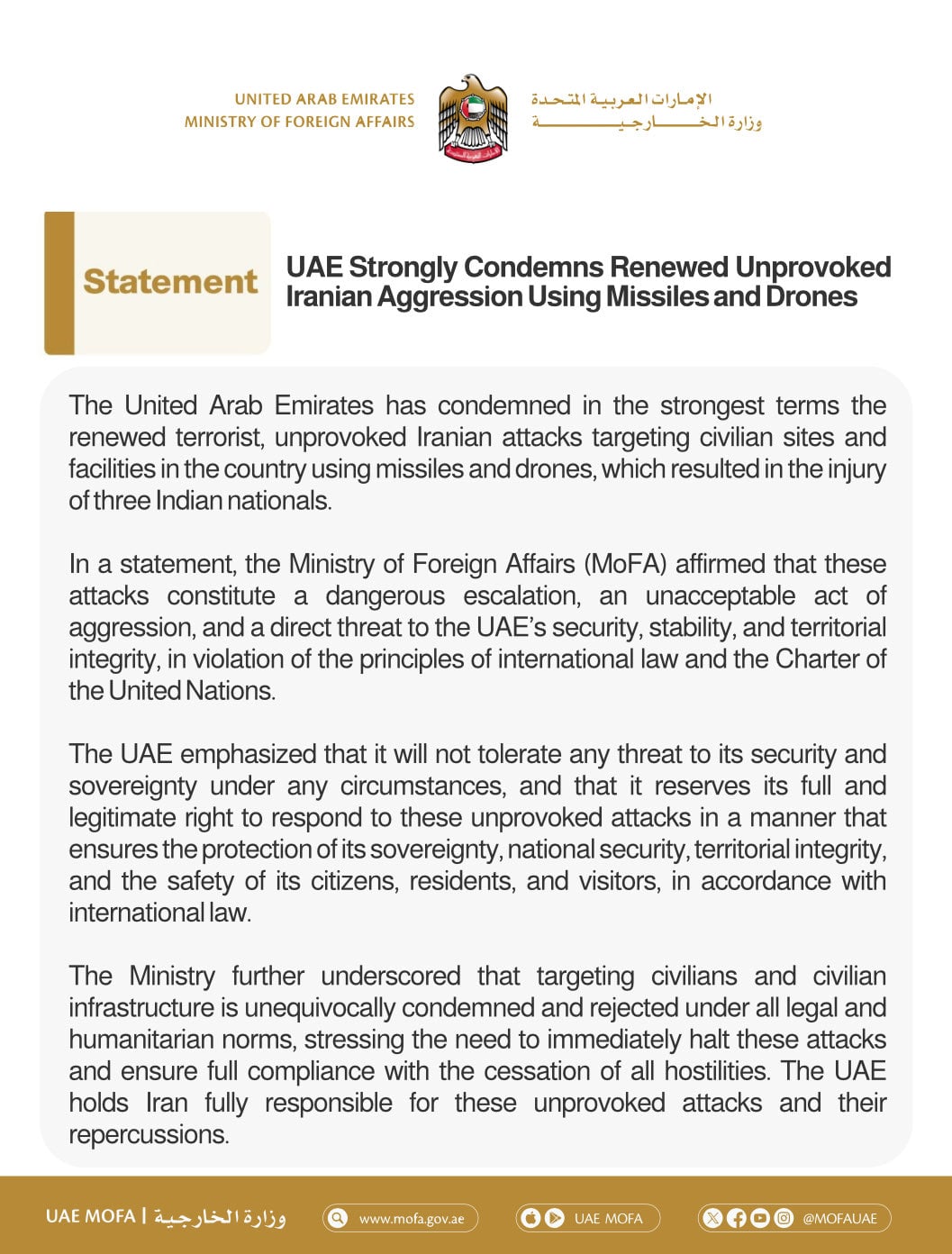
On May 4, 2026, tensions escalated sharply as the UAE announced it had intercepted a wave of missiles and drones launched from Iran. This included 12 ballistic missiles, three cruise missiles, and four drones. One of the drones managed to breach defenses and hit the Fujairah Petroleum Industries Zone, causing a significant fire and injuring three Indian nationals. Emirati officials labeled the attack as unprovoked aggression targeting civilian and economic infrastructure, while Iran’s Islamic Revolutionary Guard Corps denied any involvement, claiming no such operation took place.
The strikes, which were followed by more attacks the next day, sparked a swift and unusually united international outcry. Leaders from Riyadh to Berlin, and Islamabad to Ottawa, condemned the actions as unjustified, unacceptable, and a blatant violation of sovereignty and international law. Interestingly, even Iranian President Masoud Pezeshkian reportedly referred to the incident as “madness,” highlighting rare internal discord in Tehran and underscoring how this escalation has left Iran feeling increasingly isolated on the world stage.
The UAE also revealed that a broad cross-section of global leaders personally reached out to express solidarity, underscoring the depth of international concern. Among them was Israeli Prime Minister Benjamin Netanyahu, who joined other heads of government in directly contacting the Emirati leadership to condemn the attacks. These calls were not merely symbolic—they reflected a widening diplomatic consensus that the targeting of the UAE had crossed a line the world is not prepared to ignore.
Below is a detailed compilation of official condemnation statements and reactions from world leaders, governments, and foreign officials, drawn from verified reports as of May 6, 2026.
Middle East: Gulf Unity and Strongest Terms Condemnation
Saudi Arabia (Riyadh) Saudi Crown Prince Mohammed bin Salman, in a phone call with UAE President Sheikh Mohamed bin Zayed Al Nahyan, expressed the Kingdom’s “strong condemnation and denunciation of the unjustified Iranian aggressions” targeting the UAE. He reaffirmed full support for the UAE’s security, stability, and sovereignty.
HH Sheikh Mohamed bin Zayed Al Nahyan received a phone call from His Royal Highness Prince Mohammed bin Salman bin Abdulaziz Al Saud, CP and PM of Saudi Arabia, during which he condemned the Iranian terrorist attacks and affirmed Saudi Arabia's solidarity with the UAE. pic.twitter.com/Eg9aOR4IAN
— Emirates News (@Emirates_News) May 5, 2026
Separately, the Saudi Foreign Ministry condemned the attacks “in the strongest terms,” calling them violations of international law and urging Iran to “halt its attacks, abide by the principles of international law… and respect the principle of being a good neighbor.”
???? BREAKING: Saudi Arabia’s Foreign Ministry condemns in the “strongest terms” the Iranian attacks on civilian and economic facilities in the UAE, including a tanker affiliated with an Emirati company. pic.twitter.com/l3ZeDKT9Tz
— Al Arabiya English (@AlArabiya_Eng) May 4, 2026
Other Gulf & Arab Leaders
- Egypt’s President Abdel Fattah El Sisi, Jordan’s King Abdullah II, Bahrain’s King Hamad bin Isa Al Khalifa, and Qatar’s Emir Tamim bin Hamad Al Thani all condemned the strikes as “violations of sovereignty and international law,” offering full support for UAE defensive measures.
Statement | Qatar Strongly Condemns Targeting of UAE ADNOC Tanker while Transiting Strait of Hormuz
Doha | May 04, 2026
The State of Qatar strongly condemns the Iranian attack that targeted an Emirati tanker operated by Abu Dhabi National Oil Company (ADNOC), which was struck… pic.twitter.com/mqZ5mt3lyd
— Ministry of Foreign Affairs – Qatar (@MofaQatar_EN) May 4, 2026
Europe: “Stop Holding the World Hostage”
Germany (Berlin) Chancellor Friedrich Merz strongly condemned the attacks, stating: “We strongly condemn these attacks. Our solidarity is with the people of the United Arab Emirates and our partners in the region.” He urged Iran to “return to the negotiating table” and stop “holding the region and the world hostage.”
The United Arab Emirates has once again been the target of Iranian drone and missile attacks. We strongly condemn these attacks. Our solidarity is with the people of the United Arab Emirates and our partners in the region.
— Bundeskanzler Friedrich Merz (@bundeskanzler) May 4, 2026
France: President Emmanuel Macron condemned the “unjustified” Iranian strikes.
Iran’s attack on the UAE draws sharp global condemnation.
Donald Trump, Ursula von der Leyen, Emmanuel Macron, Giorgia Meloni, Mohammed bin Salman, other Gulf leaders and the United Nations warn of threats to regional stability and global energy flows.https://t.co/kRIwbgdR1V— The Thursday Times (@thursday_times) May 4, 2026
European Union European Commission President Ursula von der Leyen declared the attacks “unacceptable and constitute a clear violation of sovereignty and international law.” She pledged continued work with partners on de-escalation and diplomatic resolution.
Today, our partner, the UAE, was once again the target of a vicious missiles and drone attacks originating from Iran.
I extend my full solidarity to @MohamedBinZayed, the people of the UAE, and our partners across the Middle East.
These attacks are unacceptable and constitute a…
— Ursula von der Leyen (@vonderleyen) May 4, 2026
Multiple governments, including the UK, have echoed calls for immediate de-escalation and respect for international law.
UK PM Keir Starmer:
“The UK condemns the drone and missile strikes targeting the United Arab Emirates.
As I set out during my visit to the region last month, stability in the Gulf directly affects the UK.
We stand in solidarity with the UAE and will continue to support the… pic.twitter.com/n2iSVSn6s3
— Open Source Intel (@Osint613) May 5, 2026
South Asia: Solidarity with UAE and Concern for Nationals
Pakistan (Islamabad) Prime Minister Shehbaz Sharif stated: “Pakistan strongly condemns the missile and drone attacks on civilian infrastructure in the United Arab Emirates last night.” He expressed “full solidarity with our Emirati brothers and sisters” and called for upholding the ceasefire to enable diplomacy and lasting peace.
Pakistan strongly condemns the missile and drone attacks on civilian infrastructure in the United Arab Emirates last night. I express full solidarity with His Highness @MohamedBinZayed. Pakistan stands firmly with our Emirati brothers and sisters as well as with the Government of…
— Shehbaz Sharif (@CMShehbaz) May 5, 2026
India (New Delhi) Prime Minister Narendra Modi strongly condemned the strikes, particularly noting the injuries to three Indian nationals. In a post on X, he wrote: “Strongly condemn the attacks on the UAE that resulted in injuries to three Indian nationals. Targeting civilians and infrastructure is unacceptable.” Modi expressed solidarity with the UAE and supported peaceful resolution through dialogue.
Strongly condemn the attacks on the UAE that resulted in injuries to three Indian nationals. Targeting civilians and infrastructure is unacceptable.
India stands in firm solidarity with the UAE and reiterates its support for the peaceful resolution of all issues through…
— Narendra Modi (@narendramodi) May 5, 2026
North America: Unprovoked Aggression Must End
Canada (Ottawa) Prime Minister Mark Carney issued a strong statement: “Canada strongly condemns Iran’s unprovoked missile and drone strikes on the United Arab Emirates and stands in solidarity with its people. We commend efforts to protect civilians and civilian infrastructure and reiterate our call for de-escalation and diplomacy in the region.”
Canada strongly condemns Iran’s unprovoked missile and drone attacks on the United Arab Emirates.
We stand in solidarity with @MohamedBinZayed and the people of the United Arab Emirates and commend defensive efforts to protect civilians and civilian infrastructure.
Canada…
— Mark Carney (@MarkJCarney) May 4, 2026
Iran’s Internal Reaction: President Calls It “Madness”
In a reported clash with the IRGC leadership, Iranian President Masoud Pezeshkian described the strikes as “madness” and “completely irresponsible.” Sources indicate he was kept in the dark about the operation and demanded an emergency meeting with Supreme Leader Ayatollah Ali Khamenei to halt further escalation, warning of “irreversible consequences” for the region.
Iranian Presidential Backlash Over Unauthorized Regional Strikes
Iranian President Masoud Pezeshkian angered with IRGC Commander Ahmad Vahidi over recent attacks in the Strait of Hormuz, the UAE, and Oman, which were allegedly conducted without prior government approval.
The… pic.twitter.com/8IzLtOPjt6
— ME24 – Middle East 24 (@MiddleEast_24) May 5, 2026
The global response is remarkably unified across ideological and geographic lines. From Gulf monarchies to Western democracies and South Asian partners, the message is clear: attacks on civilian infrastructure and attempts to weaponize critical waterways like the Strait of Hormuz are intolerable. The involvement of Indian nationals in the casualties has drawn particular attention from New Delhi, while Pakistan’s mediation role adds weight to its call for ceasefire adherence.
UAE presidential advisor Anwar Gargash welcomes Gulf, Arab and international messages of solidarity with the UAE, saying they condemn what he calls a “treacherous Iranian attack” and Iran is responsible for escalating the Arabian Gulf crisis.
ُنُقدر ونُثمن رسائل التضامن الخليجية والعربية والدولية مع الإمارات، والتي تستنكر وتدين الهجوم الإيراني الغاشم، وتعكس تمسك المجتمع الدولي بنظام قائم على القيم والمسؤولية، يرفض التصرفات المارقة ويعزل مرتكبيها.
وتؤكد هذه المواقف أن إيران هي الطرف المعتدي، والمسؤولة عن تفاقم الأزمة…
— د. أنور قرقاش (@AnwarGargash) May 5, 2026
The world stands united in condemning Iran’s actions—described by leaders as treacherous, vicious, and completely irresponsible. Even Tehran’s own president appears to agree it was an act of madness.
What this episode ultimately highlights is the lasting significance of coming together as a collective. When the world unites in a single voice, it strengthens the principles that support international order. While that unity alone doesn’t solve the conflict, it sets the groundwork for any potential resolution. It draws a clear boundary—not just around the UAE, but around the idea that some actions simply cannot be overlooked or justified.
The way ahead may be unclear, but the direction is unmistakable. Escalating tensions could deepen instability, whereas exercising restraint—though challenging—keeps the door open for a negotiated solution. By standing with the UAE, the global community has not only denounced an attack; it has also reaffirmed a wider commitment to stability, legality, and the delicate yet vital quest for peace.