
UK Recognizes Palestine, but Most Britons Remain Undecided
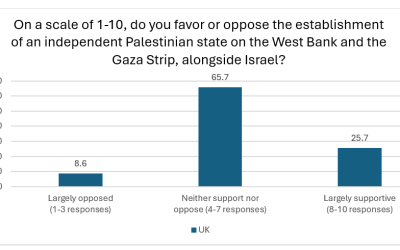
With Prime Minister Keir Starmer announcing today that the U.K. officially recognizes a Palestinian state, it is worth examining what the British public thinks. A national survey we conducted on U.K. Christians’ attitudes toward the Gaza war shows that most respondents (66%) neither support nor oppose the creation of a Palestinian state alongside Israel.
The Christian Attitudes Survey was carried out online from December 9 to 23, 2024, with 2,062 adult respondents. At a 95% confidence level, the margin of error is ±3%. The findings demonstrate that a majority of British Christians remain neutral on this issue. About a quarter support Palestinian statehood, while only 7% oppose it. These numbers illustrate why today’s recognition by the government may not face strong domestic backlash.
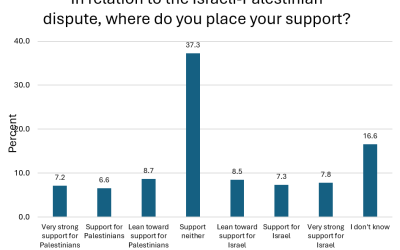
When asked to choose between supporting Israel or the Palestinians, more than half of respondents again selected a neutral stance — either supporting neither or saying “I don’t know.” The remainder split almost evenly between backing Israel and the Palestinians.
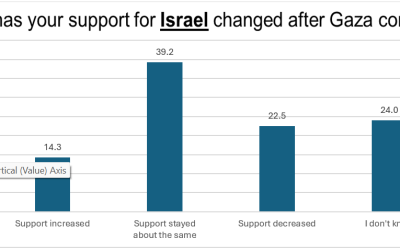
The sights of war and the constant coverage of it may have an emotional impact and change opinions. Fourteen months into the conflict, media coverage and stark images from Gaza appear to have had only a modest impact on opinions. Roughly 40% said their attitudes toward Israel had not changed, and another 25% said they did not know. Among those reporting a shift, more respondents said their support for Israel had decreased than increased — by about 10 percentage points. This indicates that the prolongation of the war has gradually eroded sympathy for Israel.
Historical context also shapes the discussion. The Palestinian ambassador to London recently described the British recognition of Palestinian statehood as a “historical correction” to the 1917 Balfour Declaration, which affirmed Britain’s support for a Jewish homeland. To test whether Britons agree, we asked if they felt the British Empire bears responsibility for today’s conflict. Only one-third agreed, suggesting that historical guilt does not significantly influence public opinion.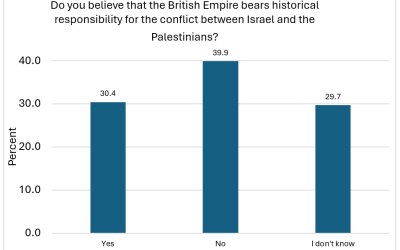
Overall, the study shows that most Britons do not take a firm side: they neither strongly support nor strongly oppose either party in the conflict, and few feel a direct colonial responsibility. Yet the survey demonstrated that attitudes toward Israel have been shifting negatively, a trend likely to continue if the war drags on.
With most Britons undecided on Palestinian statehood, the government can move diplomatically without facing significant domestic resistance. Recognition of Palestine is not universally popular — but critically, it is not widely opposed either. The trend of declining sympathy for Israel does not yet translate into clear support for the Palestinians, as we see in Ireland or Spain, but it signals that U.K. public opinion may slowly be moving away from Israel. In short, the U.K. government’s decision to recognize a Palestinian state rests on relatively safe political ground.
—
The op-ed is co authored by Motti Inbari (UNC Pembroke) and Kirill Bumin (Boston University)