NAnews - Nikk.Agency Israel News
Ukraine, Israel, and the Conflict of Two Traumas: When Memory Becomes a Weapon
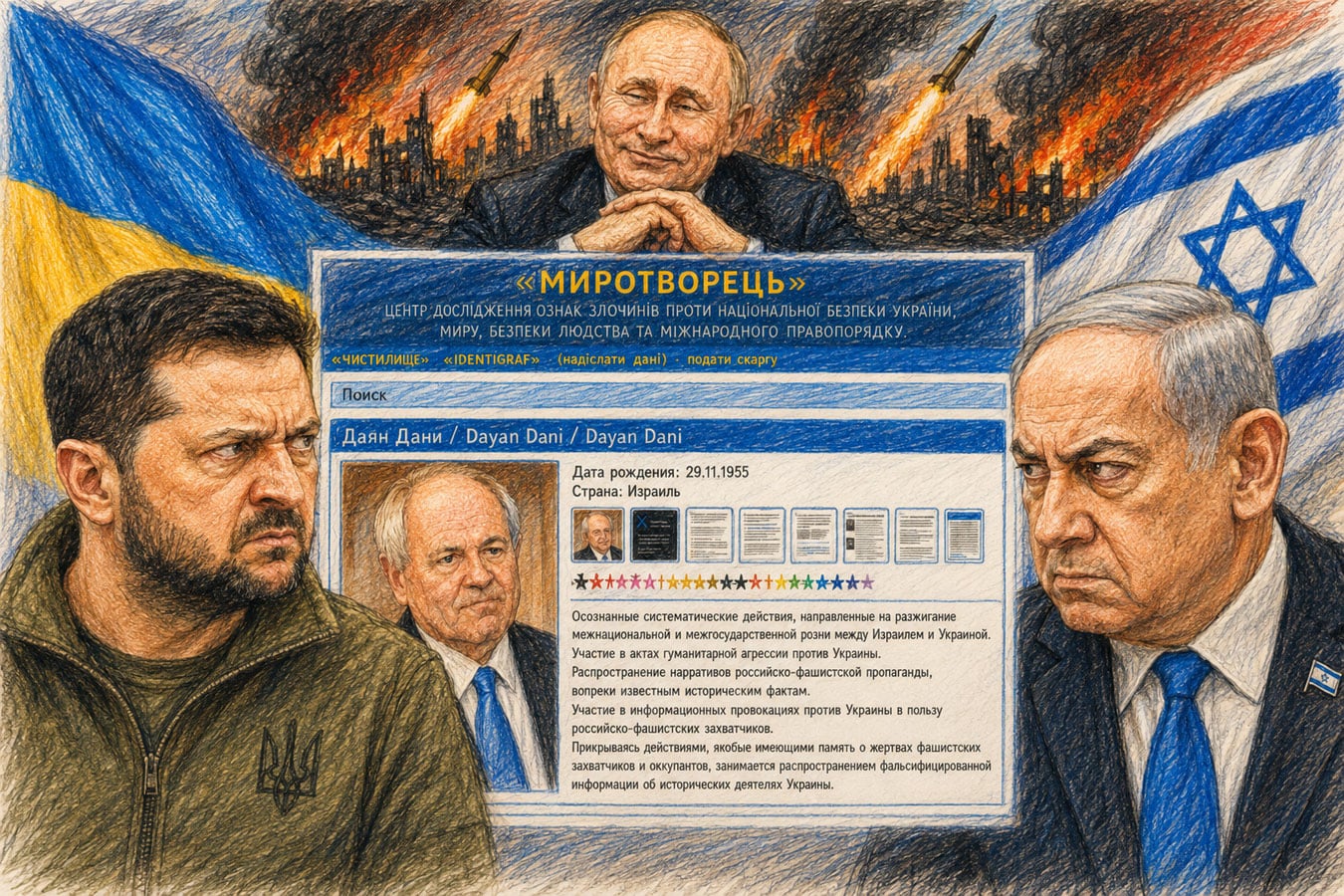
Ukraine, Israel, and the Conflict of Two Traumas: When Memory Becomes a Weapon. The image was created using AI.
This is not just a dispute about Andriy Melnyk.
It is not only about Yad Vashem.
And it is not only about the Ukrainian website Myrotvorets placing Dani Dayan, the chairman of Yad Vashem, into its database after Yad Vashem and Israel’s Foreign Ministry criticized Ukraine’s state reburial of Andriy Melnyk and his wife, Sofia Fedak-Melnyk.
This story is bigger than one ceremony, one statement, or one controversial historical figure.
It is a conflict of two traumas.
Ukraine speaks from its own pain: war, Russian missiles, occupation, destroyed cities, and decades of Soviet and Russian propaganda that tried to describe almost every Ukrainian struggle for independence as “Nazism.”
Israel speaks from its own pain: the Holocaust, the destroyed Jewish communities of Eastern Europe, the memory of millions of murdered Jews, and the deep sensitivity to state honors granted to figures connected with the era of the Second World War.
Both traumas are real.
That is exactly why this story cannot be reduced to a primitive formula: “Ukraine is right and Israel is wrong,” or “Israel is right and Ukraine is wrong.”
The real question is harder: can Ukraine and Israel speak about the most painful chapters of history without allowing Russia to turn memory into another weapon of war?
What Myrotvorets Wrote
On the Myrotvorets page, the inclusion of Dani Dayan is explained with an extremely harsh accusation: “conscious systematic actions aimed at inciting interethnic and interstate hostility between Israel and Ukraine.”
The page also accuses him of participating in “acts of humanitarian aggression against Ukraine,” spreading “Russian-fascist propaganda narratives,” and participating in information provocations against Ukraine.
The reason for this, according to the page, was Yad Vashem’s reaction to the reburial of Andriy Melnyk.
Myrotvorets quotes the episode as follows:
“On 25.05.2026, during the reburial of the remains of the leader of the Organization of Ukrainian Nationalists, Andriy Melnyk,
❗️who during the Second World War protected Jews from fascists and pogroms, ❗️
and his wife Sofia Fedak-Melnyk, Yad Vashem commented on this event as follows: ‘The reinterment of Andriy Melnyk for a state burial in Ukraine raises serious concerns. Honoring the leader of a movement that supported and collaborated with Nazi Germany during the persecution and murder of millions of Jews undermines the moral integrity essential to Holocaust remembrance.’”
That quote is important.
Not because it settles the historical debate. It does not.
It is important because it shows that the dispute is not only about today’s ceremony. It is also about the very historical framing of Melnyk.
For the authors of the Myrotvorets page, Melnyk is presented as a Ukrainian figure unfairly demonized through a Soviet-Russian lens.
For Yad Vashem, the central issue is different: the connection between the Organization of Ukrainian Nationalists, Nazi Germany, the political context of World War II, and the fate of Jews during the Holocaust.
This is where two historical memories collide directly.
The Ukrainian frame says: we cannot surrender our memory to Soviet and Russian propaganda.
The Israeli frame says: we cannot remove the Holocaust and the responsibility of wartime movements from the conversation.
Both frames have reasons behind them.
The problem begins when one side demands that the other fully accept its frame.
Where Yad Vashem Had a Point — and Where It Needed More Precision
Yad Vashem had every right to speak.
More than that, Yad Vashem has a duty to speak when Holocaust memory is involved.
For Israel and for the Jewish people, the Holocaust is not an abstract historical topic. It is not a diplomatic accessory. It is not a political instrument. It is the central trauma of Jewish modern history.
So when state honors are given to a figure whom Israeli memory connects with nationalist movements of the World War II era and with the painful history of Jewish persecution, Yad Vashem is almost certain to respond.
That response was understandable.
But the right to speak does not remove the responsibility to choose language carefully.
There is a difference between saying: “For Jewish memory, the figure of Andriy Melnyk remains deeply painful and requires serious historical discussion,” and saying it in a way that can be perceived in Ukraine as a public moral verdict on the country’s internal policy of memory.
Yad Vashem could have framed its statement differently.
It could have said: Ukraine has the sovereign right to shape its national pantheon, but Jewish memory has serious concerns about figures connected with nationalist movements of the World War II era.
It could have called for a joint historical dialogue between Ukrainian and Israeli scholars.
It could have recognized that Ukrainian history cannot be reduced to Soviet or Russian propaganda, while still insisting that Holocaust memory cannot be ignored.
That would have been a stronger statement, not a weaker one.
It would have defended Holocaust memory without sounding as if Israel was instructing Ukraine on whom it may or may not rebury with honors.
This distinction matters.
Because today Ukraine is at war with Russia. And in this war, history is not merely history. Russia uses it as a weapon. Every word about “Nazism,” “collaboration,” or the OUN is immediately taken by Russian propaganda and placed into its own machinery.
That does not mean Israel should remain silent.
It means that every word must be precise.
Where the Ukrainian Response Went Wrong
The response through Myrotvorets did not fix the problem.
It deepened it.
Myrotvorets is not an official state registry of Ukraine. It is a non-governmental website that presents itself as a center for researching elements of crimes against Ukraine’s national security, peace, humanity, and international law.
But outside Ukraine, such distinctions are often lost.
For an Israeli, American, or European reader, the phrase “the chairman of Yad Vashem was placed in a Ukrainian database” does not sound like a technical detail about a non-governmental project.
It sounds like a political signal.
And that signal was damaging.
If the goal was to show Israel that the Ukrainian memory of Melnyk cannot be reduced to Soviet-Russian propaganda, then the answer should have been built on facts, historical context, scholarship, and respect for the sensitivity of Jewish memory.
Instead, the language of accusation appeared.
And when such language is directed at the chairman of Yad Vashem, it is almost inevitably perceived in Israel not as a defense of Ukrainian memory, but as an attack on one of the most sensitive institutions of Jewish remembrance.
Ukraine had the right to disagree with Yad Vashem.
But it needed a better answer.
Who Is Dani Dayan?
Dani Dayan is not a random commentator.
He was born in Buenos Aires in 1955, immigrated to Israel, became a businessman, later became a prominent figure in the Israeli right, and served as chairman of the Yesha Council.
He was also Israel’s consul general in New York from 2016 to 2020.
Since 2021, he has served as chairman of Yad Vashem.
There is also a political connection to Benjamin Netanyahu. In 2015, Netanyahu promoted Dayan for the post of Israeli ambassador to Brazil. Brazil did not approve the appointment because of Dayan’s settlement background, and Dayan was later appointed consul general in New York.
This is a real political-diplomatic connection to the Israeli right.
But it is not evidence of any connection to Russia.
That is why accusing Dayan of spreading Russian narratives is weak.
His position on Melnyk comes primarily from the Israeli and Jewish memory of the Holocaust, not from Moscow.
This memory may be incomplete in its understanding of Ukraine.
It may not fully grasp the anti-Soviet dimension of Ukrainian history, the experience of political exile, or the current war against Russia.
But it does not automatically become a Kremlin narrative simply because Russia also exploits the subject of the OUN against Ukraine.
A shared topic is not the same as a shared motive.
The Conflict of Two Traumas
Ukraine speaks from the trauma of war.
From destroyed cities.
From occupation.
From Russian missiles.
From mass crimes.
From the long Soviet and Russian attempt to portray Ukrainian statehood as a “Nazi project.”
Israel speaks from another trauma.
From the Holocaust.
From the memory of millions of murdered Jews.
From Eastern Europe, where Jewish communities disappeared from entire towns and regions.
From the painful sensitivity to any state honors given to figures connected with the era of Nazi Germany.
Both traumas are real.
But when one trauma speaks as if the other does not exist, dialogue becomes almost impossible.
Yad Vashem spoke from the memory of the Holocaust, but it did not sufficiently account for the Ukrainian context of war and Russia’s weaponization of history.
Myrotvorets responded from the pain of Ukraine’s struggle against Russian historical falsification, but it did not sufficiently account for what Yad Vashem represents in Israel and the Jewish world.
The result was not dialogue.
It was escalation.
How Russia Benefits
This is the most dangerous part of the story.
Yad Vashem gave Russian propaganda the first part of the picture: Israel condemns Ukraine for honoring Andriy Melnyk.
Myrotvorets gave it the second part: a Ukrainian resource places the chairman of Yad Vashem in a database as a person acting against Ukraine.
For Moscow, this is an ideal package.
It can tell the outside world: Israel accuses Ukraine of honoring a Nazi collaborator, and Ukraine responds by attacking the Holocaust memorial.
After that, nuance is no longer needed.
The complex history of the OUN is not needed.
The context of Soviet repression is not needed.
The difference between the Ukrainian state and a non-governmental website is not needed.
The Holocaust as a living trauma of Israel is not needed.
The war of Russia against Ukraine is not needed.
Russia needs only the picture.
And the picture can be turned into a weapon.
That is why this conversation matters so much for both Israeli and Ukrainian audiences.
What Ukraine Could Have Said
Ukraine did not need to remain silent.
It also did not need to abandon its history because Russia has spent decades trying to steal Ukraine’s right to its own memory.
But Ukraine could have answered differently.
It could have said: we do not accept the Soviet and Russian frame of the Ukrainian national movement.
It could have explained that the reburial of Melnyk is seen in Ukraine as part of a broader policy of returning historical figures to the national pantheon.
It could have emphasized that Ukrainian history in the twentieth century cannot be reduced to Soviet labels.
At the same time, it could have acknowledged that for Israel and the Jewish world, the Holocaust remains a central trauma, and any figure connected to the World War II era requires especially careful language.
The best response would have been an expert conversation: Ukrainian historians, Israeli historians, archives, documents, different perspectives, and no slogans.
That would have been a strong position.
A mature position does not fear hard questions.
It explains.
What Israel Could Have Said
Israel, too, could have chosen a more precise language.
It could have said: we do not interfere with Ukraine’s right to shape its national pantheon, but we believe it is necessary to raise painful questions connected with Holocaust memory.
It could have recognized that Ukrainian history cannot be reduced to Soviet-Russian narratives.
It could have acknowledged that Ukraine is fighting a defensive war against Russia and that this context cannot be ignored.
It could have offered historical dialogue rather than political condemnation.
This would not have made Yad Vashem weaker.
It would have made its message stronger.
Because moral precision is not only the right to speak about Jewish pain. It is also the ability to avoid turning another nation’s memory into an object of external instruction.
Ukraine should not tell Israel how to remember the Holocaust.
But Israel should not speak to Ukraine as if Ukrainian memory exists only within the limits of Israeli historical judgment.
The Real Lesson
This story is not about the victory of one side over another.
It is about the failure of the language of memory.
Yad Vashem had reasons to raise the painful Jewish historical dimension of the OUN and Andriy Melnyk.
Ukraine had reasons to react painfully to language that, during a war against Russia, easily fits into Moscow’s propaganda frame.
But then both sides took steps that did not bring the conversation closer. They pushed it into a public crisis.
Ukraine is not obliged to abandon its historical pantheon because of external criticism.
Israel is not obliged to remain silent when Holocaust memory is involved.
But if these two positions are expressed without respect for each other’s context, a dispute about the past becomes not a historical dialogue but a political crisis — one that Russia immediately exploits.
That is why this matters.
Not only for Ukraine.
Not only for Israel.
And not only for the memory of Andriy Melnyk or the role of Dani Dayan.
It matters because Russia understands very well how to weaponize memory. It can take one Israeli statement, one Ukrainian reaction, one painful historical figure, and turn all of it into a tool against both countries.
The challenge for Ukraine and Israel is not to erase their differences.
The challenge is to speak about the most difficult things without allowing Moscow to turn memory into another weapon of war.
And this is exactly what we need to keep discussing with each other.
Related Topics
Related Posts