NAnews - Nikk.Agency Israel News
Ukraine’s 2,000-Hryvnia Note: Ukrainian Poet Stus, a Jewish Prisoner and Israel
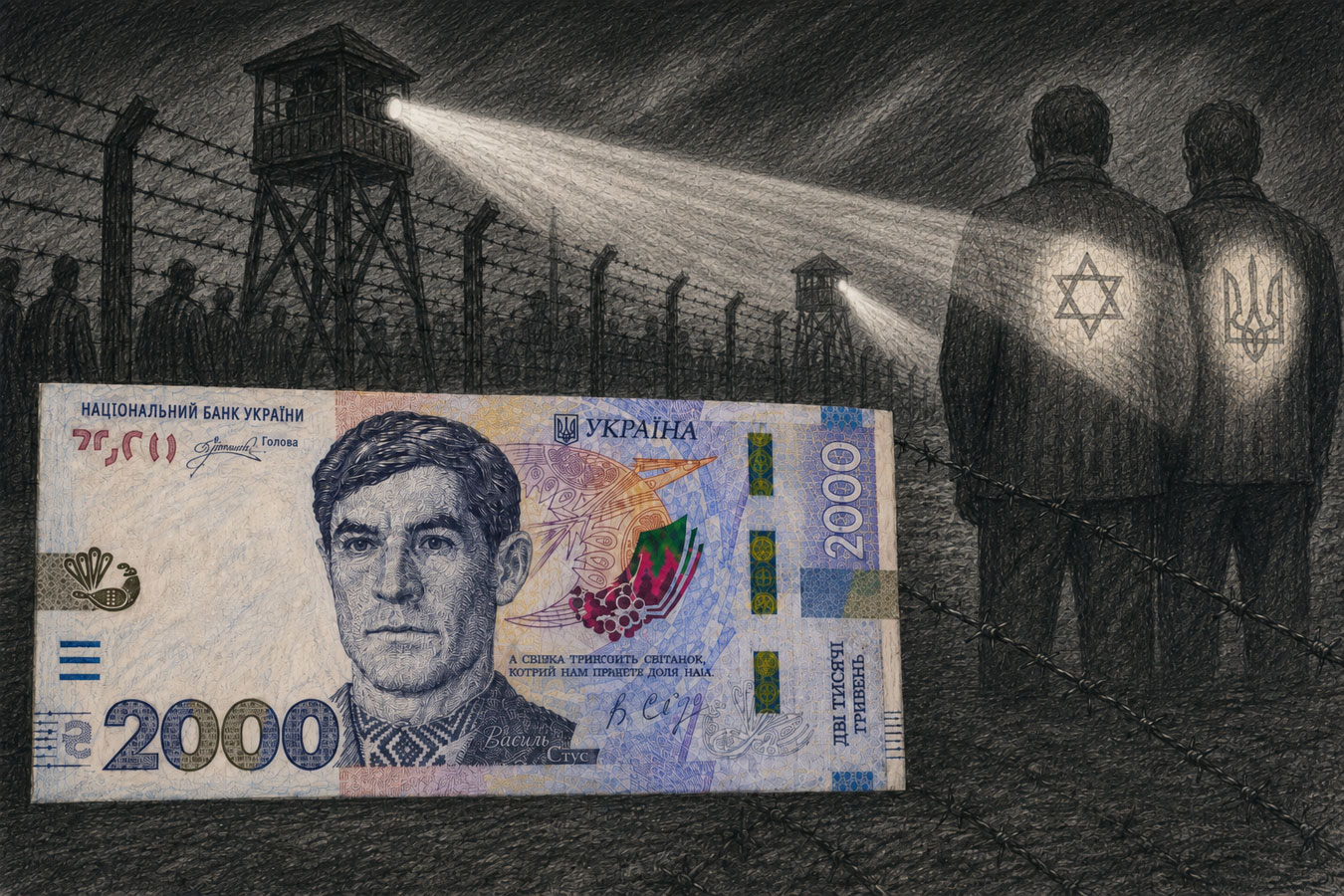
Ukraine’s New 2,000-Hryvnia Note: Vasyl Stus, the Jewish Prisoner Who Saved His Poems, and the Israeli Connection. The image was created using AI.
On September 4, 2026, Ukraine will introduce a new 2,000-hryvnia banknote into circulation, worth roughly NIS 130. Its face will bear the portrait of Vasyl Stus — one of the most important Ukrainian poets of the 20th century, a dissident, human-rights activist and Soviet political prisoner who died in a labor camp in 1985.
The obvious conversation around the new note has already begun: inflation, rising prices, why Ukraine needs a 2,000-hryvnia denomination at all, and why now.
But if we stop at the economics, we miss one of the most remarkable parts of the story.
When Soviet camp authorities confiscated a notebook containing Stus’s poems and later announced that it had been destroyed, some of those poems survived in the memory of another prisoner. His name was Mikhail Heifetz. He was Jewish, a Leningrad literary critic and writer, and himself a political prisoner.
Heifetz later immigrated to Israel, lived in Jerusalem and continued writing about the people he had met behind Soviet barbed wire.
That is where Ukraine’s new banknote acquires an Israeli story — one that is not printed anywhere on the note itself.
Why does Ukraine need a 2,000-hryvnia banknote?
The economic explanation should not be avoided.
Since Ukraine introduced the 1,000-hryvnia banknote in 2019, the average monthly wage, according to the National Bank of Ukraine, has roughly tripled, while the overall price level has approximately doubled.
The amount of cash in circulation has also changed dramatically. In 2019, Ukraine had around 390 billion hryvnias in cash circulation. By July 1, 2026, the figure had risen to more than 970 billion.
Another number is even more revealing: 1,000-hryvnia notes now account for more than 55 percent of the total value of all banknotes in circulation.
So the appearance of the next large denomination is hardly mysterious. Inflation is clearly part of the explanation — the central bank itself points to the rise in prices — but the popular formula “the currency lost value, so they simply printed a bigger note” misses much of what is happening.
Introducing a higher denomination does not, by itself, create more money. The new notes will replace part of the cash already circulating or be issued against non-cash funds. What changes is the structure of the physical currency.
There is also a specifically wartime Ukrainian reality.
Bank cards work wonderfully until electricity, communications or payment terminals disappear after a Russian attack. Cash does not depend on a mobile signal or a functioning power grid. For millions of Ukrainians, it remains a practical backup system.
At the same time, Ukraine is an overwhelmingly cashless economy in everyday retail use: according to the National Bank, roughly 96 out of every 100 card transactions are conducted without withdrawing cash.
But the economics tell us only why Ukraine wants a larger banknote.
They do not explain why the country chose Vasyl Stus to appear on it.
Who was Vasyl Stus?
Vasyl Stus was born on January 6, 1938, in Ukraine’s Vinnytsia region, but he grew up in the Donbas. His family moved to Stalino — today’s Donetsk — when he was a child.
He studied history and philology, worked as a teacher and literary editor, and translated European writers including Rainer Maria Rilke and Johann Wolfgang von Goethe.
Yet Stus occupies a place in Ukrainian history that goes far beyond literature.
He belonged to the generation known as the Sixtiers — Ukrainian writers, artists and intellectuals who emerged during the relative liberalization of the Khrushchev era and tried to reclaim cultural space for the Ukrainian language, literature and historical memory after decades of Soviet repression.
For Stus, cultural resistance eventually became political resistance.
On September 4, 1965, a premiere of Sergei Parajanov’s Shadows of Forgotten Ancestors was being held at the Ukraina cinema in Kyiv. During the screening, literary critic Ivan Dziuba informed the audience about a new wave of arrests targeting Ukrainian intellectuals.
Vyacheslav Chornovil and Vasyl Stus joined the protest.
It was an extraordinary act in the Soviet Union: people publicly challenging political repression in a crowded cinema.
Stus paid for it.
He was expelled from postgraduate study, increasingly prevented from publishing and pushed to the margins of professional life. In 1972 he was arrested and convicted of “anti-Soviet agitation and propaganda.”
After imprisonment and exile, he returned to Kyiv and joined the Ukrainian Helsinki Group, which documented Soviet violations of the human-rights commitments Moscow itself had signed.
He was arrested again.
In 1980, Stus was sentenced to ten years in a special-regime labor camp followed by five years of internal exile.
He never completed that sentence.
On September 4, 1985, Vasyl Stus died in the Perm-36 camp system. He was 47.
After the Soviet Union collapsed, his work returned openly to Ukrainian cultural life. He became one of the defining figures of Ukrainian dissent and a symbol of resistance to Soviet political repression and Russification.
Now his face is going onto Ukrainian money.
Why Stus?
In choosing a figure for the new denomination, the National Bank consulted historians, Ukraine’s Ministry of Culture, the Ukrainian Institute of National Memory and the Institute of History of the National Academy of Sciences.
Stus’s name appeared among proposals from several institutions.
The National Bank’s board eventually supported his candidacy unanimously.
The symbolism began even before the banknote itself was designed. The decision to develop the new note was taken on January 6, 2026 — Stus’s birthday.
Its release date is even more deliberate.
September 4, 1965: Stus joins the public protest at the Ukraina cinema.
September 4, 1985: Stus dies in a Soviet labor camp.
September 4, 2026: independent Ukraine places his portrait into circulation on the highest-denomination banknote in the country.
It is difficult to imagine a more deliberate historical arc.
What the new 2,000-hryvnia note looks like
The banknote is predominantly blue and measures 75 by 166 millimeters.
On the front is the portrait of Vasyl Stus. But the design surrounding him is meant to evoke more than one man.
Elements of the note draw on Ukrainian modernism and the culture of the Sixtiers. One important visual source is the art of Alla Horska, the Ukrainian monumental artist and dissident associated with the same generation.
Among the motifs is the kestrel — boriviter in Ukrainian — inspired by Horska’s mosaic art. The National Bank presents the bird as an image of endurance against a powerful opposing current, an unusually fitting metaphor for Stus himself.
The banknote also carries a line from a poem Stus wrote while imprisoned:
“And the candle trembles like a dawn that our great-grandchild will one day call daylight.”
Other graphic elements refer to Heorhiy Narbut, the artist who helped create the visual language of the first modern Ukrainian state currency during the era of the Ukrainian People’s Republic.
In this way, the banknote quietly connects several periods of Ukrainian history: the early 20th-century struggle for statehood, the cultural resistance of the 1960s and 1970s, and independent Ukraine today.
The reverse shows a building associated with the university in Donetsk where Stus studied.
That detail matters as well.
A man deeply rooted in Donetsk and the Donbas — and simultaneously one of the clearest symbols of Ukrainian-language culture and resistance to Russification — sits rather awkwardly with the Russian propaganda narrative that the region somehow lacked a Ukrainian cultural history before Moscow arrived to “protect” it.
More than 20 security features
The new 2,000-hryvnia note is also technologically ambitious.
The National Bank says it contains more than 20 security elements.
These include a multi-tone watermark depicting Stus, a separate light watermark showing the denomination, tactile elements intended to assist visually impaired people, microprinting and features designed for verification using ultraviolet and infrared equipment.
An optically variable SPARK element changes appearance as the note is tilted, shifting between purple and a golden-green tone.
The most unusual feature, however, is a blue-and-yellow windowed security thread known as Anima Colour.
Part of the ribbon appears on the surface of the banknote, and when the note is tilted, the Ukrainian trident appears to transform into the hryvnia symbol and back again.
According to the National Bank, the 2,000-hryvnia note will be the first banknote in the world to use this particular type of polychromatic animated Anima Colour security thread.
The banknote was unveiled well before it enters circulation for a practical reason: banks, ATM operators, cash-handling companies and manufacturers of counting equipment need time to teach their machines to recognize it.
But even before mass printing began, the design managed to produce a political controversy.
A banknote honoring a Soviet dissident — and a dispute over a “Russian” font
After the first presentation, Ukrainian type designers noticed that part of the denomination’s lettering resembled an unofficial Cyrillic adaptation of a typeface associated with a Russian designer.
The National Bank said it had not used a ready-made third-party font file and that its artists had drawn the required lettering themselves inside a protected design environment.
From a legal standpoint, the bank said, there was no problem.
Politically and symbolically, however, the argument did not end there.
National Bank Governor Andriy Pyshnyy said that on a banknote dedicated to Vasyl Stus, even an association with the work of a citizen of the aggressor state was unacceptable. The lettering was therefore ordered to be changed before mass production.
The September 4 release date remains unchanged.
There is something almost surreal about the historical contrast.
The Soviet state persecuted Stus for defending Ukrainian culture.
Four decades later, independent Ukraine is debating the provenance of a few letters printed next to his portrait because even the possibility of a Russian association is regarded as inappropriate.
Stus wrote openly against antisemitism
For an Israeli reader, another part of Stus’s biography deserves particular attention.
Discussions of Ukrainian national movements in the 20th century are often forced into one of two simplistic narratives. In one, Ukrainian national identity is treated as inherently antisemitic. In the other, uncomfortable chapters of Ukrainian-Jewish history are polished away altogether.
Stus gives us the luxury of not having to guess what he thought.
He wrote it down himself.
In a letter to Petro Shelest, then the Communist Party leader of Soviet Ukraine, Stus spoke about the need to rid part of Ukrainian society of self-absorption, antisemitism and provincial narrow-mindedness.
At the same time, he demanded that Russians, Jews and members of other communities respect the Ukrainian language, culture and history.
Those ideas were not contradictory for him.
He did not believe that Ukrainians needed to hate Jews in order to defend their own national identity. Nor did he believe that fighting antisemitism required Ukrainians to surrender their claim to their own language and cultural dignity.
Soon enough, that position ceased to be theoretical.
Ukrainian and Jewish dissidents began meeting one another in Soviet prisons.
The “friendship of the trident and the Star of David”
In Mordovian and Perm political camps, the Soviet system assembled people it usually preferred to keep in separate ideological boxes.
There were Ukrainian dissidents and national activists from other Soviet republics.
And there were Jewish prisoners, including refuseniks and Zionist activists who had fought for the right to leave the Soviet Union and move to Israel.
That did not produce instant harmony.
Former prisoners remembered prejudices and stereotypes on both sides. Some Soviet Jews had grown up hearing official propaganda about dangerous “Ukrainian bourgeois nationalists.” Ukrainians had their own inherited ideas about Jews.
The camp forced them to meet actual human beings instead of propaganda caricatures.
Jewish prisoners sometimes embroidered Stars of David onto their camp clothing. Some attempted to maintain Jewish religious practices. Ukrainian prisoners spoke to them about Ukrainian history, language and the reasons they resisted the Soviet system.
One former prisoner would later describe the relationship that emerged as the “friendship of the trident and the Star of David.”
The phrase is beautiful, but it should not be romanticized too far.
The political objectives of the two movements were different. Ukrainians were struggling for national rights and, ultimately, a state of their own. Jews already had such a state: Israel. For many Jewish Soviet activists, the immediate goal was simply to force Moscow to let them leave and go there.
Yet Soviet repression created a very practical solidarity.
Different groups discovered that the same state was punishing all of them for insisting that Moscow did not have the final right to decide who they were.
And this is where Mikhail Heifetz enters the story.
Mikhail Heifetz and the notebook that no longer existed
Mikhail Heifetz was a Leningrad writer and literary critic.
In 1974, Soviet authorities arrested him and sentenced him to four years in a labor camp followed by two years of exile for “anti-Soviet agitation and propaganda.”
In prison, he met Vasyl Stus.
Former political prisoner Vasyl Ovsienko later recalled an episode that says more about the relationship than almost any formal biography could.
During one camp search, the authorities confiscated a notebook containing Stus’s new poems.
Later, the prisoners were told that it had been destroyed because the writings supposedly had no value.
But the texts had disappeared only from the paper.
Heifetz had an exceptional memory.
He brought Ovsienko some written material and then began to dictate poems he remembered.
He reconstructed roughly two dozen of Stus’s poems from memory.
His Ukrainian was imperfect, so the scene became almost absurdly intimate: a Jewish intellectual from Leningrad reciting Ukrainian poems he had memorized, while another Ukrainian prisoner wrote them down and corrected his language as they went.
The camp administration could confiscate a notebook.
Searching another prisoner’s memory was more difficult.
Heifetz preserved more than poems
Heifetz did not stop with memorizing Stus’s work.
He began writing about the Ukrainian political prisoners around him. He left portraits of Stus, Vyacheslav Chornovil, Mykola Rudenko and other figures of Ukrainian resistance.
Those writings later became part of his Ukrainian Silhouettes.
Years later, Vasyl Ovsienko summarized the value of Heifetz’s testimony in a wonderfully simple phrase:
“Thanks to the Jew Heifetz.”
Ukrainian political prisoners, Ovsienko acknowledged, had endured an enormous amount, but they had not always been able to record everything themselves. Heifetz, an outsider to the Ukrainian national movement, documented the people he encountered as individuals.
That makes his testimony particularly interesting.
He did not enter the camp intending to build a Ukrainian pantheon.
He simply met these people.
And then, in 1980, his own road out of the Soviet Union led to Israel.
For NAnews – Israel News, this is where the story becomes particularly relevant to an Israeli audience. The connection between Stus and Israel was not created decades later for commemorative purposes. It grew inside the Soviet prison system itself, where Ukrainian dissidents and Jewish prisoners fighting for the right to reach Israel found themselves behind the same barbed wire.
What happened to Mikhail Heifetz after his release makes that connection even more tangible. He brought his memories of Stus and other Ukrainian political prisoners with him to Israel, continued writing about them in Jerusalem, and became part of a little-known chapter of Ukrainian-Jewish history that began not at diplomatic receptions, but inside Soviet labor camps.
From the Soviet camps to Jerusalem
After completing his exile, Mikhail Heifetz immigrated to Israel.
Here he continued writing about Soviet dissent and Eastern European Jewish history. During the 1980s he worked as a researcher at a center devoted to the study and documentation of East European Jewry at the Hebrew University of Jerusalem.
His interest in Ukraine did not disappear when he crossed the Soviet border.
In Israel, Heifetz was also connected with initiatives promoting Jewish-Ukrainian cooperation. The relationships first formed under the absurd conditions of a Soviet political camp therefore continued in a free society.
Heifetz died in Jerusalem in 2019.
His trajectory was not unique.
A number of Jewish dissidents and Zionist activists who passed through Soviet prisons eventually became part of Israeli public life. Among the best known are Natan Sharansky, Yuli Edelstein and Viktor Brailovsky.
Their individual stories were different, and Jewish and Ukrainian dissident movements should not be collapsed into one movement.
But their members often knew one another personally.
Behind the grand narratives of “Soviet Jews” and “Ukrainian dissidents” were people sharing cells, hunger strikes, scraps of information, poems and memories.
Vasyl Stus was not an “Israeli hero” — and we should not turn him into one
It would be easy to stretch the story too far.
Stus was not a Zionist activist. He was not campaigning for Israel. His political and cultural struggle was first and foremost Ukrainian: the dignity of the individual, Ukrainian language and culture, human rights, and resistance to Soviet repression.
The Israeli connection lies elsewhere.
Jewish dissidents were imprisoned alongside him.
One of them memorized his poems, wrote about him and eventually built a new life in Jerusalem.
That is more interesting than inventing a stronger connection.
It is also more honest.
Ukrainian-Jewish history does not need to be sanitized into a sentimental story of eternal friendship. There were terrible chapters, antisemitism, violence, incompatible memories and genuine historical disputes.
But there was also this chapter.
Two groups that Soviet ideology often taught to distrust one another encountered each other behind barbed wire and, in some cases, chose solidarity instead.
First his poems survived in a man’s memory. Now his face will be printed millions of times
The story of the new 2,000-hryvnia banknote can be compressed very easily.
A new denomination. Vasyl Stus. Blue design. More than 20 security features. September 4.
All of that is true.
But another scene is harder to compress.
A Soviet prison camp. A search. A notebook is taken from a political prisoner.
The authorities later announce that his poems have been destroyed because they are worthless.
Then another prisoner sits down and begins reciting them from memory.
He is Jewish. His name is Mikhail Heifetz.
A few years later, he will be living in Israel.
Stus will never leave his camp alive.
And 41 years after Stus’s death, independent Ukraine will begin printing his portrait on the highest-denomination banknote in the country.
Perhaps that is the most fitting way to understand the new 2,000-hryvnia note.
It is not really a story about money.
It is a story about what a state once tried to erase, what another prisoner refused to forget, and what a later generation chose to place back into public memory.
A notebook could be destroyed. Memory proved much harder to kill.
Related Topics
Related Posts