
Writer covering Israel–Africa, Jewish affairs, and Israel worldwide
Ukraine’s Greatest Gift to Israel Is Not a Weapon, but a Warning
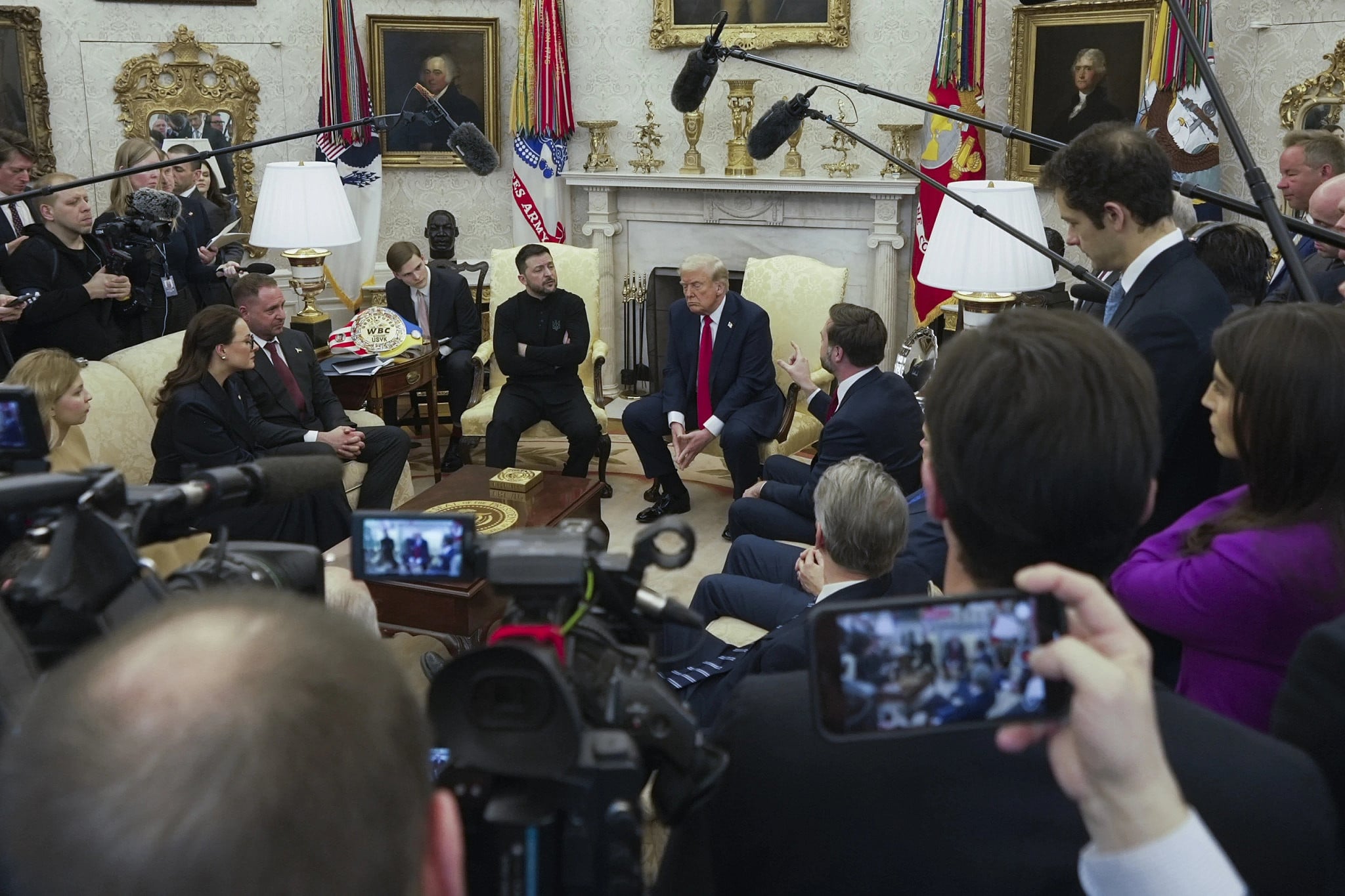
Vice President JD Vance, center right, speaks with Ukrainian President Volodymyr Zelenskyy, center left, as President Donald Trump, center, listens in the Oval Office at the White House, Friday, Feb. 28, 2025, in Washington. (AP Photo/ Mystyslav Chernov)
Every military in the world seems to be studying Ukraine these days. Defense officials arrive eager to learn how Ukrainian drones evade air defenses, how artificial intelligence is reshaping the battlefield, and how a country fighting for its survival became one of the most innovative wartime laboratories on earth.
This is perfectly understandable. Ukraine has demonstrated remarkable ingenuity under pressure. It has adapted faster than many larger and wealthier militaries. It has forced military planners from Washington to Jerusalem to reconsider assumptions about modern warfare. Israel, facing its own growing drone threats from Hezbollah and Iran, has naturally paid close attention. Reports even suggested that Israel sought Ukrainian expertise in countering Iranian drones during the 12 day war.
Everyone seems determined to learn from Ukraine’s drones. Far fewer seem interested in learning from Ukraine’s dependence.
The most important lesson Ukraine offers Israel is not technological. It is political.
For years, Ukraine enjoyed enormous support from the United States. Military aid flowed. Ammunition arrived. Diplomatic backing was strong. American politicians competed with one another to demonstrate solidarity with Kyiv. If one had visited Ukraine during those years, one could have been forgiven for believing that this arrangement was as permanent as gravity.
Then something outrageous happened.
Americans held an election.
Ukraine discovered an uncomfortable truth about democratic allies. They have a habit of remaining democracies.
Governments change. Priorities change. Voters change. Foreign policy changes.
What appeared to be a permanent strategic reality turned out to be a political moment.
This should not have been surprising. American foreign policy is ultimately conducted by Americans. Yet much of the world routinely behaves as though every administration represents the final edition of American politics. Every few years reality arrives to correct this misunderstanding.
The lesson is not that America is uniquely unreliable. Quite the opposite. Every democracy behaves this way. Elections exist precisely because policies are not permanent. The surprise was never that American priorities could change. The surprise was that so many people convinced themselves they could not.
Ukraine paid dearly for that discovery.
To its credit, it adapted. Faced with uncertainty, it innovated. Faced with shortages, it improvised. Faced with the possibility that external support might not always arrive on schedule, it built capabilities of its own. Today, military planners around the world admire Ukrainian innovation. But they often overlook the reason that innovation became necessary in the first place.
Necessity remains the most effective defense contractor in human history.
Israel would be wise to pay attention.
Today, the Jewish state enjoys a relationship with the United States that is stronger than any relationship Ukraine ever possessed. American military assistance has been indispensable. Diplomatic support has often been critical. The alliance remains one of the most important strategic partnerships in the world.
None of this changes the underlying principle.
The existence of a powerful ally is not a strategy.
One of the most dangerous habits Israel faces is confusing an alliance with an insurance policy against reality. The stronger the alliance, the greater the temptation.
Strategic dependence is a bit like borrowing ammunition during a battle. It works brilliantly right up until the moment the supply convoy is delayed. At that point, one discovers the difference between possessing resources and having access to resources. One belongs to you. The other belongs to circumstances.
Israel’s challenge is not that American support is disappearing tomorrow. It isn’t.
The challenge is that there are growing signs that the political environment surrounding that support is changing.
Polls increasingly show negative attitudes toward Israel among younger Americans. Political divisions regarding Israel are becoming more pronounced. Congressional debates that would have been unthinkable a generation ago are now commonplace. Recent votes concerning military assistance demonstrated levels of opposition that would once have been politically unimaginable.
The significance of these developments is frequently misunderstood. They do not mean America is abandoning Israel. They mean America is evolving.
And when a country of 340 million people evolves, wise allies pay attention.
Some Israelis respond to these trends by insisting that the alliance is too strong to be affected. Perhaps they are right. Then again, many people once believed bipartisan support for Ukraine was too strong to be affected.
History contains countless examples of nations mistaking favorable conditions for permanent conditions. Great powers have a tendency to rearrange their priorities with little regard for the assumptions of smaller allies. This is not cruelty. It is simply how international politics works.
None of this means Israel should distance itself from the United States. Such a conclusion would be absurd. The alliance remains enormously valuable and should remain so.
But independence and alliance are not opposites.
In fact, the strongest alliances are often those between partners who can survive without one another.
Israel should continue expanding domestic production of critical munitions. It should continue reducing vulnerabilities in supply chains. It should continue investing in capabilities that ensure strategic freedom of action regardless of political winds abroad.
Not because America is abandoning Israel.
Not because catastrophe is imminent.
But because responsible nations prepare for possibilities before they become emergencies.
For years, military officers have traveled to Ukraine to learn how its drones fly farther, strike harder, and survive longer.
They should also study something less visible.
They should study what happens when a nation discovers that foreign support, however generous, is ultimately tied to foreign politics. Ukraine’s greatest wartime innovation was not a drone. It was learning how to survive when assumptions stopped working. Israel would be wise to learn that lesson while support remains abundant rather than after it becomes uncertain.
The question is neither whether America remains Israel’s greatest ally nor whether the alliance will survive the next election.
The question is whether a people that survived Pharaoh, Rome, the Inquisition, pogroms, and the Holocaust should place excessive faith in the permanence of any political arrangement, however favorable it may appear today—or whether the true lesson of Jewish history is to remain prepared for the day one must once again rely primarily on oneself.
Related Topics