Director of Diplomacy, Representative to UN Geneva & UNESCO, World Jewish Congress
UN Human Rights Council: Challenges and Opportunities
Today, the 63rd session of the UN Human Rights Council (UNHRC) kicks-off for another month-long meeting. The Council, the United Nation’s top body dealing with the protection and promotion of human rights around the world, is mandated to put the spotlight on egregious country situations, address thematic issues, and contribute to norms and standard setting across the international community.
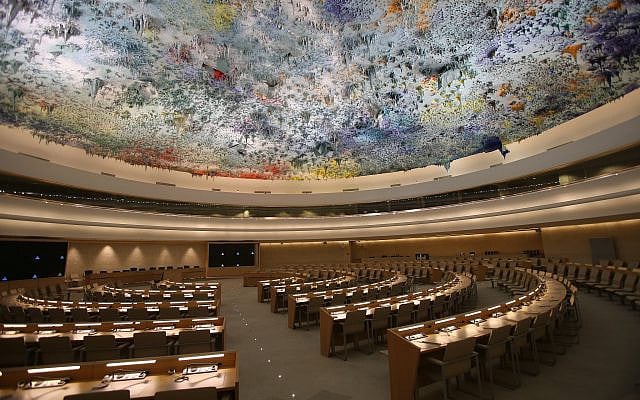
Beyond its noble goals, the Council has also been marred in controversy. It is true that its resolutions turn a blind eye to major abusers and the body is obsessively focused on Israel, so much so that it has dedicated one of its agenda items (Item 7) solely to condemning Israel. This comes in clear violation of its founding document that calls for “objectivity, non-selectivity, and the elimination of double standards and politicization.” In 2025, the United States and Israel left the body, citing the above reasons.
During the current session, an updated report on the so-called database, or blacklist, will be presented, which lists companies that operate in the West Bank. It is part of the anti-Israel machinery that has been built over the decades and that seeks to isolate and delegitimize the Jewish state.
We cannot afford to shy away from these and many more immense challenges confronting the Jewish people in the international arena. That is why the World Jewish Congress is committed to remaining active and engaged in all international forums, even as others pull back. The WJC has been active at the UNHRC since its establishment in 2007. We have been a consistent voice for Jewish communities across the world demanding global action in the fight against antisemitism and broader effort to preserve Jewish life globally.
We prioritize the fight against antisemitism, the protection of Jewish communities, the safeguarding of the memory of the Holocaust, curbing online hate as well as addressing developments in the Middle East. We do that by conducting daily diplomatic encounters, organizing events, delivering statements, hosting exhibitions and cultural events, and providing information on social media and the press. If we fail to represent Jewish communities in these discussions, no one else will.
Today at @UN_HRC I decried the coordinated and transnational escalation of antisemitic attacks around the world. No country is immune to antisemitism, even those without a Jewish community. Governments have the responsibility to protect their Jewish communities. @WorldJewishCong pic.twitter.com/Ua38uatD3H
— Leon Saltiel (@LeonSaltiel) March 25, 2026
The WJC is no stranger to this challenge. Since its founding in Geneva in 1936, the WJC has prioritized universal respect of human rights, religious coexistence, education, interfaith relations, and the fight against racism. In that sense, its work is entangled with the development of the UN system. The WJC was one of the first NGOs to be given UN ‘consultative status’ (in 1947) and was very engaged in all efforts to build the UN human rights system. Its experts were important stakeholders in drafting the Universal Declaration of Human Rights (UDHR), the two International Covenants, and other human rights treaties.
In recent years, the WJC has brought numerous eyewitnesses of the October 7th massacre as well as families of hostages and released hostages to testify before the Council. They have also met with senior UN and other world officials, and thus kept the issue high on the international agenda. We hold regular events to highlight important issues around the topics of combating discrimination and antisemitism, the dangers of hatred online, and to promote interfaith dialogue. Last but not least, we deliver statements at all relevant items advocating for the interests of the Jewish people.
UN High Commissioner for Human Rights, Volker Türk, met with families of female captives of Hamas in Gaza, already kept for four months in horrific conditions. The families asked the High Commissioner to use all of his influence to set their loved ones free. pic.twitter.com/MJ15hBURcb
— Leon Saltiel (@LeonSaltiel) February 6, 2024
In the current session, the WJC will hold a showcase event to support Muslim-Jewish dialogue, with high-level participation from both sides; we will help build support for a joint statement on antisemitism, spearheaded by Czechia, Austria and Slovakia, focusing on the linkages between antisemitism and the development of AI technologies; and we’ll deliver statements documenting the rise of antisemitism. In its totality, this work serves as a counter-balance against further efforts to isolate Jewish voices and marginalize Israel.
We are not naïve. We are deeply aware of the challenges and negative impact some of the Council’s actions and statements have on the rise of antisemitism around the world. Access to the Council is one of the primary tools at our disposal and we leverage our diplomatic engagement with key partners to keep our priorities on the agenda and ensure antisemitism remains the human rights priority it should be for the whole world.
Through our work, we solidify alliances with important democracies around the globe. We remove space that our enemies could otherwise use to promote their radical and hateful agendas. And by being present, engaged and effective, day in, day out, we continue to find friends in unexpected places.
Related Topics