Understanding how humanity works is a prerequisite for perfecting the world
Understanding how humanity works is a prerequisite for perfecting the world
What is Adam?
By the time we argue about what humanity should be, we’ve usually skipped a more basic question: what humanity actually is.
The Torah begins not with politics or policy, but with a creature called Adam—formed from earth, animated by breath, and immediately vulnerable. Before Adam chooses, believes, or obeys, Adam reacts. Hunger, fear, desire, shame, belonging—these arrive before ethics. That ordering matters.
If human beings are meant to be guardians and co-creators of the world, then understanding how we actually function is not optional. It is foundational.
Adam is not one mind
Adam is not a single, unified consciousness. Adam is a layered system.
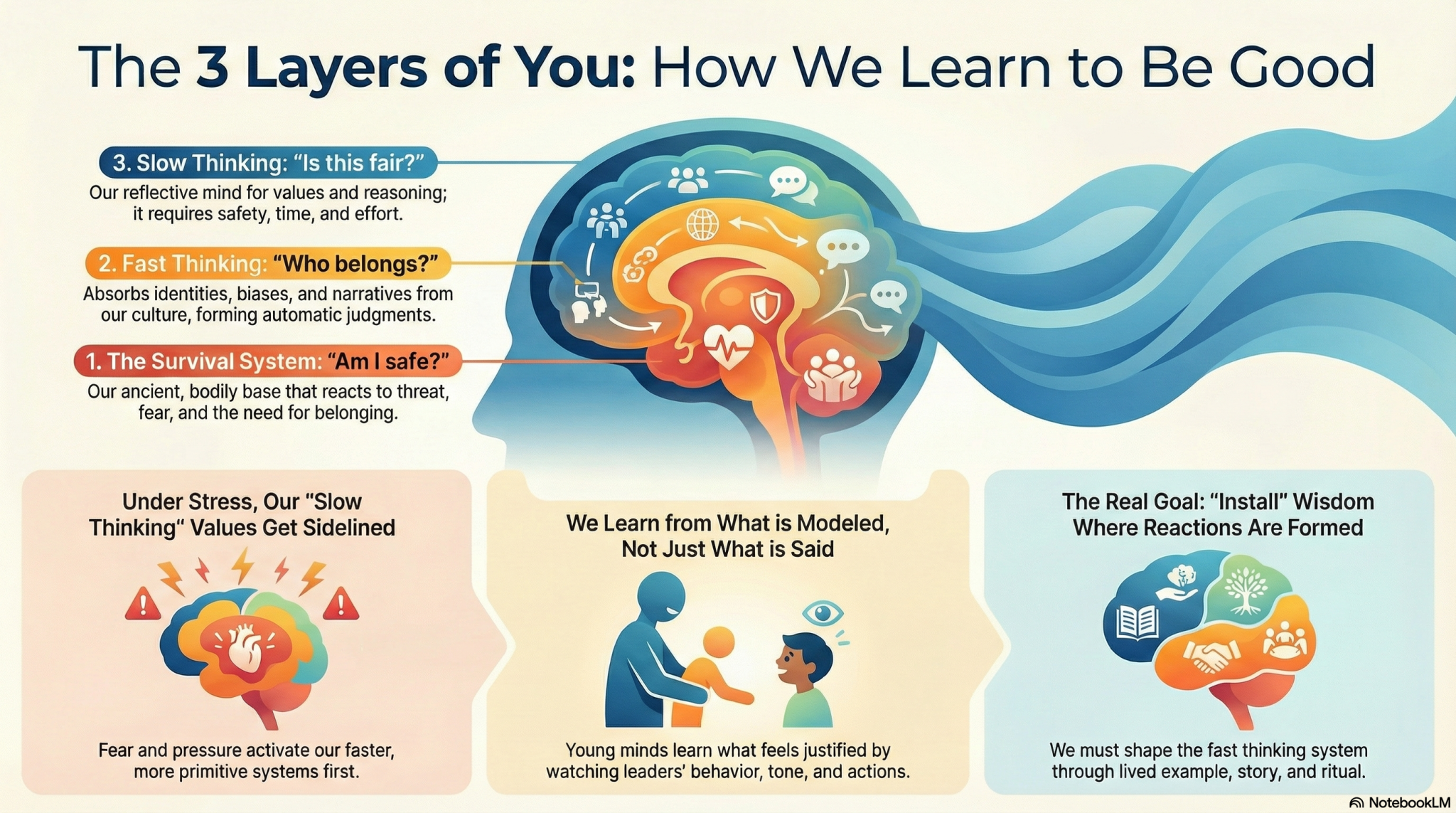
At the base is what we might call the survival system: ancient, bodily, and already preloaded by evolution. This layer detects threat, mobilizes fear or aggression, seeks safety, and protects belonging. It does not deliberate; it reacts. Its central question is simple: Am I safe?
Above it sits the fast thinking system. This layer is born with powerful learning machinery—but not with fixed content. It fills itself automatically from repetition, emotion, and social cues. It absorbs identities, narratives, categories, and justifications from the surrounding world. Over time, it turns raw survival signals into meaning: who belongs, who threatens, what is permitted, what is forbidden. It is quick, confident, and persuasive—especially to itself.
At the top is the most delicate layer: the slow thinking system. This is where reflection, abstraction, and principle live. It reasons across time, tests assumptions, compares alternatives, and articulates values. It can ask questions the other layers cannot: Is this true? Is this fair? What kind of society does this create? But it requires time, safety, and effort—and under threat it is often the first system to fall silent.
The Torah as an intervention in human wiring
Seen through this lens, the Torah is doing something profound. It is not merely offering ideals; it is attempting to shape human defaults.
Much of what the Torah teaches—justice, restraint, compassion, limits on power, care for the vulnerable, responsibility toward the stranger—could, in principle, be discovered through human slow thinking over long stretches of history. But the Torah does not wait for that slow process to unfold unevenly and incompletely. It presents these insights as given knowledge, entrusted to a people charged with stewarding the world responsibly.
Why? Because a society cannot run on slow thinking alone.
Daily life runs mostly on fast thinking—on habit, instinct, and the scripts learned early. A tradition that aims to form guardians and co-creators must do more than inspire. It must install. It must place wisdom where reactions are formed.
This is why Torah is taught and retaught, embedded in story, ritual, law, calendar, and communal practice. It is an attempt to populate the fast thinking system with moral material—so that when pressure rises, the first response is not panic or domination, but responsibility, restraint, and care.
Nothing is taught in a vacuum
And here is the responsibility that follows.
The fast thinking system does not learn primarily from what is said, but from what is modeled, repeated, and emotionally charged. It learns from tone more than theory, from behavior more than proclamation.
Which means that parents, teachers, mentors, and leaders are never neutral.
Every response to fear, every joke told in contempt, every boundary enforced—or ignored—every way power is exercised, every “us” and “them” that is implied rather than stated: all of it feeds the fast system of those who are watching, especially children.
Young minds are not simply learning ideas; they are learning what feels natural, what feels justified, and what feels safe to do under pressure.
Children do not just learn Torah. They internalize the Torah as it is lived around them.
If what they repeatedly see is that fear overrides compassion, that loyalty excuses cruelty, or that strength means domination, then those patterns will surface automatically when stress arrives. If what they see is restraint under pressure, moral clarity in ambiguity, and responsibility even when afraid, those too can become instinctive.
This influence is constant and cumulative. It does not pause when formal teaching ends.
Why morality collapses under stress
When threat rises, the survival system tightens its grip. The fast system rushes in to explain and justify the feeling. Labels appear. Stories harden. Moral permission follows. All of this can occur before slow reflection has a chance to speak.
This is how fear becomes ideology. This is how sacred texts can be pressed into the service of raw instinct—not because religion uniquely corrupts, but because the fast system is exquisitely sensitive to authority, identity, and belonging. Under pressure, it reaches for whatever it has been stocked with.
Slow thinking—where values and aspiration live—often arrives too late. Or worse, it is recruited to defend conclusions already reached automatically.
This is not simply a failure of intelligence. It is a failure of integration.
The unfinished work of Adam
Adam is expelled from Eden not because he lacks reason, but because knowledge alone does not produce wisdom. Awareness does not equal alignment. That gap still defines us.
We invest enormous energy in declaring ideals, while underestimating how relentlessly fast thinking is shaped by daily behavior, especially by those in positions of trust and authority. Then we are surprised when, under strain, individuals and societies revert to instinct and justification.
But insight alone does not change defaults.
The fast thinking system updates through repetition, emotional experience, and social reinforcement. If we want human beings to act as responsible guardians and co-creators, we cannot rely on slow thinking sermons alone. We must attend seriously to what we are installing, moment by moment, through how we live and lead.
Conclusion: the real work
Understanding how humanity works is not a distraction from moral ambition. It is its prerequisite.
If the Torah can be understood as an act of divine pedagogy—an attempt to give people early access to the wisdom required to steward the world—then our responsibility is clear. We must teach, model, and interpret it in ways that genuinely shape instinct, not merely belief.
Our fast thinking system needs an overhaul—not through rejection of tradition, but through the most demanding form of faithfulness: concerted slow thinking, careful interpretation, and deep integration.
The goal is not only to know what is right, but to become the kind of people—and to raise the kind of people—for whom doing right feels natural, especially when it is hardest.
That is the unfinished work of Adam. And it is the work required of anyone entrusted with shaping the next generation of guardians and co-creators of the world.