
Tech Executive Amplifying Israel’s Truth
Understanding the U.S.-Iran MOU: Hormuz first, nuclear talks next
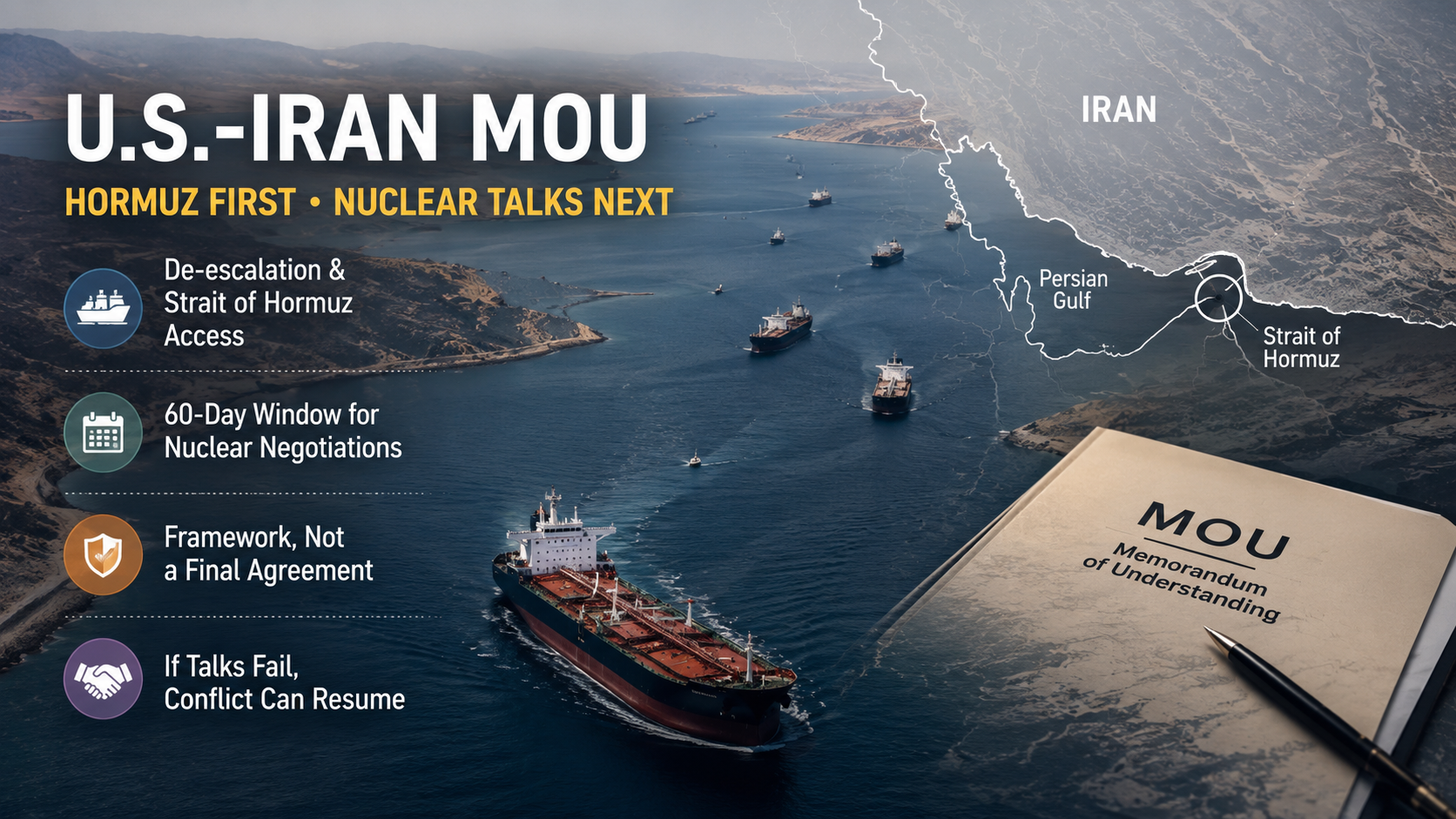
An illustrative depiction of the reported U.S.-Iran memorandum of understanding, highlighting the Strait of Hormuz, maritime de-escalation efforts, and the next phase of nuclear negotiations.
There is considerable confusion around the reported U.S.-Iran memorandum of understanding, or MOU.
Many are treating it as if a final Iran nuclear agreement has already been signed.
That is not what this appears to be.
An MOU is typically a framework document. It records what the sides understand, what objectives they are pursuing, and how they intend to move forward. It can carry political weight, but it is generally not the same as a final binding agreement with detailed enforcement, verification, implementation, and consequences for violations.
That distinction matters.
Based on current reporting, one of the immediate objectives of the MOU appears to be de-escalation and reopening the Strait of Hormuz, one of the world’s most important shipping lanes for oil, gas, and commercial traffic.
In practical terms, that appears to be the first phase: stabilize the maritime arena, reduce the immediate pressure on global energy markets, and prevent the conflict from expanding further.
The second phase appears to be the harder one: a 60-day window for technical negotiations over Iran’s nuclear program.
That is where the real test begins.
President Trump’s own statement helps explain the distinction. He posted:
“Iran has agreed to never have a Nuclear Weapon!”
That is a statement of objective.
It does not by itself answer the technical questions that determine whether such an objective can be enforced:
• What restrictions will apply?
• What inspections will be required?
• Who verifies compliance?
• What sanctions relief is triggered, and when?
• What happens if Iran violates the terms?
• What happens if talks fail during the 60-day period?
Those are the questions that separate a political framework from a serious enforceable agreement.
This is also why the MOU should not be dismissed, but should not be treated as the final deal either.
It may establish the direction of travel. It does not yet prove the destination has been reached.
There is historical precedent for this staged approach. The Obama administration’s Iran process began with the 2013 Joint Plan of Action, an interim understanding that set the stage for further negotiations. Only later did the 2015 JCPOA emerge as the broader nuclear framework.
Whether one supported or opposed that process, the structure is important: Iran diplomacy often develops in stages.
There is also an important Israel angle.
The MOU may seek to calm the Iran front and reopen Hormuz, but it does not automatically resolve Israel’s security challenges in Lebanon, Gaza, or against Iranian-backed forces across the region.
Reports and official comments indicate that Israel does not view the MOU as preventing continued operations against Hezbollah threats in Lebanon. That is a critical distinction.
A U.S.-Iran framework may affect the regional atmosphere.
It does not erase Israel’s operational requirements.
For Israel, the key question is not only what Washington and Tehran signed. It is whether the arrangement limits Iran, restrains its proxies, preserves Israeli freedom of action, and creates real enforcement if Iran violates its commitments.
For now, the most accurate way to understand the situation is neither panic nor celebration.
This appears to be a political framework and a diplomatic pause.
One immediate goal appears to be reopening Hormuz and lowering the temperature.
The next goal is nuclear negotiations.
The decisive question is whether those talks produce real restrictions, real inspections, real enforcement, and real consequences.
The MOU tells us where the parties say they want to go.
The next 60 days will show whether they can actually get there.
Related Topics