
Fiber-Optic Drones and the Evolving Character of War
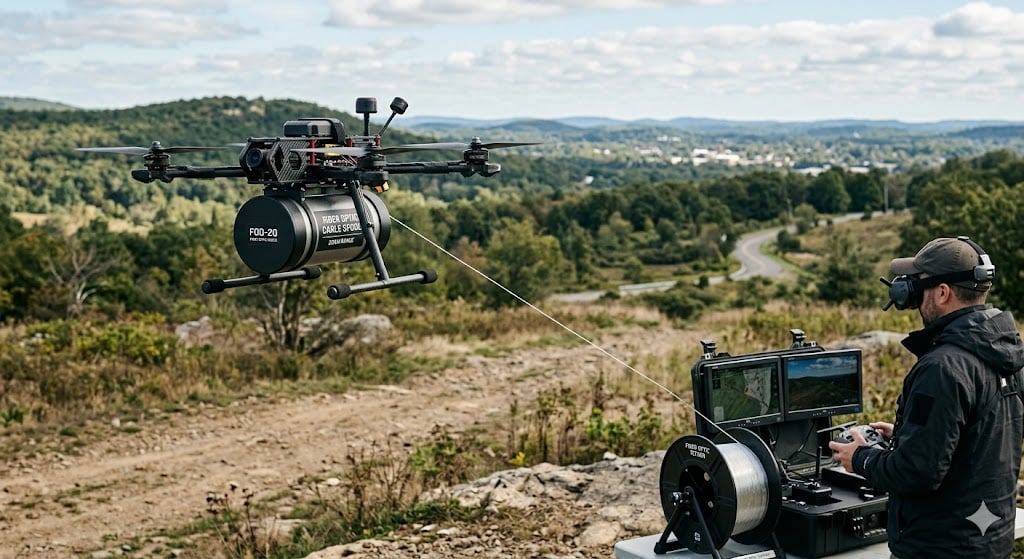
Hezbollah is now using fiber-optic drones to kill Israeli soldiers — and it is a direct lesson learned from the war in Ukraine. A recent BBC News report makes this connection explicit, and the implications are significant for Israel, the United States, and every military that is serious about prevailing in modern warfare.
Since the ceasefire came into force, eight of the twelve Israeli soldiers and civilian contractors killed have been taken out by these drones. They are First-Person View (FPV) drones loaded with explosives, flying low and without a radio signal — which means Israel’s jamming systems are useless against them. Instead of wireless transmission, they are guided by a thin optical wire, allowing operators to see and chase targets in real time with no electronic signature to exploit.
Russia has been deploying this technology against Ukrainian forces for two years. Hezbollah was paying attention.
Israeli forces have been criticized for being slow to absorb the lessons coming out of Ukraine. That is a costly mistake — and a warning to everyone else.
Three Lessons That Cannot Be Ignored
This development reinforces three points that deserve serious strategic attention.
First, the character of war continues to evolve — rapidly and unpredictably. What worked last year may be obsolete today. The assumption that yesterday’s countermeasures will defeat tomorrow’s threat is dangerous in any operational environment, but particularly so when adversaries are actively studying and adapting in real time.
Second, those adversaries — both state and non-state — are watching operational developments in Ukraine and the Middle East simultaneously and integrating those lessons into their own tactics and procurement. The battlefield has become a global classroom, and our enemies are enrolled. Hezbollah’s adoption of fiber-optic drone technology is not an isolated innovation. It is part of a systematic effort by Iran and its proxies to identify and exploit Western vulnerabilities at minimal cost.
Third, Israel, the United States and their allies cannot afford to be slow learners. Adapting tactics, doctrine, and procurement to these operational realities is not optional — it is a core national security imperative. The speed at which adversaries are iterating on the battlefield is outpacing the speed at which Western militaries are updating their doctrine and acquisition processes. That gap is dangerous.
Technology Is Not Enough
Israel is now scrambling to develop countermeasures, including AI-assisted targeting systems. But Israel’s own media acknowledges that the defensive solutions developed so far are falling short. That shortfall reflects something deeper than a technology deficit.
Retired US Army General (Ret.) David Petraeus captured the essential lesson precisely in a recent article:
“The lesson was clear: A drone without doctrinal concepts for employment, substantial force structure changes, trained operators and units, educated leaders, maintenance systems, intelligence integration, and personnel policies is not a weapons system at all — it is an asset on a spreadsheet.”
Technology alone is never enough. Doctrine, training, and institutional adaptation are what turn capability into combat power. A military that acquires new systems without overhauling the doctrine, training pipelines, and organizational structures required to employ them effectively has not solved its problem — it has deferred it.
The Broader Implication
The fiber-optic drone is not a curiosity. It is a signal. Hezbollah has demonstrated that a non-state actor with Iranian backing and Ukrainian battlefield intelligence can neutralize a sophisticated jamming infrastructure with a commercially available airframe and a spool of wire. The cost asymmetry is striking. The implications for US and allied forces operating in future contested environments — whether in the Indo-Pacific, the Middle East, or Europe — are direct and immediate.
Israel, the United States and its partners need to move faster — on counter-drone systems, on doctrine, on procurement reform, and on the kind of rapid institutional learning that modern warfare now demands. The battlefield is not waiting for bureaucratic processes to catch up.
Our adversaries are adapting in real time. We need to do the same.