Director of Diplomacy, Representative to UN Geneva & UNESCO, World Jewish Congress
Unearthing the Memory of Thessaloniki’s Ancient Jewish Cemetery
National histories are neither uniform nor linear and often hide, just below the surface, “difficult heritages.” The term describes a past that we recognize as important, yet one that may be controversial, uncomfortable, or not easily conducive to national self-affirmation. Rather than fostering pride, it encourages reflection, remembrance, self-criticism, and the honoring of victims. Instead of simplifying, it complicates our understanding of history, revealing its more challenging facets.
These are some of the questions that a ground-breaking exhibition in Athens seeks to explore. Entitled “Difficult Heritages: Greece, Cyprus, Turkey,” the exhibition presents ten such examples from the three countries, focusing on the prisons of Gyaros, Spinalonga, Famagusta; the Jewish cemetery of Thessaloniki, Karya, the Greek villages of the Occupation era, the Haidari concentration camp, Ottoman monuments, refugee settlements and the villages of Ionia. It is organized by the National Technical University of Athens (NTUA), the Hellenic Foundation for European and Foreign Policy (ELIAMEP), and the National Bank of Greece Cultural Foundation (MIET) and it can be currently visited at the Eynardos Mansion in Athens.
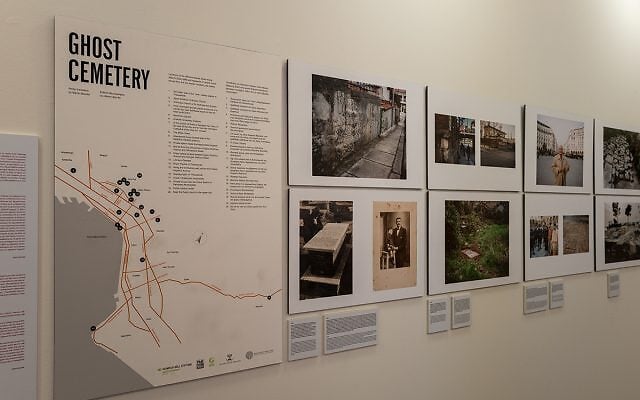
I had the great honor and privilege to curate the section on the destruction of Thessaloniki’s ancient Jewish cemetery, which took place during the German occupation of the city, starting in December 1942. The cemetery contained almost 500,000 graves, dating since the arrival of the Sephardic exiles from Spain five centuries ago. It was akin to an archeological site, testifying to the long presence and contribution of the Jews in the city, and documenting their religious, cultural, scientific and professional life and customs.
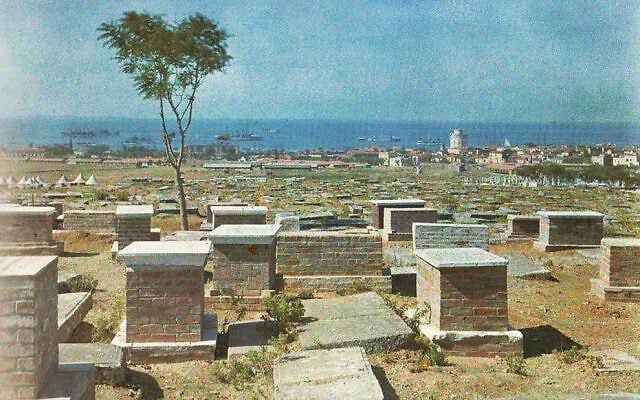
The German occupation provided local Greek authorities and elites the opportunity to remove the cemetery from the city’s heart. Under German command, municipal workers hastily demolished the site. Its bricks and tombstones were widely plundered and repurposed for roads, churches, municipal buildings, and university facilities. The vast grounds were registered to the Greek state, and the Aristotle University campus was built over them. This unique event in occupied Europe tested relations between the Germans, Greek officials, and the Jewish community. It exposed local hostility, leaving the Jewish population isolated and setting a tragic stage for their impending deportation to Auschwitz, that commenced three months later.
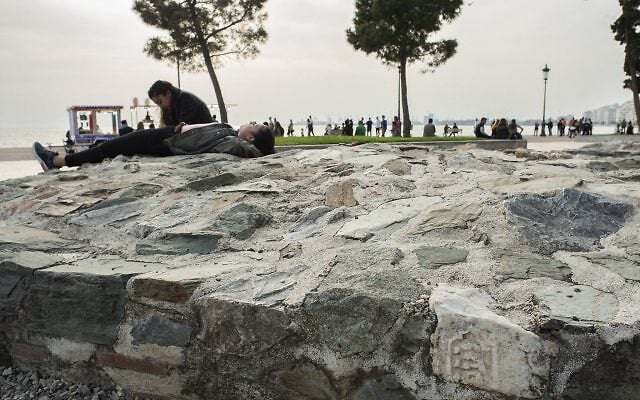
This contribution builds on my academic research on the Holocaust in Thessaloniki, where I have paid particular attention on the case of the cemetery, as an important element to understand the Second World War in Greece. The display on Thessaloniki’s cemetery also features the work of photographer Martin Barzilai, who traced the remnants of the tombstones, republished and spread throughout the modern city and beyond. The exhibition has been featured in major Greek newspapers, such as Kathimerini (in Greek and English) and Ta Nea.
In parallel, a recent publication by the German Historical Museum, “German occupation of Europe 1939–1945: What objects tell us,” traces key aspects of the World War II and the subsequent German occupation of European countries, using historical objects: forced labor, camps, plunder, cultural destruction, starvation, the murder of patients, the Holocaust. My contribution to the volume deals with the story of the cemetery and how fragments from its erased memory are still visible to a modern passerby.
Delving into Greece’s trouble past, and unearthing difficult and contested memories, such as the destruction of Thessaloniki’s Jewish cemetery, is a much welcome and needed development in a long process of self-understanding and self-awareness. It is commendable that researchers, academics, institutions and the wider public in several countries can be exposed to lesser known aspects of the past and play their role to internalize it in the national consciousness.
Info: Difficult Heritages: Greece | Cyprus | Turkey
Curated by Kalliopi Amygdalou and Valia Gialia
Until 28 November 2026 (with possible extension until 19 December due to high turnout)
Eynardos Mansion
20 Ag. Konstantinou & Menandrou Str. (near Omonia metro station), Athens
Opening Hours: Thursday & Friday 12:00–19:00, Saturday 11:00–15:00
Free Admission
Related Topics