
CEO of Time to Stand Up for Israel
Unearthing Truth: When Israel’s Past Spoke to Me
- Unearthing Truth: When Israel’s Past Spoke to Me
On October 30th, I attended a symposium on Biblical Archaeology, expecting nothing more than a pleasant evening of lectures and networking. But what I experienced was something entirely different: a reconnection with my own memories of Jerusalem, and an overwhelming realization of how deeply the Jewish people’s roots are intertwined with the very stones of the Holy Land.
The event hosted three distinguished guests from the Israel Antiquities Authority (IAA):
- Dr. Amit Reem, Jerusalem Regional Archaeologist of the IAA
- Dr. Ilit Cohen-Ofri, Director of the IAA Dead Sea Scrolls Conservation Laboratory
- Benyamin Storchan, Senior Archaeologist, IAA
Each of them brought a unique piece of Israel’s story and each reminded the audience that archaeology is not just about ancient objects, but about identity, continuity, and truth.
Childhood Among the Stones of Jerusalem
My connection to archaeology goes back to my childhood. When I was a girl, my family lived in Rehov Mordechai Caspi, on a hill just west of the Old City of Jerusalem, a few hundred meters as the crow flies from the Jaffa Gate. From our balcony, we could see the ramparts of the Old City and the Tower of David, that magnificent citadel standing guard over centuries of Jewish history.
At the foot of our hill lay a tangle of rocky terraces, dry grass, and olive trees. Below that, the ancient valley led toward Sultan’s Pool and the path that winds around Mount Zion. My brother and I, along with other expat children, used to roam that area endlessly. Our Israeli friends were not allowed to play there, too close to the security zone, but for us it was an endless adventure of caves, stones, and mysteries.
One afternoon, as the golden light of Jerusalem faded, we discovered a small cave opening in the hillside, about fifty meters below the old monastery that still stands there today. The entrance was narrow, half-hidden behind a fig tree. My brother insisted it was a burial cave, “look at the cut stones,” he said. We crawled inside through a small entrance and saw a cave with openings in the wall. We wanted to start digging, but my mother, ever cautious, forbid us to enter again. “It could collapse,” she warned. We listened, reluctantly, and stayed outside, throwing pebbles into the darkness.
That cave would return to my life in the most unexpected way, decades later.
The Pot from the Old City
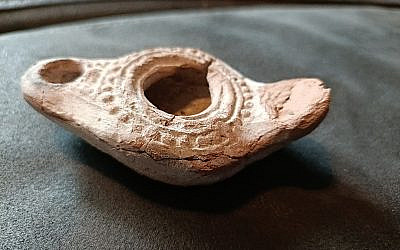
Around the same period, my brother had another discovery. During one of our visits to an excavation site near the Tower of David, just inside the Old City walls, he wandered away from the regular path and noticed a small ceramic pot half buried in the corner of a trench. It was intact, reddish-brown clay, about 15 centimeters high, with a slightly chipped rim. To him, it looked like something straight out of a Roman kitchen.
He picked it up and proudly carried it home, declaring it his treasure. In those days,the late 1970s, no one thought much about removing small artifacts. Today, of course, we know it’s strictly forbidden; every shard is a piece of Israel’s living history and belongs in its soil or museums. But back then, we were children, fascinated by the idea of touching something that someone might have used two thousand years ago.
For decades, that little pot sat on a shelf in the Netherlands, a quiet reminder of Jerusalem. I never imagined that one day I would hear its story reflected back to me, by one of Israel’s leading archaeologists.
Dr. Amit Reem: The Storyteller of Jerusalem’s Stones
At the symposium, Dr. Amit Reem began his lecture with passion and precision. As the Jerusalem Regional Archaeologist, he oversees many excavations in the heart of the city, from the City of David to the slopes of Mount Zion. When he projected an image of a recently studied burial cave, I froze, it was identical to the place where my brother and I once played, it was exactely the same cave we crawled into decades ago.
“This,” Dr. Reem said, “was an ancient Jewish burial cave from the Second Temple period, later reused during Roman times.”
I felt chills. That was our cave. The one we had found and never dared to enter.
When his lecture ended, I turned to my friend beside me and whispered, ” I need to give that pot back.”
My brother still jokes, “They have enough artifacts,” but I know better. It belongs in Israel, just like every stone and every shard of that sacred city.
Dr. Ilit Cohen-Ofri: Resurrecting the Words of Scripture
Then came Dr. Ilit Cohen-Ofri, head of the IAA’s Dead Sea Scrolls Conservation Laboratory. Her work bridges ancient faith and modern technology. She explained how her team has used hyperspectral imaging to read texts invisible to the naked eye, including scrolls so burned they looked like charcoal.
One of the most remarkable examples came from the ruins of the Ein Gedi Synagogue, where a pile of blackened papyrus rolls turned out to contain verses from Leviticus, written in Hebrew over 1,500 years ago. The scrolls, now known as the Ein Gedi Scrolls, represent the earliest known copy of the biblical text outside the Dead Sea Scrolls.
Listening to her, I realized that in Israel, archaeology isn’t about proving faith wrong, it’s about proving history right.
Benyamin Storchan: Digging for Unity
Finally, Benyamin Storchan, a senior archaeologist with the IAA, shared the story of an excavation of an early Christian church near Beit Shemesh. His team included Jews, Muslims, and Christians, as well as local schoolchildren. Together they uncovered mosaics, crosses, and Hebrew inscriptions, tangible reminders of coexistence and shared heritage.
Storchan’s message was powerful: archaeology can unite where politics divides. When children uncover history together, they see that this land has always been shared, sacred, and Jewish at its core.
Israel: The Homeland Beneath Our Feet
As I left the symposium, my heart was full. I am not a religious person, but I am a believer in evidence and Israel provides it in abundance. Every excavation, every scroll, every stone tells the same story: that Israel is the ancestral homeland of the Jewish people.
It’s a shame these brilliant Israeli archaeologists cannot lecture in every European university. If more people could hear them, if they could see the proof with their own eyes, they would no longer deny the truth buried in the soil of Jerusalem.
Israel doesn’t need to invent its history. It unearths it, piece by piece, layer by layer, as the stones of Jerusalem whisper the same eternal message:
This land is ours. It always was.
am Yisrael Chai
Related Topics
Related Posts