Unsung Hero! Imtiaz Mir.
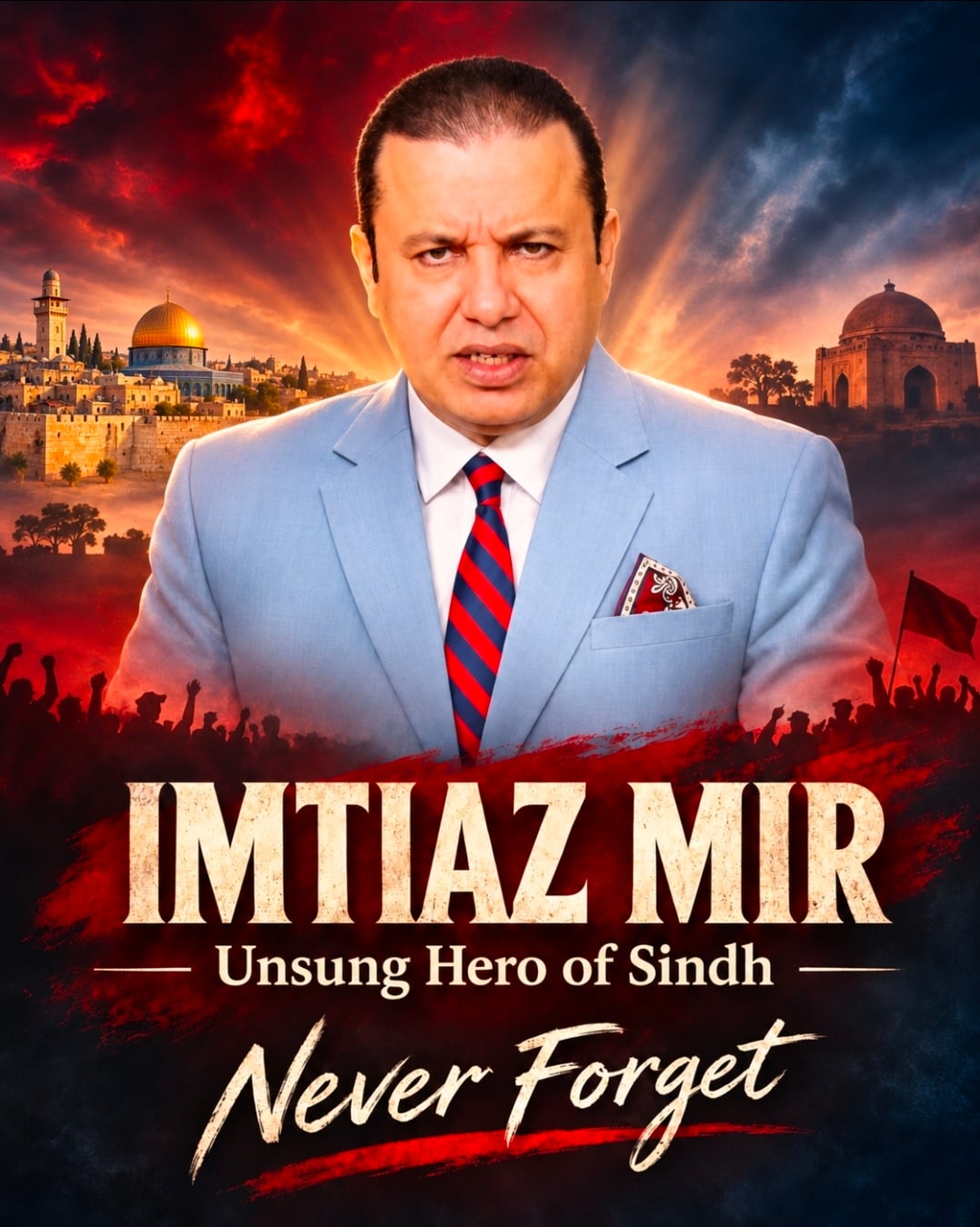
Imtiaz Mir: The Journalist Pakistan Could Not Protect Because He Dared to Visit Israel
The murder of a Sindhi journalist exposes the deadly consequences of religious extremism, the failure of Pakistan’s justice system, and troubling questions about intelligence accountability.
By Mansoor Hussain Laghari
Human Rights Activist | U.S. Army Veteran | Muslim Zionist | Founder, Global Youth Unity Project
There are countries where journalists are threatened for exposing corruption. There are countries where journalists are imprisoned for criticizing governments.
And then there is Pakistan, where a journalist can become a target simply because he visits Israel and refuses to treat Jews as enemies.
His name was Imtiaz Mir.
He was a Sindhi journalist, a television anchor, and, in my eyes, one of the unsung heroes of Sindh.
On September 21, 2025, armed men on motorcycles intercepted his vehicle in Karachi and opened fire. His brother was also wounded. Mir fought for his life in a hospital but died eight days later.
His supposed crime was not terrorism, espionage, or violence.
He had visited Israel.
He had spoken with Israelis.
He had dared to look beyond the ideological walls that Pakistan’s political and religious establishment has spent generations building.
And according to Sindh’s own home minister, that perceived sympathy for Israel became the motive for his murder.
Think about the barbarity of that proposition: A Muslim journalist allegedly marked for death because he refused to hate Jews or reject dialogue with Israel.
The dangerous price of independent thinking
For Muslims who openly support Israel, the danger is not theoretical.
It is a reality of threatening messages, accusations of apostasy, public intimidation, reputational attacks, and sometimes violence.
A Muslim who advocates coexistence with Jews may be branded a traitor to Islam. A Pakistani who visits Israel may be accused of serving a foreign intelligence agency. A journalist who interviews Israelis may find himself treated as an enemy of his own country.
This is not a defense of religion. It is the weaponization of religion against freedom of conscience.
When disagreement becomes blasphemy, dialogue becomes treason, and peaceful coexistence becomes a capital offense in the eyes of extremists, society has surrendered its moral compass.
Imtiaz Mir’s murder should disturb every Muslim, every journalist, and every defender of human rights, regardless of their position on Israel.
He had the right to travel. He had the right to ask questions. He had the right to form opinions.
Most importantly, he had the right to live.
Who really ordered his murder?
In October 2025, Sindh Home Minister Ziaul Hasan Lanjar announced the arrest of four suspects allegedly associated with Lashkar Sarullah, described by authorities as linked to the Iran-backed Zaynabiyoun Brigade.
Authorities claimed the suspects acted under instructions from a handler outside Pakistan.
That announcement raised serious questions. It did not settle them.
The Committee to Protect Journalists subsequently reported that progress in the case had stalled, with no formal charges brought against the identified suspects at the time of its reporting.
Mir’s family also challenged elements of the police investigation, raising concerns about evidence collection and the identification of suspects.
Those concerns cannot simply be dismissed.
Who commissioned the assassination? Who provided intelligence about Mir’s movements? Who financed the operation? Who gave the final order?
And who, if anyone, within Pakistan’s security establishment knew that he was being threatened?
These questions deserve answers supported by evidence, not political theater.
The uncomfortable question about Pakistan’s ISI
Pakistan’s powerful Inter-Services Intelligence agency, commonly known as the ISI, has long occupied a central place in the country’s national-security establishment.
Its institutional power makes independent scrutiny especially important when a politically sensitive assassination occurs.
Some may suspect that elements within Pakistan’s intelligence apparatus were aware of threats against Mir, or even wonder whether there was a deeper connection to his killing.
But suspicion is not proof. There is currently no verified public evidence establishing ISI involvement in Mir’s assassination.
That distinction matters.
Still, the absence of proof of complicity is not a reason to avoid examining whether the security establishment fulfilled its responsibilities.
Did any intelligence agency possess advance warning of threats against journalists who visited Israel?
Were such warnings shared with civilian police?
Did officials adequately investigate the alleged foreign handlers?
What role did the federal intelligence agencies that assisted the investigation actually play?
And why did the prosecution of the alleged killers encounter such serious difficulties after officials publicly announced a breakthrough?
An independent investigation should examine these questions, preserve the forensic evidence, scrutinize any intelligence failures, and establish an accountable chain of responsibility.
If the ISI or any other agency had relevant information, the investigators should be able to examine it under appropriate legal safeguards.
No institution should be beyond scrutiny. No allegation should be treated as proven without evidence.
Justice for Imtiaz Mir requires both principles.
Pakistan’s contradiction
Pakistan regularly speaks about the rights of Palestinians and presents itself as a defender of oppressed Muslims.
But what does that commitment mean when a Pakistani Muslim is allegedly murdered over his engagement with Israel?
How can a country claim to defend human dignity abroad while failing to deliver justice for a journalist killed on its own streets?
There is nothing inherently anti-Muslim about recognizing Israel’s existence, engaging with Jewish communities, or advocating peace between Israelis and Palestinians.
One can support Palestinian rights while rejecting antisemitism. One can criticize Israeli government policy without denying Jewish history. One can remain a practicing Muslim while believing that Israel deserves security and peaceful relations with its neighbors.
Millions of Muslims hold different political and religious views. No cleric, militant organization, or intelligence establishment has the right to decide who is sufficiently Muslim.
A Muslim does not become an apostate by shaking a Jewish hand. A journalist does not become a traitor by crossing a border.
And a society does not become stronger by murdering those who challenge its prejudices.
Remember him as an unsung hero of Sindh
I was born in Sindh, into a family that experienced the consequences of challenging entrenched authority.
My father, Comrade Ghulam Mohammad Laghari, spent approximately 27 years in prison during his lifetime because of his political struggle and defense of oppressed people.
I understand what ideological intimidation can do to a family.
I also understand that silence allows it to continue.
Imtiaz Mir belonged to a tradition of Sindhi voices willing to question established boundaries.
He should not be remembered only as another journalist murdered in Karachi.
He should be remembered as an unsung hero of Sindh — a man whose life was taken amid a climate where engagement with Israel could make a Muslim a target.
His memory belongs not only to Sindh but also to those working for Muslim-Jewish dialogue and peaceful coexistence.
Journalists in Pakistan should not need permission from extremists to interview Israelis. Muslim peace advocates should not have to live under threats because they reject inherited hatred.
And no family should have to spend years fighting for justice after an assassination.
Justice must mean more than announcing arrests
Pakistan’s authorities have an obligation to establish exactly what happened, prosecute those responsible through a credible legal process, and pursue whoever ordered or financed the murder.
An independent inquiry should address the allegations of investigative failures raised by Mir’s family and press-freedom organizations.
International journalist-protection organizations should continue demanding accountability and transparency.
The world should not allow this case to disappear.
Because the danger extends far beyond one journalist.
If armed extremists can murder someone for visiting Israel, and the justice system cannot credibly bring the responsible people to account, every Pakistani who advocates peace receives the same terrifying message:
Keep your mouth shut, or you could be next.
That message must be rejected.
Imtiaz Mir deserved to return safely to his family. He deserved to continue his journalism. He deserved the freedom to engage with the world without a death sentence hanging over his head.
His killers took those possibilities away.
They must not be allowed to erase his memory.
Remember Imtiaz Mir. Remember the unsung hero of Sindh.
You can murder a journalist. You cannot murder the truth.
Long live Sindh. Long live freedom. Long live the courage to think independently.
–-
Mansoor Hussain Laghari is an American human rights activist born in Sindh, a U.S. Army veteran, a Muslim Zionist, a film producer, and founder and president of the Global Youth Unity Project, an organization promoting Muslim-Jewish cooperation, youth peacebuilding, and opposition to religious extremism.