
Geopolitical Analyst: Bridging Somaliland & Israel to the world
US vs China in the Red Sea: Berbera, Taiwan, Israel and the Houthis
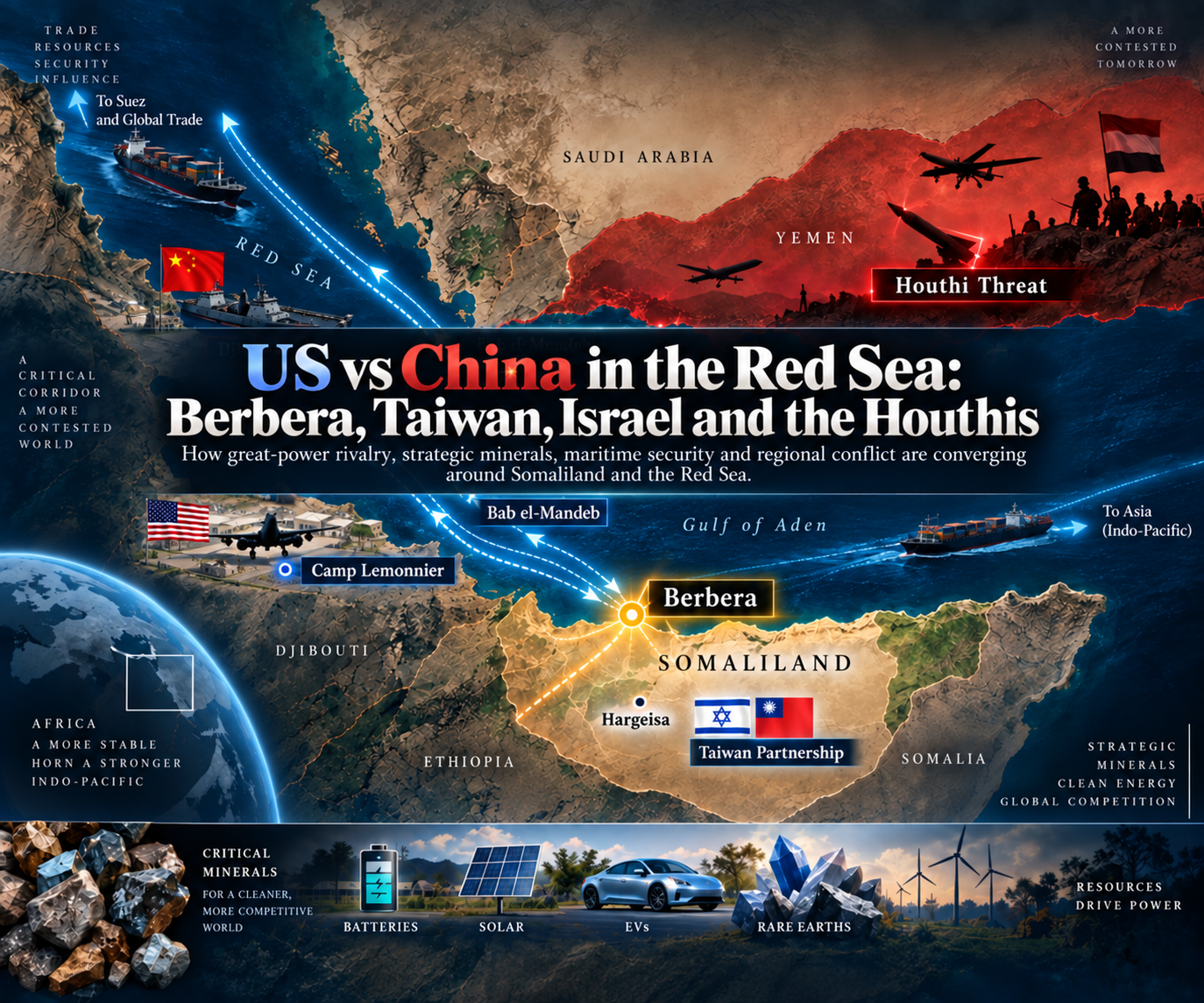
HOASR geopolitical illustration examining the widening US-China competition across Africa and the Red Sea, including China’s military presence in Djibouti, Camp Lemonnier, Somaliland’s partnership with Taiwan, Israel’s recognition of Somaliland, the Houthi threat around Bab el-Mandeb, Berbera’s strategic position and the global competition over critical minerals, trade routes and clean-energy supply chains.
The contest around Somaliland is part of a wider struggle over trade, critical minerals, infrastructure, political influence and military access. As US–China rivalry deepens across Africa, the Red Sea is becoming one of its most sensitive meeting points.
President Abdirahman Mohamed Abdullahi Irro went to Washington seeking a wider hearing for Somaliland. His September 14 appearance at the Hudson Institute placed Somaliland’s recognition campaign inside a larger American debate about China, Taiwan, maritime security and the changing balance of power around the Horn of Africa. Hudson itself framed the event around China’s growing influence in Africa, the Houthis, Iran and Somaliland’s potential role as a pro-Western strategic partner (Hudson Institute, 14 September 2026).
Beijing responded two days later. The Chinese Embassy in Somalia condemned Irro’s remarks on Taiwan, reaffirmed China’s support for Somalia’s territorial claims over Somaliland and warned that crossing Beijing’s line on Taiwan would bring “serious consequences” (Chinese Embassy in Somalia, 16 September 2026). The speed and tone of the response showed that Beijing was following Somaliland’s Washington engagement closely.
Yet Taiwan alone does not explain the rivalry. The deeper contest between the United States and China stretches across global trade, advanced technology, critical minerals, infrastructure finance, ports, telecommunications, political influence and military power. Africa has become one of the principal arenas in which these interests meet.
Africa has become a strategic arena
China spent more than a decade building an economic position across Africa through trade, infrastructure finance and the Belt and Road Initiative. Chinese companies helped finance or construct roads, railways, ports, electricity networks, telecommunications systems and mining projects in countries where infrastructure shortages were severe and Western capital was often slower or more cautious. AidData estimates that Chinese official-sector institutions supported more than 20,000 projects worth about $1.34 trillion across 165 low- and middle-income countries between 2000 and 2021 (AidData, Belt and Road Reboot).
This investment brought real benefits as well as risks. The World Bank has found that Belt and Road transport corridors can improve trade, investment and living standards, but it has also warned that gains depend on transparency, debt sustainability and safeguards against corruption and environmental damage (World Bank analysis of Belt and Road risks). The strategic question for Washington is how economic networks can later produce political influence, control over supply chains or access to infrastructure with military value.
That concern is now explicit in US military planning. AFRICOM’s 2026 posture statement describes China’s investments in African mining, infrastructure and transportation as part of a wider effort to secure critical minerals and strategic infrastructure, and it warns that deep-water ports can carry dual-use value (US Africa Command 2026 Posture Statement). China rejects the portrayal of its African engagement as an expansionist military project and presents its approach as development and mutually beneficial cooperation. The disagreement over intent, however, has not reduced Washington’s concern over the strategic effect of China’s growing footprint.
Critical minerals are now part of national security
The clean-energy transition has intensified the competition. Electric vehicles, battery storage, solar power, advanced electronics and modern defense systems depend on minerals such as cobalt, lithium, graphite, manganese, copper and rare earth elements. Africa holds major reserves of several of them, making the continent increasingly important to the industrial strategies of both powers.
The Democratic Republic of Congo illustrates the scale of Chinese involvement. The US Geological Survey reports that Congo supplied about 75 percent of global mined cobalt in 2024 and that 15 of the country’s 19 operating cobalt mines were operated or funded by Chinese companies (US Geological Survey). Control of the mine is only part of the equation. China’s greater advantage lies in refining, processing and manufacturing, where raw minerals are converted into the materials used in batteries, vehicles and other high-value products.
The International Energy Agency reports that China accounted for nearly 75 percent of global electric-car production in 2025 and more than 80 percent of battery-cell production. It also produced about 85 percent of cathode active material and more than 90 percent of anode active material used in electric-car batteries (IEA Global EV Outlook 2026). In critical-mineral refining, the imbalance remains similarly large: Reuters reported in September, citing IEA data, that China still controlled roughly 70 to 95 percent of refining for several minerals including lithium, cobalt and graphite despite expanding US investment (Reuters, 14 September 2026).
The United States has begun trying to close the gap through domestic investment and new African partnerships. The Lobito Corridor, minerals agreements and Western-backed investment in Congo are intended to build supply chains that do not depend so heavily on China. On September 15, Congo created a DRC–USA task force to accelerate its strategic minerals partnership with Washington and attract more Western investment in copper and cobalt (Reuters, 15 September 2026). The race is therefore not simply over who extracts African minerals, but who finances the mines, processes the output, controls the transport routes and manufactures the technologies that depend on them.
Debt can become influence, but the evidence is more complicated than the slogan
Chinese lending has also become part of the geopolitical debate. Critics frequently describe Belt and Road finance as “debt-trap diplomacy,” arguing that Beijing burdens weaker states with loans and later converts repayment problems into political leverage. AidData estimates that developing-country borrowers owe China at least $1.1 trillion in outstanding principal and notes that many large borrowers have faced liquidity or solvency problems (AidData executive summary).
The evidence does not establish that China systematically lends with the deliberate purpose of bankrupting governments and seizing their assets. Borrowing governments, weak project selection, corruption and domestic political decisions have also contributed to debt distress. The more defensible strategic concern is that heavy dependence on Chinese credit, contractors, trade and debt restructuring can increase Beijing’s leverage even when no seizure of assets occurs. Economic dependence can influence diplomatic choices without requiring a secret debt strategy.
Economic reach is being joined by security reach
China’s African engagement now extends well beyond commerce. Under the Forum on China–Africa Cooperation action plan for 2025–2027, Beijing pledged RMB 360 billion in financial support, an RMB 1 billion military grant, training for 6,000 African military personnel and 1,000 police officers, along with joint exercises, training and patrols (FOCAC Beijing Action Plan 2025–2027). These programs deepen relationships with African governments at the same time that Chinese companies remain important in infrastructure, communications and resource extraction.
Djibouti provides the clearest example of the economic and military strands meeting in the same strategic geography. China opened its first overseas military base there in 2017 near Bab el-Mandeb, while the United States operates Camp Lemonnier nearby. For Washington, the proximity of a peer competitor to its principal enduring military installation in Africa raises a practical question: how much strategic access should the United States concentrate in one small country?
Somaliland enters the wider rivalry
Somaliland’s relationship with Taiwan places Hargeisa directly inside one of Beijing’s most sensitive political disputes. The partnership established in 2020 has expanded through health, agriculture, technology and development cooperation. In July 2025, Taiwan and Somaliland signed an agreement on coast guard cooperation, adding a maritime-security component to the relationship (Taiwan Ministry of Foreign Affairs, 24 July 2025).
Meanwhile, Beijing has strengthened its political alignment with Mogadishu. In January 2026, China reaffirmed its support for Somalia’s territorial integrity and described Somaliland as part of Somalia, while Somalia reaffirmed the one-China principle and supported Beijing’s position on national reunification (China–Somalia Joint Press Statement, 12 January 2026). This reciprocal support has tied the Somaliland and Taiwan questions more closely together in China–Somalia diplomacy.
Irro’s Hudson appearance therefore arrived at a sensitive moment. Somaliland was presenting itself as a potential American partner while maintaining a close relationship with Taiwan, just as Washington was trying to reduce Chinese dominance in critical minerals, infrastructure and strategic access across Africa. Beijing’s response was rooted in the Taiwan dispute, but the wider setting was unmistakably one of great-power competition.
Israel and the Houthis add a second strategic contest
Israel’s recognition of Somaliland on December 26, 2025 brought another set of interests into the same geography (Reuters, 26 December 2025). Israel’s concerns in the Red Sea center on Iran, the Houthis and freedom of navigation rather than the Taiwan dispute. Somaliland’s position across the Gulf of Aden from Yemen gives the relationship a maritime and security dimension that goes beyond recognition.
The urgency has increased with the Houthi advance along Yemen’s Red Sea coast. Reuters reported on September 16 that Houthi gains had strengthened the movement’s position around Bab el-Mandeb, a chokepoint central to global trade and regional energy flows (Reuters, 16 September 2026). The United States has separately declared that it will not allow strategic waterways such as the Red Sea to be held hostage by state or non-state actors and has identified navigability of the Red Sea and Israel’s security among its continuing interests (White House 2026 Counterterrorism Strategy).
American interest in Somaliland’s geography predates Irro’s current vis
Berbera becomes a question of strategic options
During congressional consideration of the FY2023 defense legislation, lawmakers proposed a feasibility study on collaboration with Somaliland that specifically asked whether a US partnership could protect maritime interests at Bab el-Mandeb and Berbera, provide a maritime gateway in East Africa, counter China’s growing regional military presence and bolster cooperation between Somaliland and Taiwan (Congressional Record, July 2022).
The strategic case does not require an immediate decision to build a permanent American base. Access can take many forms: naval visits, logistics agreements, refueling, maritime surveillance, joint exercises, intelligence cooperation, emergency airfield access and contingency arrangements. Berbera already has infrastructure capable of supporting a much larger commercial role. DP World lists a 17-meter draft and current container capacity of 500,000 TEU, with expansion plans reaching two million TEU (DP World Berbera terminal facts).
China has established its first overseas military base in Djibouti, while the United States operates Camp Lemonnier nearby. Somalia has aligned itself with Beijing on Taiwan, and China in turn continues to back Mogadishu against Somaliland’s recognition. At the same time, Taiwan maintains its partnership with Hargeisa, Israel has recognized Somaliland, and the Houthis are strengthening their position across the Gulf of Aden. Berbera now sits at the center of these intersecting interests. For more than three decades, Somaliland’s international case rested on history, sovereignty, stability and democratic government; those arguments remain, but they are now joined by a broader strategic question about Somaliland’s place in the emerging contest over the Red Sea.
Washington now faces a broader choice
The United States is already trying to diversify critical-mineral supply chains, protect maritime commerce, limit Chinese strategic expansion and respond to a more dangerous Houthi position around Bab el-Mandeb. Those policies increasingly overlap in the Horn of Africa.
The case for examining deeper economic, maritime and security cooperation, however, is stronger than it was when Congress first considered the issue several years ago. Somaliland alone cannot alter the global balance between the United States and China. But, can Washington afford to overlook useful geography while that competition is spreading fast across Africa and the Red Sea?
For years, Somaliland has asked Washington to look at its historical, legal and political record. The widening US–China rivalry may now compel Washington to examine with due diligence something equally consequential: its geography.
Related Topics
Related Posts