


Geopolitical Analyst: Bridging Somaliland & Israel to the world
Somaliland’s Strategic Moment: Geography Is Not Enough
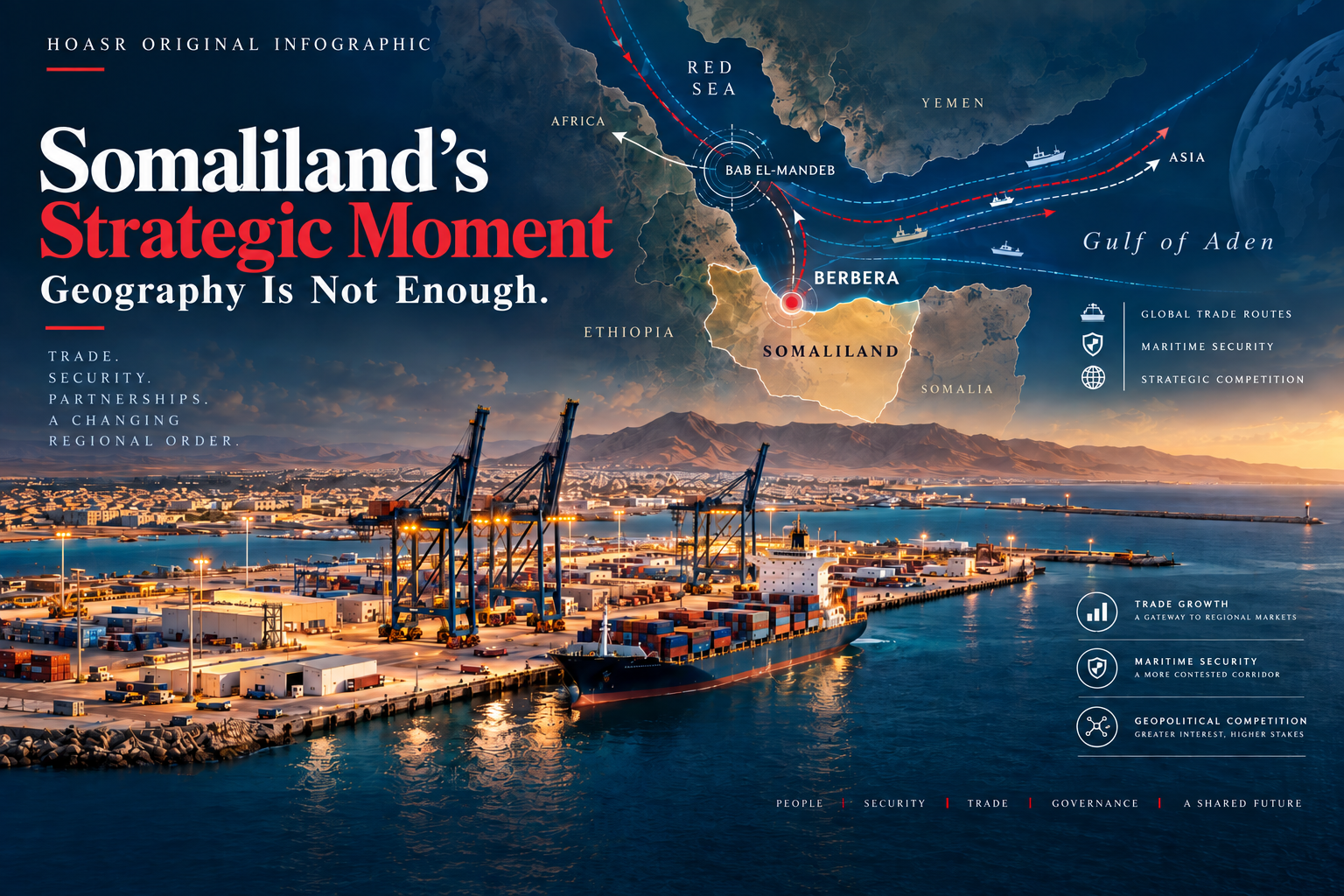
Somaliland's Strategic Moment: Berbera, maritime security and the changing geopolitical order of the Red Sea. HOASR Original Infographic.
The Red Sea’s changing security order has brought Somaliland new diplomatic attention. President Irro’s challenge is to turn that attention into lasting economic, political and security relationships before regional competition determines the terms.
For much of its modern history, Berbera has attracted the attention of outside powers without allowing Somaliland to determine the regional order around it. The port has witnessed empires, Cold War competition and the arrival of new commercial investors. Today, another geopolitical transformation is taking place across the Red Sea. This time, Somaliland has an opportunity to become more than a strategically located territory whose importance is principally determined by the interests of others.
President Abdirahman Mohamed Abdullahi Irro’s recent engagements in Washington and New York have coincided with a changing security environment. The Houthi advance around Bab el-Mandeb, the resurgence of Somali piracy and competing foreign partnerships have increased international interest in maritime access and regional security. Somaliland’s geographical position has become more relevant to several of these developments. But geography cannot negotiate agreements, attract sustainable investment or independently guarantee political influence.
That is the central challenge confronting Somaliland as it evaluates the results of Irro’s American diplomatic campaign.
The president’s September 14 appearance at the Hudson Institute and September 24 discussion at the Council on Foreign Relations placed Somaliland’s international recognition campaign before influential American foreign-policy audiences. His CFR appearance specifically addressed recognition and regional security, reflecting the close relationship between these two issues in Somaliland’s current diplomacy. Hudson Institute: Irro address | CFR: Irro discussion
These engagements provide opportunities for dialogue, but their lasting significance will depend on what follows. Congressional interest, policy discussions and favorable coverage are different from formal agreements and executive decisions. A serious assessment of the visit must distinguish between these outcomes rather than treating every meeting as a diplomatic breakthrough.
Somaliland’s international position has nevertheless acquired a new dimension. Israel’s recognition has introduced a significant diplomatic relationship, while continuing maritime insecurity has sharpened interest in the African coast of the Gulf of Aden. Washington’s relationship with Mogadishu and its regional counterterrorism commitments remain important considerations, however, and expanded engagement with Hargeisa would have to be reconciled with them.
The immediate strategic question is therefore not confined to recognition. It is also whether the United States and Somaliland can identify mutually acceptable areas of practical cooperation, supported by defined responsibilities, resources and institutions.
Across the Gulf of Aden, the security environment is becoming more demanding. The Africa Center for Strategic Studies reported on September 22 that Houthi territorial advances around Bab el-Mandeb have strengthened the movement’s position near one of the world’s most important maritime passages. Its assessment describes the resulting risks to African economies and commercial shipping. Africa Center: Red Sea assessment
A separate Royal United Services Institute analysis places Houthi advances within a wider competition involving Saudi Arabia, Israel, Türkiye, Pakistan and the United States. The region’s maritime-security challenges can no longer be understood exclusively through the military confrontation in Yemen. They are increasingly connected to competing visions of regional security. RUSI: Battle for Bab al-Mandeb
Meanwhile, renewed piracy has introduced another operational problem. Christopher Hockey’s September 23 RUSI analysis reported that six commercial vessels had been seized since late April, with four still held at the time of publication. He also examined possible connections between piracy networks and the wider conflict surrounding Yemen, while acknowledging that evidence of direct Houthi assistance remains circumstantial. RUSI: Somali piracy in 2026
These developments have increased the relevance of maritime surveillance, coastal security, port infrastructure and reliable regional partnerships. They help explain why Berbera features prominently in discussions about the Gulf of Aden. They do not, however, establish that foreign military deployments or additional security agreements are inevitable.
Somaliland must also consider the risks associated with its location. Any prospective security arrangements would require an assessment of how they might affect commercial shipping, civilian infrastructure, relations with neighboring countries and exposure to regional confrontation.
The strategic value of Berbera rests partly on its capacity to support commercial activity in an uncertain environment. Preserving that function should remain an important consideration in evaluating competing proposals for its future.
There is a second challenge that deserves equal attention. The Horn of Africa is attracting substantial international interest without achieving comparable levels of regional economic integration.
A September study published in Frontiers in Political Science by Abdirahman O. Gaas and Mohamed J. Madar examines this contradiction. Their research argues that expanding transport infrastructure across the Horn has produced competing corridors without establishing sufficiently coordinated regional markets. The study identifies institutional weaknesses, regulatory barriers and unresolved political disputes as obstacles to greater integration. Berbera provides an important example of both the opportunities and limitations of this development. Frontiers: Corridor statecraft research
The implications for Somaliland extend beyond the port itself. Larger container terminals, improved roads and international investment provide the physical foundations for commercial growth. Their long-term economic contribution depends on the movement of goods, access to markets, predictable regulations and the ability of local businesses to participate in expanding commercial activity.
The port’s success should ultimately be measured not simply by the attention it attracts from foreign governments, but by its economic performance and contribution to Somaliland’s development.
The same principle applies to international partnerships. Research published by the Institute for Security Studies on September 18 examines how African countries might gain greater negotiating influence from competition among external powers. It also warns that competing security and commercial relationships could deepen regional fragmentation instead of strengthening African economies. ISS Africa: Red Sea rivalries
For Somaliland, this presents a practical diplomatic challenge. Its relationships with Israel, the UAE, Ethiopia, Taiwan and prospective additional partners serve different political, economic and security purposes. The government will need to consider their individual benefits, their compatibility and the consequences of becoming too dependent on any particular external arrangement.
Somalia’s relationships with Türkiye and other regional partners must also be considered within this wider environment. The danger for the Horn is that competing international partnerships could reinforce existing political divisions, making regional cooperation on trade and maritime security more difficult.
Somaliland’s response requires more than pursuing recognition or attracting another external security partner. It requires a coherent understanding of how diplomatic engagement, commercial investment and maritime cooperation can reinforce one another while preserving sufficient flexibility to work with countries whose regional interests differ.
The government’s diplomatic campaign can be assessed against several concrete indicators: documented agreements arising from Irro’s American engagements, progress in commercializing the Berbera Corridor, expanded access to international financial and commercial institutions, and the development of sustainable maritime-security capabilities. These would provide a clearer account of Somaliland’s changing international position than the number of diplomatic meetings or speculative reports about possible foreign deployments.
The Red Sea’s emerging strategic order will involve negotiations among governments whose priorities do not necessarily coincide. Somaliland cannot determine the outcome of every regional rivalry. It can, however, develop the institutions, commercial relationships and diplomatic capacity needed to participate in decisions affecting its future.
For decades, external powers have recognized Berbera’s geographical significance, approaching the port according to their changing strategic requirements. The present transformation offers Somaliland another opportunity to redefine its international role.
The measure of this strategic moment will not be how many foreign powers become interested in Berbera, but what Somaliland is able to build from that interest.
Geography has brought Somaliland into the international conversation. What happens next will depend on diplomacy, economic performance, institutional capacity and decisions that extend well beyond the recognition debate.
Related Topics
Related Posts