An Aging Jewish Feminist
Vayera: Trauma, Moral Choice, and the Possibility of Another Way
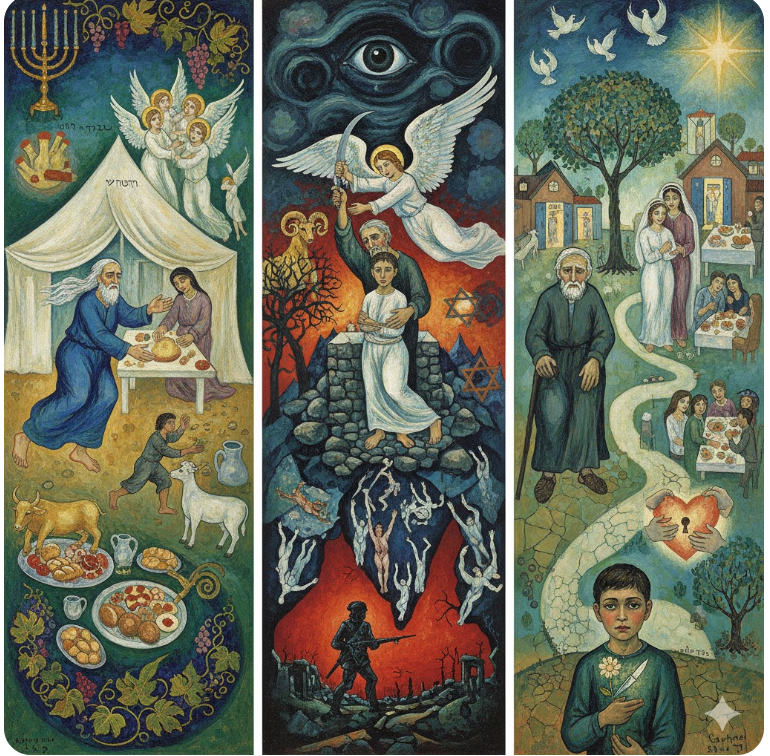
Parshat Vayera contains some of the most disturbing and some of the most hopeful stories in the Torah. It begins with Abraham opening his tent to strangers and ends with the Akedah, the binding of Isaac. Between these two episodes are stories of destruction, exile, testing, hospitality, fear, and moral choice.
This year, reading Vayera in Israel feels particularly charged. We are living with the continuing consequences of October 7, 2023, with memories of war and loss, and with the psychological wounds that have not disappeared simply because the immediate crisis has changed. Today, October 27, 2026, Israelis are going to the polls in the first national election since October 7. The election itself is a reminder that trauma is not only something we remember; it shapes the choices we make about the future. Perhaps that is why Vayera feels so relevant now. Its stories ask a fundamental question: How do we respond to trauma without allowing it to determine who we become?
- The Akedah and the Problem of Blind Obedience
The portion concludes with the Akedah, the binding of Isaac. Genesis 22 begins:
“After these things, God tested Abraham.”
God then commands Abraham to take his beloved son Isaac and offer him as a burnt offering. Abraham does not argue. He sets out to do what he has been told. The Akedah has consequently become one of the central texts of Jewish spiritual consciousness. Yet it is also one of the most horrifying. Søren Kierkegaard called the story an experience of “fear and trembling,” and Tikva Frymer-Kensky described the Akedah as, “in its stark horror and ambiguous statements,” a story that remains central to our spiritual consciousness.
What kind of God demands such obedience? And what kind of human being obeys without protest? The rabbis were clearly troubled by these questions. Rashi, following Sanhedrin 89b, introduces Satan into the story. Satan accuses Abraham of being devoted to God only because God has been good to him. God responds, in effect, that Abraham would even be willing to sacrifice his son. The story therefore begins to resemble the Book of Job: God permits a human being to become the object of a test. But why must Abraham be tested in this way? And why does God need to discover whether Abraham will obey an immoral command?
These questions become even more troubling when we remember that Abraham is capable of arguing passionately with God about Sodom. When God announces the destruction of the cities, Abraham protests:
“Shall the Judge of all the earth not deal justly?”
Yet when God tells him to sacrifice Isaac, Abraham says nothing. That contrast is crucial. Abraham knows how to challenge God on behalf of strangers, but not necessarily on behalf of his own son. And then something happens that changes the story.
At the decisive moment, Abraham raises his eyes and sees a ram caught in a thicket. The Hebrew word describing the ram is achar, a word that can mean “behind,” “after,” or “another.” Traditionally, the verse is translated as saying that Abraham saw a ram behind him. But the ambiguity invites another reading: Abraham sees another possibility. This is the reading that speaks most powerfully to me. The great moment of the Akedah is not Abraham’s willingness to kill Isaac. It is his recognition that there is another way. Abraham lifts his eyes. He sees. And he chooses the ram.
The angel has stopped his hand, but Abraham himself must still make the choice. He could continue along the path of absolute obedience. Instead, he recognizes a substitute. The cycle of human sacrifice can stop. The word achar thus becomes almost a theological principle: There is another way. And this possibility becomes even more important when we think about trauma.
- Living With the Knife in Our Hearts
The Akedah did not end with Isaac’s death. Isaac survived. But the experience remained with him—and, according to Hayim Gouri, with all his descendants. Gouri’s poem “Heritage,” written in the shadow of the Holocaust, imagines the knife becoming part of Jewish inheritance. Isaac was not sacrificed, Gouri reminds us, but:
“He bequeathed that hour to his descendants.
They are born
With a knife in their hearts.”
This is a profound description of inherited trauma.
Wilfred Owen’s “The Parable of the Old Man and the Young,” written during World War I, goes in the opposite direction and imagines Abraham actually killing his son. In both poems, the Akedah becomes a metaphor for what happens when obedience, violence, and sacrifice become normalized. The challenge for us is therefore not simply to remember trauma. It is to ask what we do with it.
This question has become painfully concrete in Israel. The dates surrounding Vayera often coincide with two deeply traumatic events in modern Jewish history: Kristallnacht, November 9–10, 1938, and the assassination of Yitzhak Rabin on November 4, 1995. Both events left wounds that continue to reverberate. And now there is October 7.
The question is not whether we have suffered. We have. The question is whether suffering must inevitably produce more suffering; whether fear must produce more fear; whether violence must reproduce itself.
The Akedah offers an unsettling answer: perhaps the crucial moment comes when someone recognizes that there is another way. That brings us back to the opening of Vayera, because the portion offers us a strikingly different model of Abraham.
- From Sacrifice to Hospitality
Before Abraham becomes the father who binds his son, he is the man who welcomes strangers. Abraham is sitting at the entrance of his tent on a hot day when he sees three figures approaching. He runs toward them and says:
“My lords! If it please you, do not go on past your servant.”
He offers water, rest, food, and shelter. He orders Sarah to prepare cakes from the finest flour and chooses a tender calf from his herd. What he calls “a morsel of bread” becomes a lavish meal. This is not passive hospitality. Abraham runs. He organizes. He provides. He notices strangers and responds to their needs.
The contrast with the Akedah is striking. In one story, Abraham is prepared to sacrifice his son because he believes God demands it. In the other, he encounters vulnerable strangers and instinctively seeks to preserve and nourish life. Which Abraham do we want to inherit?
The question has particular force in contemporary Israel. After October 7, enormous numbers of Israelis were evacuated from their homes. Many arrived traumatized, carrying little more than what they were able to take with them. In communities such as Omer, ordinary citizens opened their homes and organized food, furniture, appliances, clothing, transportation, technical assistance, and medical and psychological support. Many of the people doing this work were women—professionals in their forties and fifties, mothers, senior citizens, former soldiers, and women whose husbands were themselves serving in the army. They became an army of helpers.
Their actions reminded me of Abraham and also of Rebecca, who later encounters a stranger and not only gives him water but waters his camels. This is a different kind of heroism. It does not require killing or sacrificing anyone. It requires noticing another person’s vulnerability and responding.
During the war, I saw this hospitality personally as well. When my husband experienced chest pains, we ended up spending the day in a hospital in Beersheba. Our children were abroad, but friends appeared at the emergency room without being asked. One friend waited with us, helped us navigate the unfamiliar situation, and was eventually replaced by another friend who was a doctor. Their presence transformed a frightening experience.
I found myself thinking about Abraham again. Hospitality is not only about inviting people into one’s home. It is about saying: You are not alone. I see you. I will stay with you. And perhaps this is precisely what trauma requires. We cannot undo what happened. We cannot restore the dead or erase the memories of those who survived. But we can refuse to abandon one another.
- Choosing Life—and Another Way
This brings us to today. As Israelis vote in the 2026 Knesset election, the country is making choices about its future. This is the first national election since October 7, and the campaign has inevitably been shaped by questions of security, responsibility, leadership, military service, democracy, and the legacy of the war. Polling before election day has shown a closely contested race, with neither the Netanyahu bloc nor the opposition assured of the 61 seats needed to form a government. I do not know, as I write this, what the voters will decide. But Vayera gives us a useful framework for thinking about the choice.
There is Abraham who follows an order without questioning it. There is Abraham who argues with God when innocent people are threatened. There is Abraham who sees a stranger and opens his home. And there is Abraham who raises his eyes and discovers that another way is possible. These are not four different Abrahams. They are different possibilities within the same complicated human being.
Perhaps that is why the portion continues to speak to us. We, too, are complicated. We carry fear and generosity, anger and compassion, despair and hope. We inherit memories that can either imprison us or teach us.
The Torah itself gives us a vocabulary for the choice. In Deuteronomy, Moses tells the people:
“I have put before you life and death, blessing and curse. Choose life.”
Choosing life does not mean forgetting death. It does not mean denying evil or pretending that suffering has disappeared. It means refusing to allow death to become our only language. Hayim Gouri’s image of being born “with a knife in our hearts” is powerful because it acknowledges how deeply violence has entered our inheritance. But the Akedah also gives us another image: Abraham raising his eyes and seeing something he had not seen before: Achar. Another.
Perhaps that is the challenge of this moment in Israel. After years of trauma, fear, war, political division, and loss, can we raise our eyes? Can we see the ram? Can we recognize that history does not have to repeat itself exactly as it has before? Can we choose a response to trauma that does not require us to become traumatizers?
Today, as Israelis go to the polls, we are choosing political leaders and parties. But beneath that political choice lies a deeper human and Jewish question: What kind of society do we want to become?
The answer cannot be found only in military strength or political victory. It must also be found in the willingness to protect the vulnerable, welcome the stranger, care for those who have been traumatized, demand moral accountability, and refuse to confuse obedience with righteousness.
Vayera begins with hospitality and ends with sacrifice. Perhaps we need to reverse that trajectory. Perhaps the future begins when we learn to see differently. Perhaps the most important inheritance of the Akedah is not the knife. It is the moment when Abraham looks up, sees the ram, and realizes: There is another way.
We have been living through a very long, dark tunnel. We have seen what happens when power is concentrated in too few hands, when leaders refuse to change course, and when the voices of those who question, warn, and imagine alternatives are pushed aside. Perhaps now, more than ever, we need to learn to see differently—and to insist that there is another way.
And perhaps it is time for experienced women to be part of creating that way. Not as symbols, not as advisers brought in after the important decisions have already been made, but as leaders—with a seat at the table, a voice in the decisions, and the authority to shape our future. Women who have lived through war, loss, political upheaval, raising families, building communities, and starting over have a particular kind of wisdom. We should not have to wait until we are asked to use it.
My grandson suggested that I start a new political party. Perhaps he was joking. Perhaps he wasn’t. In any case, he created this graphic for me. NZF: NASHIM ZEKANOT FEMINISTIOT: A PARTY OF AGING FEMINISTS!! THE POWER OF EXPERIENCE!
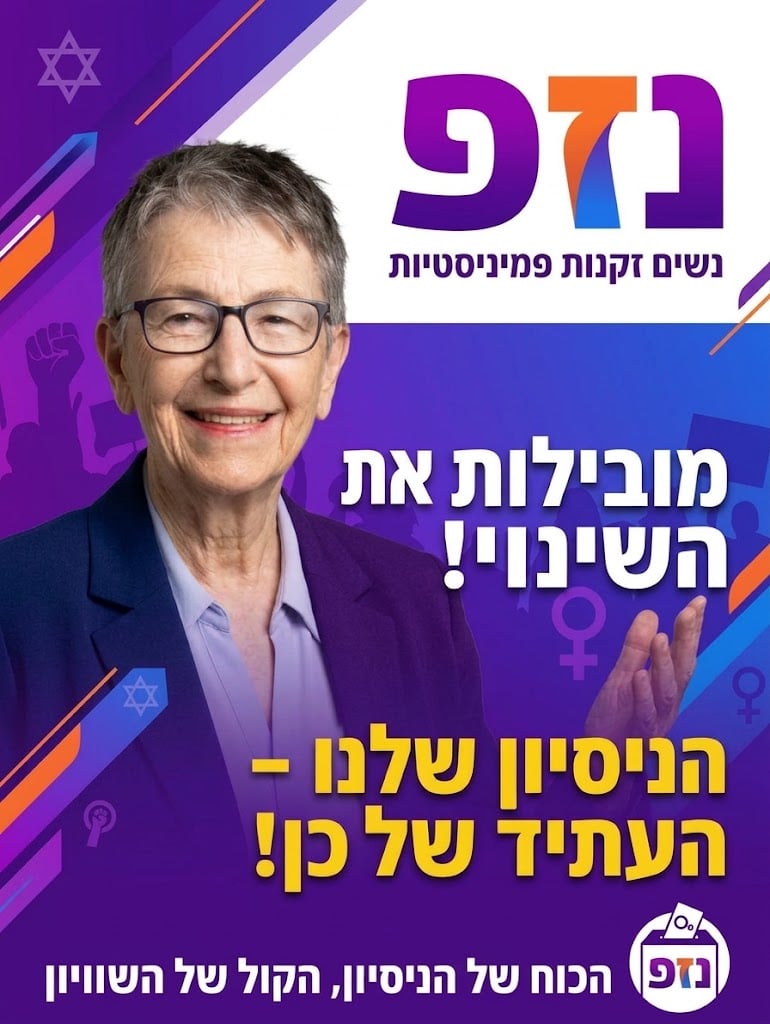
Maybe this is what hope looks like: not waiting for someone else to save us, but imagining that we can build something different ourselves.
We have seen the knife. Perhaps now it is time to look up—and choose another way.