Former Jewish Prison Chaplain / Co-Founder: L’chaim
Vengeful Punishment, Politics Ultimately Motivate Ben-Gvir’s Death Penalty Bill
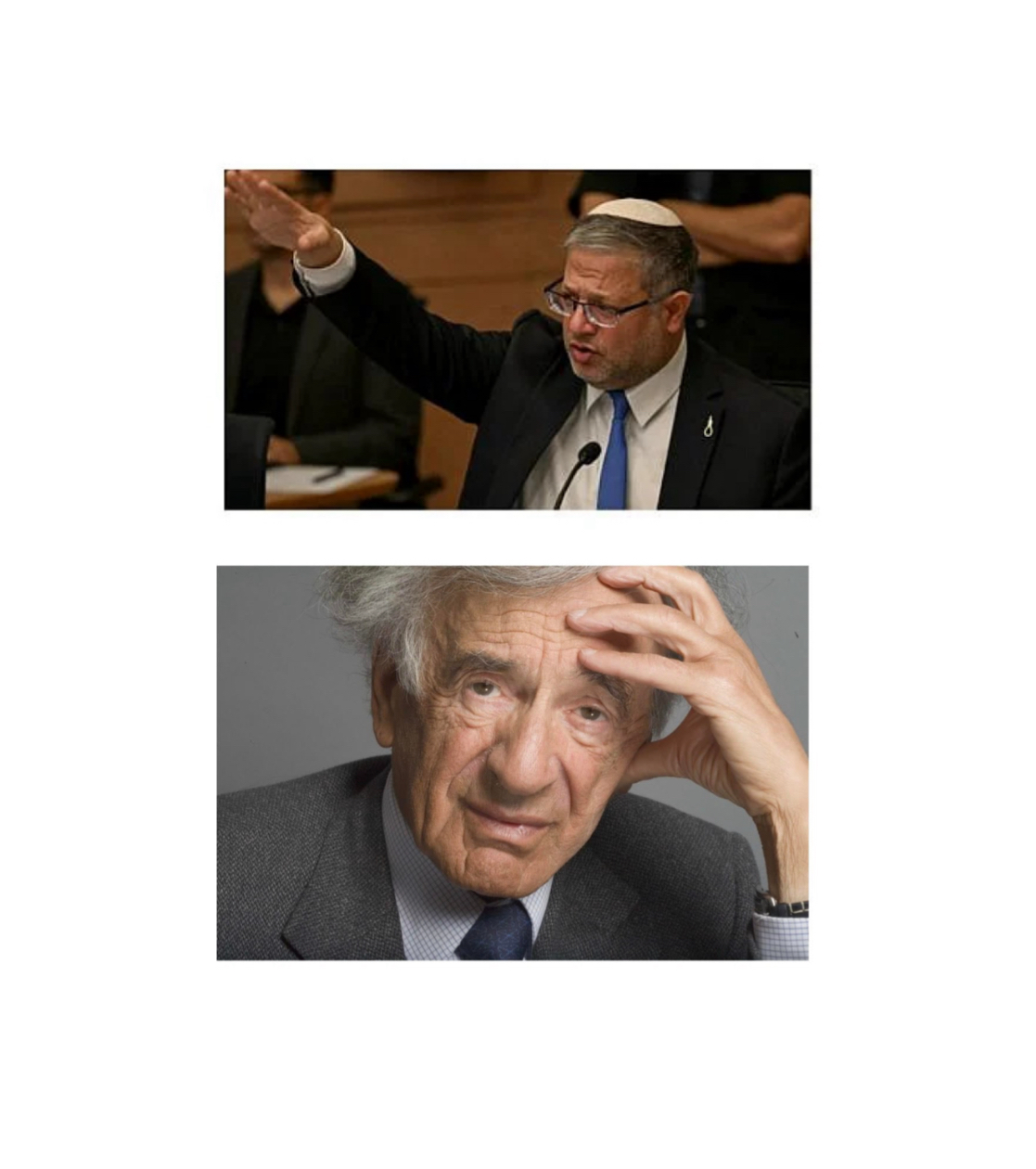
Composite Image: Top: National Security Minister Ben-Gvir, Israel’s prime death penalty bill proponent, wearing a golden noose-shaped pin at the Knesset, December 2025. No copyright. Credit: Naama Grynbaum. Bottom: Holocaust survivor and Nobel Peace laureate Elie Wiesel. Of capital punishment, Wiesel said: "Death should never be the answer in a civilized society." Photo source: https://www.jewishrichmond.org/jcrc/public-statements/jcrc-statements-comments-articles/public-statement-the-passing-of-elie-wiesel No copyright.
National Security Minister Itamar Ben Gvir, the prime proponent of Israel’s proposed death penalty for terrorists bill, recently revealed the real motivation behind his lethal initiative: vengeful punishment and political advancement. Ben Gvir showed his hand as to the true motivation for the legislation he is championing when he spoke at the funeral of fallen police officer Ran Gvili, Z’L, of blessed memory, the final hostage returned from Gaza. On that sacred, somber occasion, he said to the gathered mourners: “Punishment for the terrorists, those who raped our women and killed our children deserve the punishment of death.”
B’vir’s comment marks a blatant attempt to exploit mourners to gain political capital in this election year. It marks the latest in a deplorable campaign of noose-lapel-laden political theater that glorifies killing and sanctifies revenge. Ben Gvir, no doubt, calculated that his invoking the penalty of death would be met with applause by individuals naturally experiencing overwhelming, understandable feelings of sadness and anger. Ben G’vir’s approach echoes those of some of the most dangerous political figures the world has known.
In his advocacy for revenge, Ben G’vir has positioned himself in diametric opposition to the massive scale of rabbinic voices and Jewish human rights luminaries who stand firmly against the death penalty. Just today, various global Jewish organizations reflected this reality when they released a statement that called out Ben-Gvir’s bill as “racist, discriminatory, and indefensible.” Many have attempted to justify the potential execution of convicted terrorists by parroting Ben Gvir’s disproven, false claims that putting them to death would help deter future acts of terror. Logic, of course, dictates that the opposite is true: this bill would only incite more martyrs and invite more murders in Israel.
Few in recent memory knew this better than Holocaust survivor, Nobel laureate, and staunch death penalty abolitionist Elie Wiesel (1928-2016). More than most, Wiesel viscerally grasped the danger of giving the state the power to kill its prisoners. He would no doubt reiterate his inflamed opposition to the death penalty in all forms if he were alive today and asked about Israel’s proposed death penalty bill for convicted terrorists now, after the return of the final remaining Gaza hostage.
Wiesel expounded upon the subject of the death penalty for a 1989 recording he made with other death penalty abolitionists entitled Lighting the Torch of Conscience, in which he stated the following:
“Death should be opposed, not served. I have seen too much death in my life. I have met too many people who served death in my life…
There is no reason in the world why death should be imposed by people of good will, of intelligence, of kindness – people in the name of justice – on other people. Those who sinned – those who committed crimes – can be punished in other ways, but not with death. When we impose death on others, we are doing something to ourselves…
With every cell of my being and with every fiber of my memory, I oppose the death penalty in all forms…
I belong to a tradition – a Jewish tradition – that says that when a Sanhedrin in ancient times pronounced one death sentence in its entire tenure, that Sanhedrin – that Supreme Court – was called murderous.”
It is not difficult to discern from Wiesel’s stated position how he would respond to the notion that the modern Israeli government might execute not one, but potentially hundreds of convicted terrorists.
Some critics have argued that Wiesel was on record stating, as late as 1990, that he made an exception for convicted Nazis like Adolph Eichmann. Like Wiesel, this author, too, once supported the death penalty for those who murdered my family members in the Holocaust. Just as my mind shifted on this point, so, it seems, did Wiesel’s by the end of his life.
A public statement that Wiesel made six years before his death on October 27, 2010, reflects this apparent change of heart. It also offers crucial insights for the Jewish world in this moment of mourning for the sacred souls murdered in Gaza. Wiesel was speaking out against the death penalty during a lecture on capital punishment at Wesleyan University in Connecticut. Earlier that day at a press conference, a journalist asked him about his feelings on the possible execution of the perpetrators of a horrific home invasion that had taken place in nearby Cheshire, CT, in 2007. As a Connective native myself, I shall never forget that case, which all the local news stations carried at the time. On July 23, 2007, Linda Hayes (born Steven Hayes) and Joshua Komisarjevsky invaded the residence of the Petit family in the small town of Cheshire. Though initially planning only to rob the house, Hayes and Komisarjevsky horrifically raped, attacked, and murdered Jennifer Hawke-Petit and her two daughters, 17-year-old Hayley Petit and 11-year-old Michaela Petit. They mercilessly burned young Hayley and Michaela alive. Their father, Dr. William Petit, escaped with severe injuries. The Hartford Courant cited this case as “possibly the most widely publicized crime in the state’s history.”
When asked for his opinion on the death penalty for the perpetrators, Wiesel focused his remarks on people like Dr. Petit and himself, both of whom were family members of murder victims. (Wiesel lost both parents and a sister in the Nazi death camps.) He indicated that society should punish such murderers more harshly than other prisoners and encouraged the criminal justice system to focus efforts on the survivors of violent crimes “so that families will not feel cheated by the law.” “But,” he said, “death is not the answer.” He emphasized that he might change his stance if the death penalty could bring back victims, which, of course, it could not. “I know the pain of those who survive,” Wiesel said. “Believe me, I know… Your wound is open. It will remain. You are mourning, and how can I not feel the pain of your mourning? But death is not the answer. He concluded: “Death should never be the answer in a civilized society.”
Wiesel’s words are a clarion call. They reveal that by the end of his life, he would have stood firmly against Israel’s bill now. The thousands of members of “L’chaim! Jews Against the Death Penalty,” of which I serve as co-founder, carry the torch that Wiesel lit in Jewish minds, hearts, and souls across the Jewish world. May his words echo throughout the collective consciousness of all Israelis now as their nation considers enacting this abomination, of which Ben Gvir is fanning the flames through his detestable charades. Wiesel’s statement should serve as a mantra for our world when anyone – including Israel – raises the barbaric scepter of a return to capital punishment.
Wiesel no doubt would agree that if the Knesset were to play into Ben Gvir’s hands and pass into law his proposed death penalty, it would serve as a recipe for moral disaster for Israel and for all world Jewry. It violates the human right to life, always constitutes torture, risks executing the innocent, is racist in its application, and – from Adolf Hitler to Donald Trump to Ben-Gvir – has been used as a political tool, particularly during election campaigns. Furthermore, many execution methods are direct Nazi legacies, including firing squad, gassing, and lethal injection. Members of the Knesset – and all death penalty proponents – should heed Wiesel’s message and the thousands of rabbinic voices that stand with him in recognizing that executions are never the answer – and that Israel’s proposed death penalty bill should not be the answer now.
Cantor Michael J. Zoosman, MSM, BCC
Co-Founder: L’chaim! Jews Against the Death Penalty
Advisory Committee Member: Death Penalty Action
Related Topics
Related Posts