


A Day in the Life
Victims of Terror and Veterans Could Lose if We Win
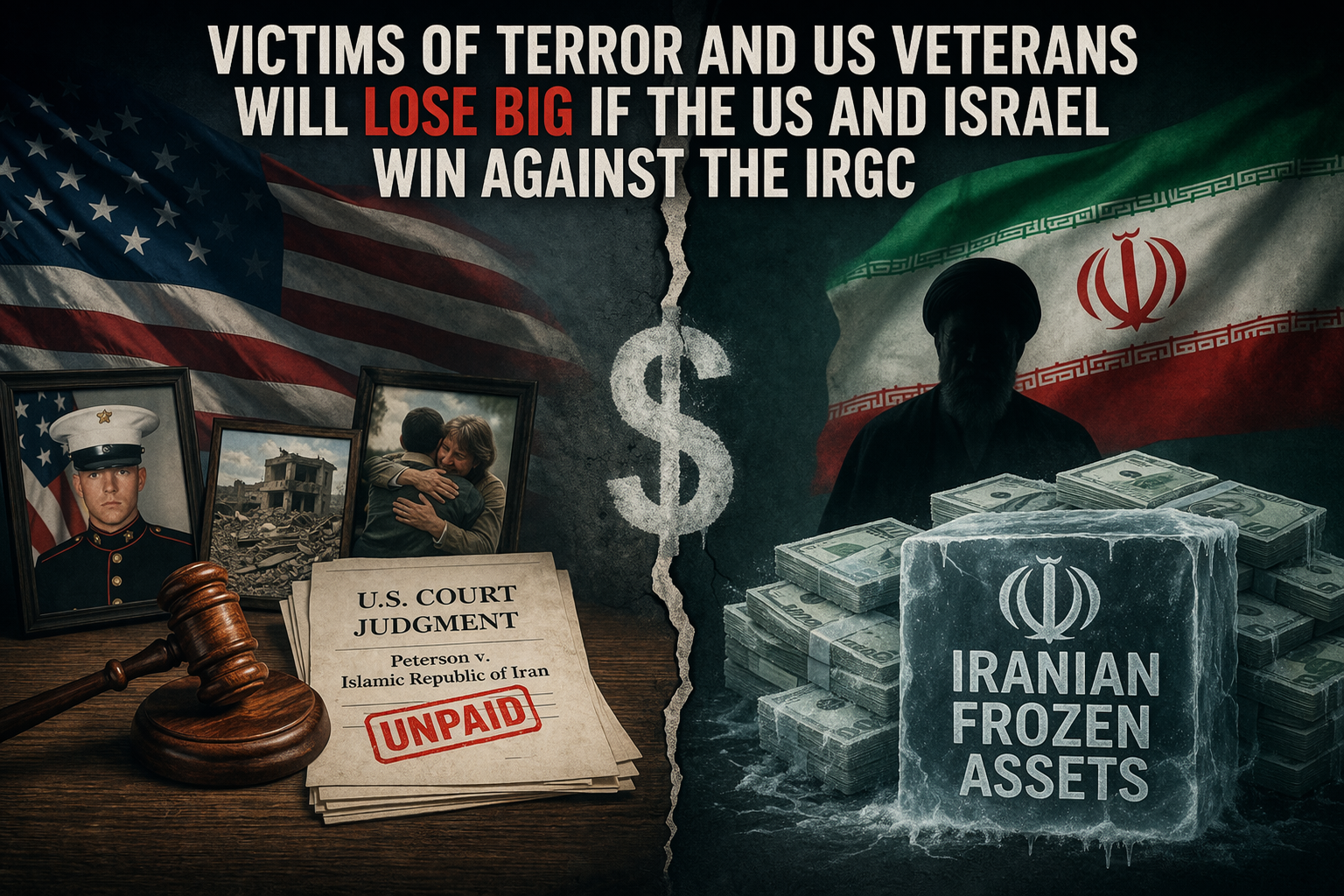
Veterans and Victims will lose big if IRCG falls before there is a plan. Imge is Free and fair use created byMiftan Labs
The United States and Israel are winning the military campaigns against Iran. But if the Islamic Republic collapses, 21,723 American families who won court judgments against the regime may never see a dollar.
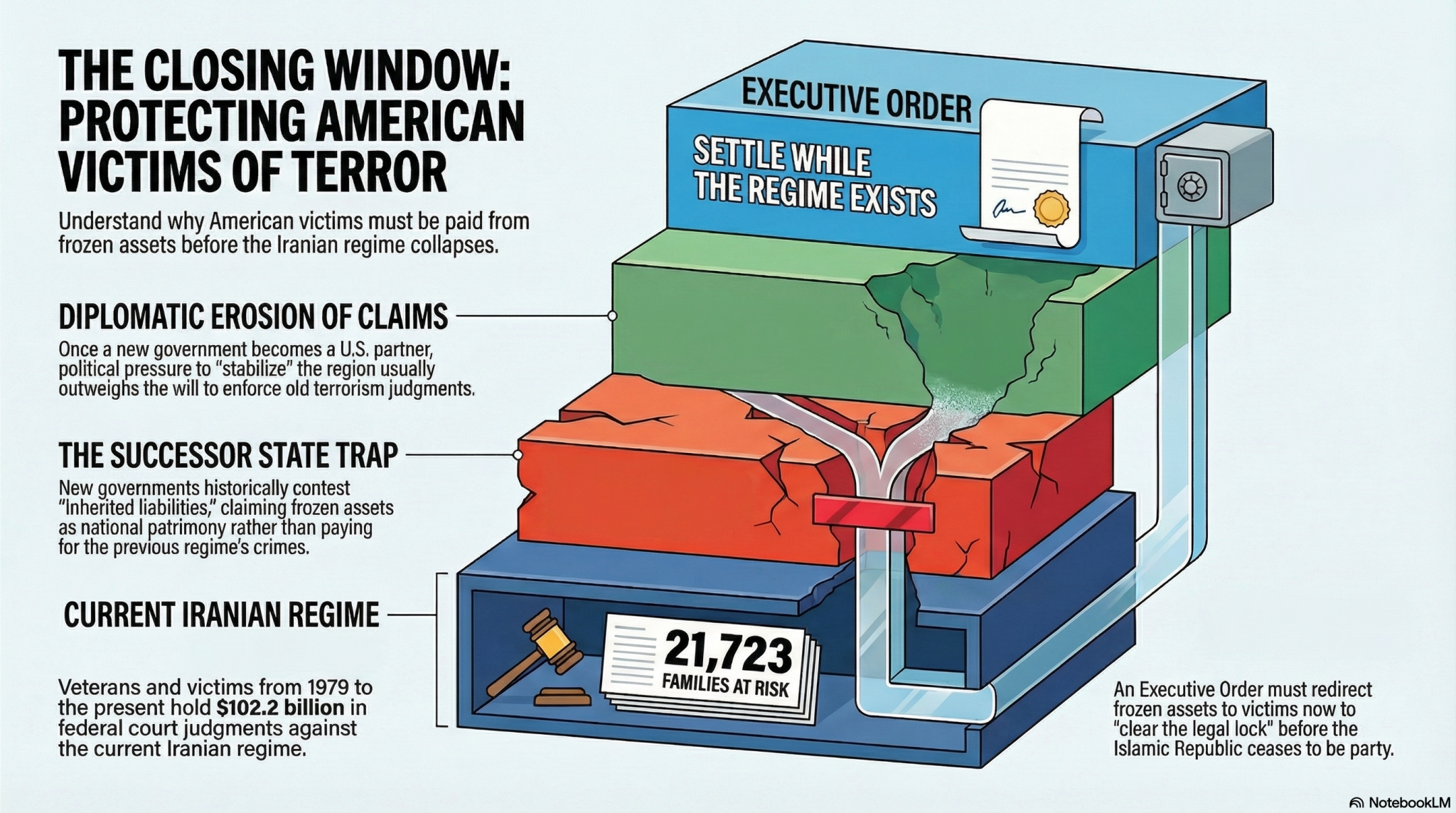
These judgments are against the Islamic Republic of Iran. Not Iran the country. The Islamic Republic — the specific legal entity that exists right now, today, as the recognized government. Which will no longer exist if the regime collapses or loses the war. A new entity will exist and it will not see itself as responsible for the misdeeds of the regime. It will want to start a new government with a clean slate. And that itself is legitimate for the people of Iran.
This problem should be keeping every veteran advocate, every Gold Star family attorney, and every member of Congress up at night.
The Numbers
Nearly 22,000 claimants are now eligible for compensation. After five rounds of payments, $102,238,100,613.37 remains outstanding. Sixth-round 9/11 claimants received just 1.64% of their eligible amounts. (sources listed at the bottom of post and available here)
These are not abstract figures. Beirut Marine barracks families — 241 Marines killed on October 23, 1983 — have been waiting 43 years. The case produced over $2.66 billion in judgments for more than 150 service members and their relatives.*** The original Iran hostage families — 52 Americans, 444 days in captivity — have been waiting 47 years. 9/11 families won a $10.5 billion judgment after federal courts found Iran liable for providing material support to the attackers.**** Iraq and Afghanistan veterans — 503 plaintiffs including 183 Gold Star families — won judgments between 2022 and 2025 against Iran for providing the explosively formed penetrators that killed and maimed their loved ones.*****
The Problem
If the Islamic Republic falls — which is the trajectory of the current military campaign — the liable party ceases to exist. A successor government, whether democratic, military, or chaotic, will immediately claim the frozen assets as Iran’s national patrimony and argue that the terrorism judgments were against the old regime, not them.
This has happened before. When the Soviet Union dissolved in 1991, Russia negotiated assumption of approximately $66 billion in Soviet debts — but only after extensive negotiation, and many individual claims were never resolved. When Iraq’s government fell in 2003, the successor government negotiated an 80% reduction of Saddam-era debts through the Paris Club. The $959 million in Gulf War POW judgments were effectively nullified when Executive Order 13290 confiscated the assets before the judgments could attach.
The International Law Commission’s own guidelines use weak language — requiring only “negotiation,” not automatic assumption of predecessor debts. The families would be back in court, potentially for decades, with no guarantee of ever seeing a dollar.
The more successful the military campaign is, the faster this will happen and the closer these families get to losing everything they are owed. Victory is the threat.
A Possible Solution
From a game theory perspective, the Miftan Protocol offers a solution: use frozen Iranian assets to pay a negotiated settlement while the Islamic Republic still legally exists as the liable party.
Between $100 billion and $120 billion in frozen Iranian assets have been accumulating for up to 47 years across multiple countries. South Korea holds approximately $7 billion. Japan holds $1.5–3 billion. Iraq holds $5–10 billion. China holds $20–30 billion plus approximately $3 billion per month in ongoing oil purchases. The US, EU, UK, and others hold the rest.
The legal tools to redirect these assets already exist. And they have already been used.
In September 2023, the Biden administration transferred approximately $6 billion in frozen Iranian assets from South Korean banks to restricted accounts in Qatar as part of a prisoner exchange — using executive authority alone, no legislation required. The funds were subsequently refrozen after October 7. Not a single dollar has been disbursed in over two and a half years. The episode demonstrates two things: the executive branch has the authority to move frozen Iranian assets quickly when political will exists, and without a plan for what to do with them, the money just sits there.
Three U.S. statutes, already on the books, create the full chain of authority:
IEEPA (International Emergency Economic Powers Act, 1977) — Section 1702(a)(1)(C), added by the USA PATRIOT Act, gives the president authority to confiscate foreign state property during armed hostilities. Not just freeze it — take title to it. President Bush used this exact provision in 2003 via Executive Order 13290 to confiscate approximately $1.7 billion in Iraqi assets. Courts upheld the action.
TRIA (Terrorism Risk Insurance Act, Section 201, 2002) — makes blocked assets of state sponsors of terrorism subject to attachment to satisfy terrorism judgments. Iran is a designated state sponsor of terrorism. The assets are blocked. The judgments exist. TRIA connects them. The Supreme Court affirmed the core mechanism in Bank Markazi v. Peterson (2016).
JASTA (Justice Against Sponsors of Terrorism Act, 2016) — enacted by Congress overriding a presidential veto, 97-1 in the Senate. Strengthened standing for certain terrorism claimants, including 9/11 families.
Together: IEEPA provides the authority to confiscate the assets. TRIA provides the mechanism to attach them to terrorism judgments. JASTA supplements standing. No new legislation is strictly required.
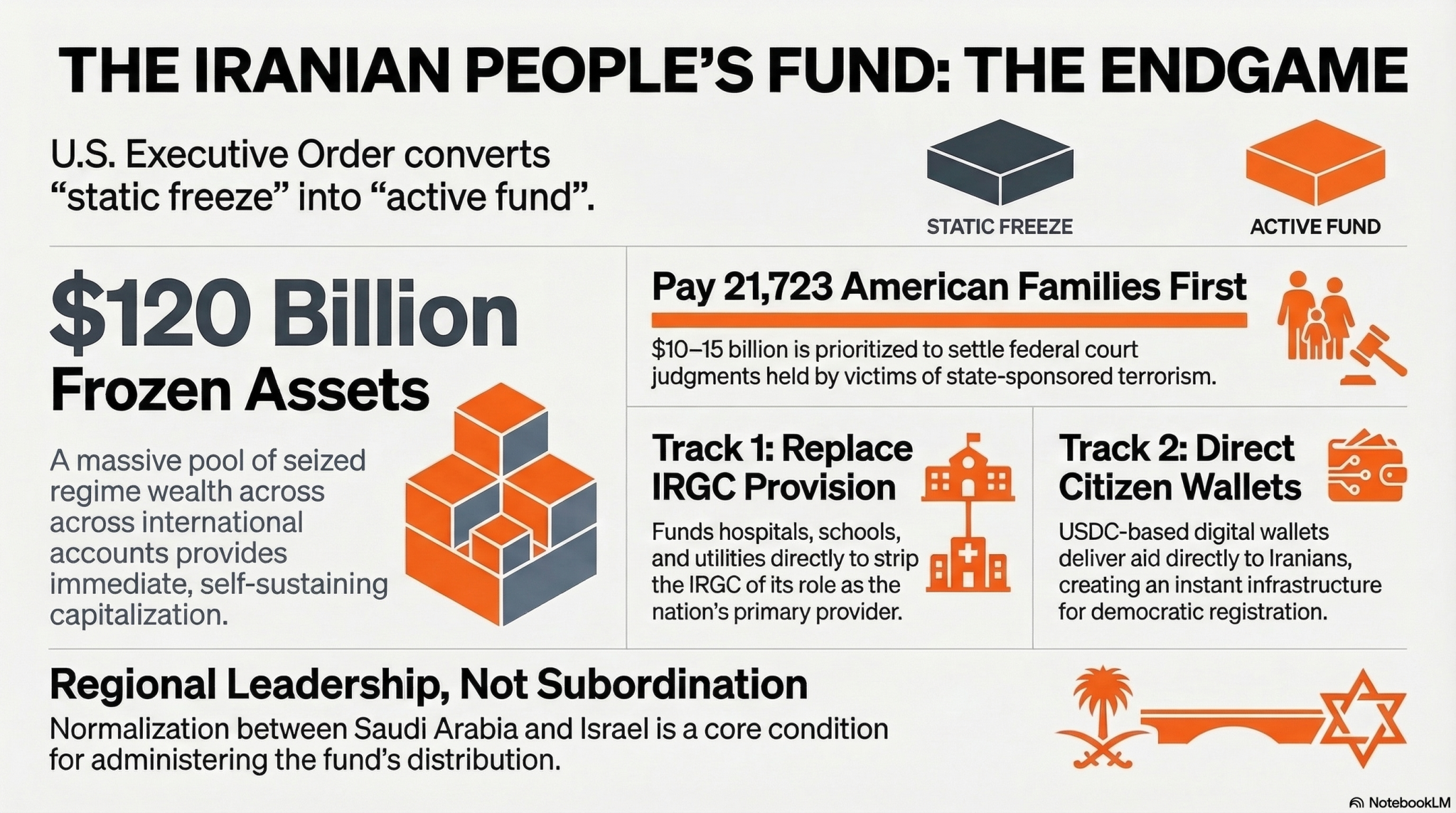
One executive order from President Trump could settle these claims. Pay the families from the frozen asset pool — a negotiated settlement, modeled on the 9/11 Victim Compensation Fund which achieved 97% claimant acceptance — before a single dollar goes anywhere else. Mass tort settlements against sovereign defendants historically resolve at 5–15% of judgment value. At that range, $10–15 billion covers the settlement. The money is there. It has been there for 47 years.
The Urgency
The settlement must be executed while the Islamic Republic still legally exists as the liable party. Every day of military success brings us closer to the moment when that entity disappears and the legal claims become ambiguous. The window closes whether we win or lose. It closes either way.
This is not a partisan issue. These are Marine families. Hostage families. 9/11 families. Veterans who lost limbs to Iranian-made bombs. They have been waiting decades. They won their cases in court. The money exists. The legal authority exists. The only thing missing is the signature.
President Trump has an opportunity to do something no president has done — pay American terrorism victims what they are owed, from the assets of the regime that harmed them, at zero cost to the American taxpayer. But only if it happens now.
I wrote about this in detail as part of the Miftan Protocol and the Iranian People’s Fund — a broader framework for how frozen assets can serve as the endgame for this war. The victim settlement is the first priority. Everything else follows.
What I created is one option, based on the law and the facts that I have access to. I’m not sure what other possible solutions exist, but we need to start discussing this now and putting a plan in place.
The full Miftan Protocol white paper, the Iranian People’s Fund white paper, the Legal Landscape analysis, and the Verifiable Claims Fact Sheet sourcing every figure cited here are all available for download at www.miftanlab.com/miftanprotocol.
The bombs are doing their job. The courts have done their job. The families have done their job. Now someone needs to do the paperwork before the window closes and 43 years of waiting turns into forever.
Sources
* U.S. Department of Justice, Office of Public Affairs, January 7, 2026: “More than 1,300 new claimants qualified to join the Fund, bringing the total number of eligible claimants to nearly 22,000.”
** USVSST Fund Special Master, 2025 Congressional Report, as reported in Congressional Research Service Product IF10341: “After the fifth-round payments, $102,238,100,613.37 will remain outstanding.”
*** Peterson v. Islamic Republic of Iran; Cohen Milstein ($1.5B+ in judgments for 150+ service members and relatives). U.S. Department of Defense historical record.
**** Havlish v. bin Laden (2011); In re Terrorist Attacks (ongoing). U.S. District Court, Southern District of New York. $10.5B judgment (March 2016).
***** Willkie Farr & Gallagher: $455M (Neiberger, 2022); Cabrera/Zambon (2022). 503 plaintiffs including 183 Gold Star families.
****** Acree v. Republic of Iraq, D.C. Cir. 2004. Soviet dissolution: Alma-Ata Protocol (1991). Iraq debt: Paris Club restructuring, UN Compensation Commission records. ILC: Vienna Convention on Succession of States (1978/1983); Leiden Journal of International Law (April 2025).
******* Congressional Research Service (CRS Product IF10341); U.S. Treasury OFAC reports. Country-level figures: Bank of Korea/Reuters (South Korea); Japanese Ministry of Finance/Nikkei Asia (Japan); Central Bank of Iraq/U.S. Treasury (Iraq); Kpler/Vortexa/CSIS Energy Program (China oil purchases).
******** Smith v. Federal Reserve Bank of New York, 2d Cir. 2003; Acree v. Republic of Iraq, D.C. Cir. 2004. IEEPA confiscation authority: 50 U.S.C. §1702(a)(1)(C), added by USA PATRIOT Act §106 (P.L. 107-56, October 26, 2001). Bush EO: Executive Order 13290 (2003).