
An Aging Jewish Feminist
Wagonloads of Tears: Power, Hunger, and Responsibility in Parshat Vayigash
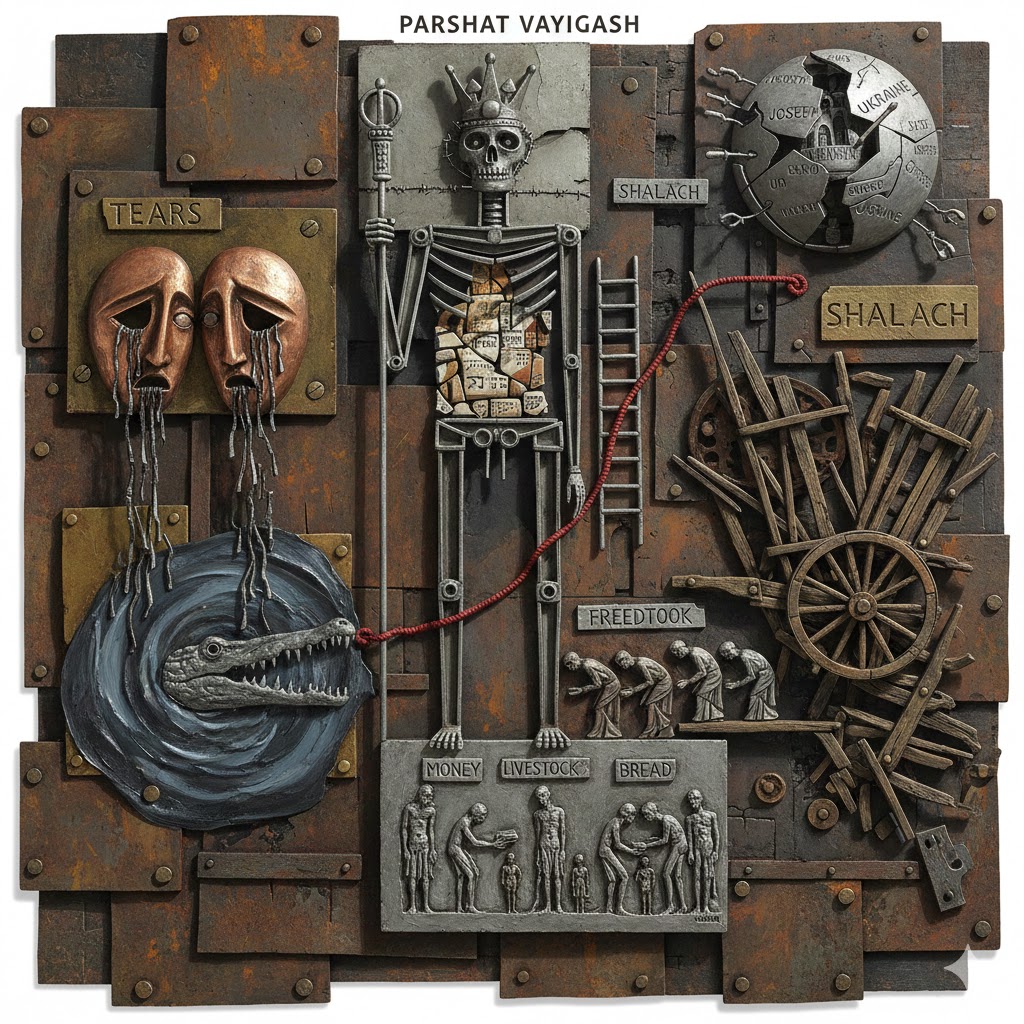
Parshat Vayigash opens where last week’s parsha, Miketz, left us with a cliffhanger. The goblet has been found in Benjamin’s sack, and Joseph pronounces judgment: “Only the one in whose possession the goblet was found shall be my slave; the rest of you go back in peace to your father” (Genesis 44: 17). We are left for a week imagining the unbearable consequences. This week Judah steps forward and delivers one of the most moving speeches in the Torah, offering himself as a slave in place of Benjamin so that his father will not die of grief. He concludes: “For how can I go back to my father unless the boy is with me? Let me not witness the woe that would overtake my father” (44:34).
TEARS
At that moment Joseph breaks down completely. He orders everyone out of the room and weeps so loudly that the sound carries through the palace. He reveals himself to his brothers, embraces Benjamin, kisses them all, and cries again. Only then are the brothers able to speak.
This is the beginning of what might be called the seven scenes of Joseph’s tears. Joseph weeps repeatedly: when he overhears his brothers’ remorse, when he sees Benjamin, when he reveals himself, when he reunites with his father, when Jacob dies, and finally when his brothers—after Jacob’s death—lie to him and claim that their father asked Joseph to forgive them. Joseph’s tears are everywhere.
Are these tears sincere? Or are they crocodile tears?
The phrase “crocodile tears” refers to a display of emotion that masks violence or guilt. Folklore imagines the crocodile weeping as it devours its prey. Joseph’s tears force us to ask uncomfortable questions. Why does he cry so easily? Is he overwhelmed by emotion? Is he reliving unresolved trauma? Or is there something more troubling going on—something that connects his tears to power?
My intuition is that Joseph never truly forgives his brothers, despite what the text and the commentaries want us to believe. His final tears, when the brothers fear revenge, suggest not reassurance but distrust. They reopen the wound of betrayal. Joseph is once again the child in the pit. Trauma does not disappear simply because life turns out well.
JOSEPH THE STATESMAN
This question of trauma becomes even more disturbing when we turn from Joseph the brother to Joseph the statesman.
Joseph is celebrated as the savior of Egypt and the surrounding world. He interprets Pharaoh’s dreams, foresees famine, and manages resources so successfully that Egypt becomes the breadbasket of the ancient Near East. People come from everywhere to buy grain. On the surface, this is a story of wisdom and foresight.
But the narrative tells a somewhat sinister story:
Joseph takes care of his own family lavishly, settling them in the choicest part of the land, Goshen, where they prosper. Meanwhile, as famine deepens, he systematically strips the Egyptian population of everything they own. First their money. Then their livestock. Then their land. Finally, their freedom. The starving people beg: “Give us bread, lest we die before your very eyes; for the money is gone!” (Genesis 47:15).
Let us not perish before your eyes, both we and our land. Take us and our land in exchange for bread, and we with our land will be serfs to Pharaoh; provide the seed, that we may live and not die, and that the land may not become a waste.” So Joseph gained possession of all the farm land of Egypt for Pharaoh, all the Egyptians having sold their fields because the famine was too much for them; thus the land passed over to Pharaoh (47: 19-20).
Joseph complies—but at a price. They become serfs to Pharaoh. He even relocates the population, town by town, consolidating state control. Hunger is a powerful weapon. People will trade anything to survive: money, land, dignity, even their own bodies. Joseph exploits this desperation with bureaucratic efficiency. Food is exchanged for souls.
FAMILY LESSONS
Where did Joseph learn this?
One might expect compassion from someone who himself was sold into slavery. Instead, the abused becomes the abuser. Perhaps Joseph learned this lesson at home.
As a favored child, Joseph would have known the story of Jacob and Esau. When Esau comes home starving, Jacob does not feed him. He negotiates. “Sell me your birthright.” Esau, facing death, agrees:
Once when Jacob was cooking a stew, Esau came in from the open, famished. And Esau said to Jacob, “Give me some of that red stuff to gulp down, for I am famished”—which is why he was named Edom. Jacob said, “First sell me your birthright.” And Esau said, “I am at the point of death, so of what use is my birthright to me?” But Jacob said, “Swear to me first.” So he swore to him, and sold his birthright to Jacob. Jacob then gave Esau bread and lentil stew; he ate and drank, and he rose and went away. Thus did Esau spurn the birthright (Genesis 25:29-34),
The language is strikingly similar to the Egyptians’ plea. In both cases, hunger is leveraged to extract something irrevocable. Joseph reenacts this family drama on a national scale. The Egyptians become Esau. Joseph becomes Jacob. The personal trauma becomes state policy.
Rabbinic commentators sensed the moral danger. Rashbam and Radak compare Joseph’s actions to those of Sennacherib, who uprooted conquered populations to prevent rebellion. Joseph’s population transfers, they argue, were about control. Dispossessed people are easier to govern.
RUSSIA AND UKRAINE 1932-1933
At this point, an uncomfortable comparison suggests itself.
Once upon a time there were two stories of famine, both centered on men named Joseph. One is biblical. The other is modern: Joseph Stalin and the Holodomor. Between 1932 and 1933, at least four million Ukrainians starved to death as a result of Soviet policies. Many scholars argue this famine was deliberate, designed to crush Ukrainian nationalism. Hunger became a political weapon.
When the 90th anniversary of the Holodomor took place in 2022, commentators drew chilling parallels to the present war in Ukraine. Ukrainian leaders warned that Russia is once again using hunger, cold, and infrastructure destruction as tools of domination. “They want to destroy us with bombs, bullets, cold and hunger again,” President Zelensky said.
At first, comparing Joseph the patriarch to Joseph Stalin seems obscene. One saves lives; the other destroys them. And yet, the logic of power is disturbingly similar. Hunger is used to neutralize resistance. Stability is purchased through dispossession.
There is, of course, a crucial difference. Stalin created starvation. Joseph prevented it. People lived because of Joseph’s policies. The end may well have justified the means. But the means remain morally corrosive.
Joseph is brilliant, rational, certain, and terrifyingly effective. Absolute power administered efficiently can still be morally bankrupt.
SENDING WAGONS
And then there are the wagons.
When Jacob hears that Joseph is alive, he does not believe it—until he sees the wagons Joseph sent. Rashi famously explains that the wagons reminded Jacob of the last Torah topic they studied together: eglah arufah, the ritual performed when someone is found murdered in the open and no one takes responsibility. The elders declare, “Our hands did not shed this blood, nor did our eyes see [this crime]” (Deuteronomy 21: 7).
Suddenly everything comes together.
Joseph was sent—shalach—by his father. The brothers sent Joseph’s bloodied coat. God sent Joseph ahead. Pharaoh sent wagons. Again and again, sending replaces responsibility. Orders come from above. Messengers carry out deeds. Everyone can say, “My hands did not shed this blood.”
This is the deepest critique of power in the parsha.
Leaders distance themselves from consequences. They delegate. They deny. They cry crocodile tears. But bloodguilt remains.
This is why this parsha is so hard to read today. It forces us to ask unbearable questions about famine, power, family loyalty, nationalism, war, innocence, and survival. Joseph saves lives—but not without crushing others. He weeps—but never fully heals. He forgives—but never forgets.
The Torah refuses to give us clean heroes. Instead, it gives us wagonloads of tears—and asks us what kind of leaders we are willing to become when hunger, fear, and power converge.
Related Topics