Walking an Israeli friend to Synagogue in Morocco
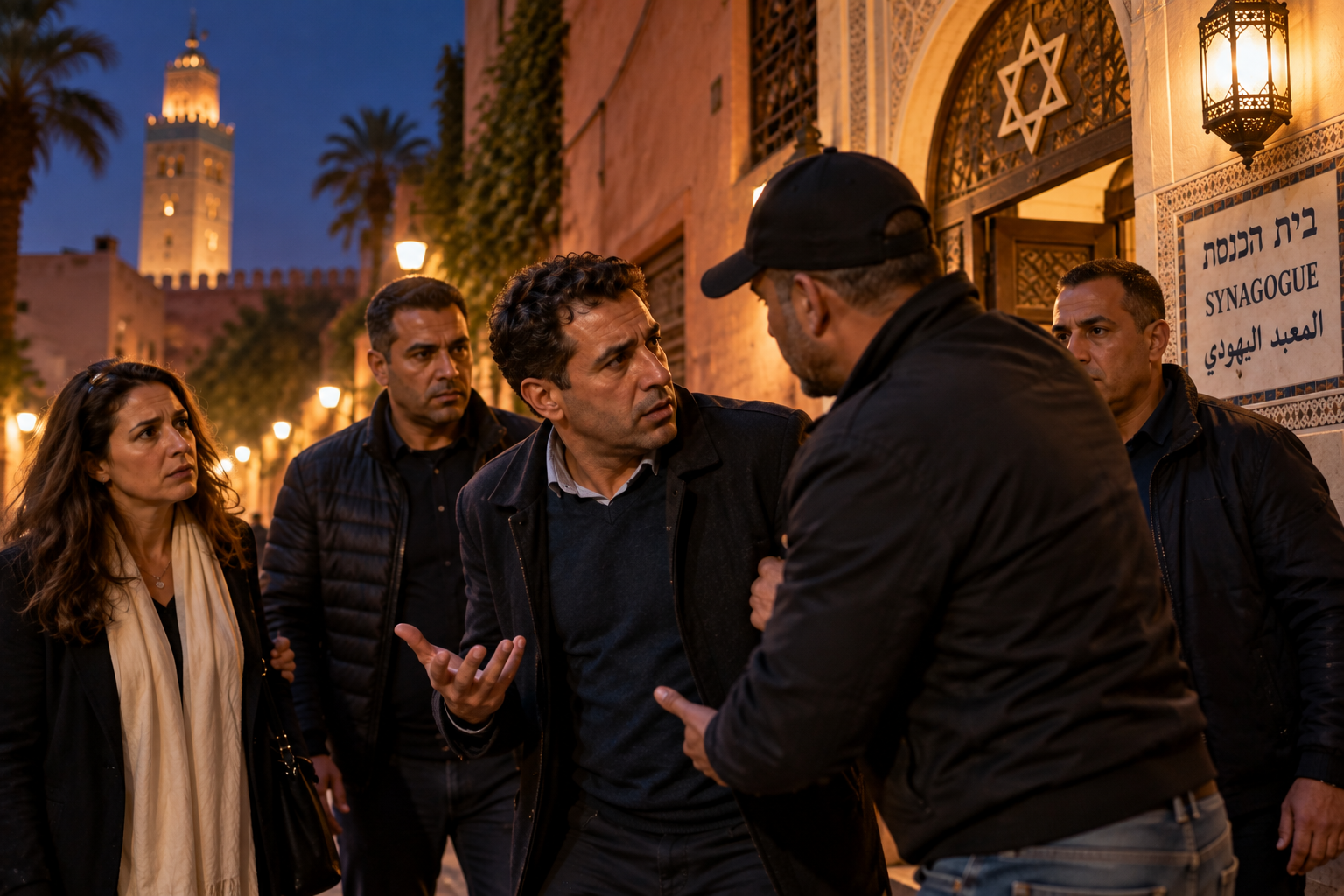
I wanted to show an Israeli friend the Morocco I have spent years defending, a country where Jewish history is not foreign history but part of our own. Instead, a walk to a synagogue ended with an unidentified man confronting me, hours in police custody, and questions that Morocco’s institutions have yet to answer.
My friend is Israeli and Jewish. She works for the Israeli parliament, has Moroccan roots, and is someone close to me. When she visited Morocco, I wanted to give her something more meaningful than the Morocco of postcards and tourist brochures. I wanted her to experience the country I know: its streets and tables, its spirituality and hospitality, and the extraordinary history Muslims and Jews share here.
For years, much of my work as a Moroccan-American journalist, author and peace activist has centered on Muslim-Jewish understanding, stronger relations between Morocco and Israel, and encouraging Moroccans to reclaim the Jewish dimension of our national story. Her visit made those ideas personal. On a Friday, we walked through the old Medina of Marrakech and later visited a Sufi religious institution outside the city. As Shabbat approached, she asked me to take her to a synagogue. I drove her there and walked with her toward the entrance. There was no demonstration, political statement or provocation. It was simply a Moroccan Muslim accompanying his Jewish friend to synagogue before Shabbat.
What happened next remains difficult for me to reconcile with the Morocco I have spent years presenting to the world. A man suddenly emerged from the darkness and confronted me. He was dressed in civilian clothes, and I saw no badge, uniform or identification that would tell me who he was or what authority he possessed. I repeatedly asked him to identify himself, but he refused. At that moment, I had no way of knowing whether I was dealing with a police officer, a security agent, a private security employee or an aggressive stranger.
I was frightened and confused. When someone approaches you from the darkness, blocks your path and refuses to establish who he is, you cannot know what rules govern the encounter. I later came to understand that the man was associated with Morocco’s plainclothes domestic security apparatus, but that knowledge came afterward. At the moment of the confrontation, I did not know who he was. That distinction matters. When a person exercises coercive power while refusing to identify himself, a citizen is expected to submit to authority he cannot independently know exists.
Uniformed police officers eventually arrived. At first, their presence brought relief because I was finally dealing with identifiable representatives of an institution. That relief did not last. I was taken into custody and questioned for approximately three hours. The questions repeatedly returned to who I was, why I was there and who the woman with me was. My answer remained the same: I was a Moroccan accompanying my Israeli friend to a synagogue.
No charge was read to me, and I was given no clear legal explanation for why I was being held. During those hours, I experienced treatment that I can only describe, based on my firsthand experience, as verbally and physically abusive. An officer gripped my hands and wrists with enough force to leave visible bruises. I was screamed at, yelled at and insulted while being questioned. Beyond the physical pain, there was the humiliation of being treated this way while still not understanding why I had been deprived of my liberty.
Eventually, I was released, but the experience did not end when I walked out. What troubles me is not only what happened to me, but what my friend witnessed. I had brought her to Morocco hoping to show her what Muslim-Jewish friendship looks like when it is lived rather than merely celebrated in speeches. Instead, near a synagogue she had asked to visit before Shabbat, she watched her Moroccan host confronted by an unidentified man and then taken away by police. An evening intended to represent hospitality became one defined by fear, humiliation and confusion.
I cannot know precisely what that evening changed in her perception of Morocco. I know what it changed in mine. There is a particular pain in feeling like a suspect in the city where you were born while standing beside a guest whom you had hoped to make feel safe. The bruises eventually faded, but the fundamental question did not: Why had this happened?
The following day, I filed a formal complaint with the regional police authorities in Marrakech. I did not assume that one man’s conduct represented an entire institution. Misconduct can occur within institutions anywhere. The true test of an institution is what happens after an allegation reaches it. Does it establish the facts, explain the legal basis for its actions and correct wrongdoing when wrongdoing occurred?
During the incident, I had also attempted to reach the Wali of Security in Marrakech, the city’s regional police chief. His office later contacted me. I want to be fair about that conversation. The concern communicated to me centered primarily on whether my Israeli friend had been harmed and whether the confrontation had extended to her. I was relieved that officials cared about her safety. They should have. An Israeli Jew visiting Morocco should be able to enter a synagogue and move through our cities without fear. But what about the Moroccan citizen standing beside her? Protecting an Israeli visitor and protecting a Moroccan citizen are not competing obligations. Morocco should be capable of doing both.
As of this writing, I have received no meaningful explanation of the legal basis for my detention and no transparent conclusion from the complaint I filed. That institutional silence concerns me almost as much as the original encounter. What was the legal basis for detaining me for approximately three hours? Why did a plainclothes individual exercising authority refuse to identify himself? What investigation followed my formal complaint?
I also want to be precise about responsibility. I have no evidence that the Wali of Security personally ordered my detention, but for sure knew about it while it was occurring. Once an allegation of abuse reaches an institution, responsibility extends beyond the conduct of one individual to the institution’s response. Accountability is what prevents alleged misconduct by one official from becoming conduct an institution appears willing to tolerate.
This matters beyond my complaint because Morocco has made Jewish heritage an important part of its national story. Under King Mohammed VI, synagogues and Jewish cemeteries have been restored, Jewish heritage has received official recognition, and Jewish identity has been affirmed as a component of Moroccan history. Morocco restored diplomatic relations with Israel in 2020 and has invested significant political and cultural capital in presenting coexistence not merely as a memory of the past but as part of the country’s future. I have proudly defended that Morocco, and that is precisely why this incident troubles me.
Jewish heritage cannot survive only in restored buildings, museums, diplomatic agreements and official ceremonies. It must survive in ordinary human encounters. A Moroccan Muslim should be able to enter a synagogue because he wants to understand the Jewish history of his country. A Moroccan should be able to befriend an Israeli without wondering whether that friendship makes him suspicious. A Muslim should be able to walk his Jewish friend to synagogue on a Friday evening and have absolutely nothing remarkable happen, because nothing should. Heritage that citizens are afraid to approach is not living heritage. It becomes an exhibit.
That is the larger danger of what happened that evening. Most Moroccans will never file a formal complaint against a security official, write an article about the experience or demand an institutional explanation. They will simply learn what to avoid. If approaching a synagogue, engaging openly with Jewish life or befriending Israelis becomes associated with scrutiny or intimidation, even mistakenly, many people will simply stay away. That is how coexistence can be weakened without anyone officially opposing it. You do not have to prohibit people from building bridges. You need only make crossing those bridges feel dangerous.
I am not writing this because I want Morocco’s experiment in coexistence to fail. I am writing because I want it to succeed. The Morocco I believe in should be strong enough to investigate the conduct of its own officials. Patriotism cannot require silence when institutions fall short of the principles the country itself proclaims. Those principles mean very little if citizens cannot invoke them when they believe they have been mistreated.
What I am asking for is neither radical nor hostile. I am asking the responsible authorities to establish what happened, explain the legal basis for my detention, determine whether the man who confronted me acted within his authority, examine the physical and verbal treatment I experienced, review my complaint and communicate their findings. These are not demands made against Morocco. They are demands made in the belief that Moroccan institutions should be capable of examining themselves and correcting wrongdoing when it occurs.
Peace between peoples is ultimately tested far away from diplomatic halls. It is tested between neighbors, friends and strangers. It is tested when a Muslim becomes curious about the Jewish history of his hometown, when an Israeli feels comfortable visiting Morocco, and when citizens attempt to practice the coexistence their government publicly celebrates. Sometimes it is tested in a moment so ordinary that nobody should ever have to write about it: a Jewish woman asks her Muslim friend to take her to synagogue, and he says yes. The next time a friend asks me to take her to synagogue, I want to be able to say yes again, without first calculating the cost of saying it.