
Waltz with Mengele
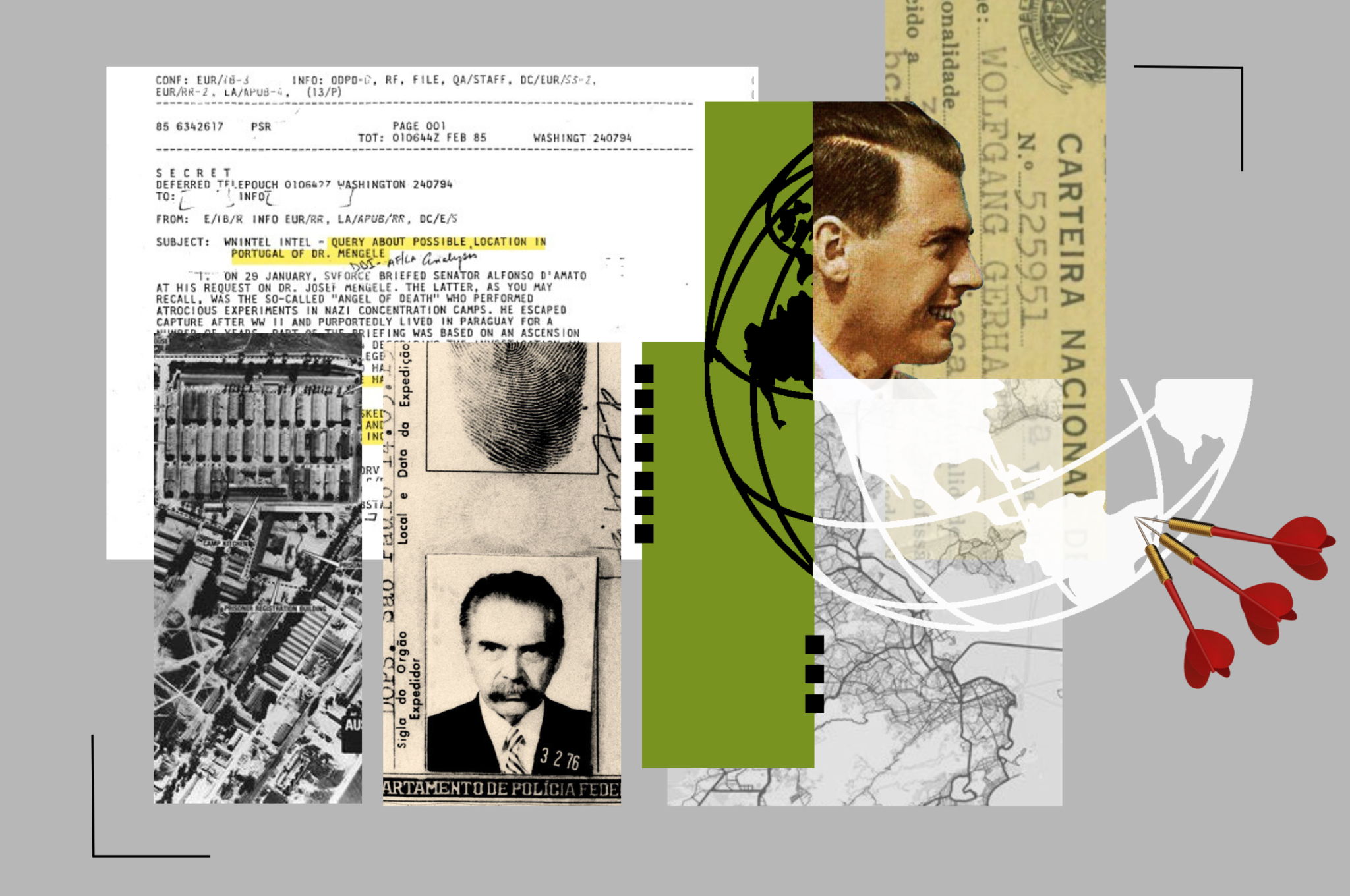
My father is a man captivated by History. For hours, we would sit together and watch war documentaries. As a child, I didn’t care about politics. What captivated me was the spectacle — the thunderous roar of explosions that sent a thrilling tremor through my small body. To me, war was not a catastrophe. It was a form of entertainment, a game I would reenact in the backyard with my grandfather’s old, decommissioned air rifle. Anyone who crossed my path was an enemy.
—“BANG! PUM! KABOOM!”, I’d shout, squeezing the trigger.
It was only later that I grasped the true horror of war — the profound evil men can inflict upon one another. When that understanding finally dawned, the rubble of a shattered Europe ceased to be my imaginary playground. The weight of the rifle in its holster seemed to change, growing heavier, as if Death itself were whispering in my ear: “Shoot!”.
I never truly stopped playing. I simply began to see the game for what it was.
— Killing is wrong, I would tell myself. This is just a game. No one gets hurt. Here, whether I show mercy or not, we all walk away unharmed. No matter how thrilling the fantasy, I knew I could never stomach a real war.
War is futile. It only benefits those who stay on the sidelines. The politicians. The businessmen. They are the ones who thrill to the sound of screams and broken bones.
In time, my perspective deepened. I realized there are evils more sordid than war itself, born from the deepest wells of human bitterness. I do not know if this malevolence is intrinsic or instilled. It does not matter. What matters is that it exists, dormant, in the minds of those who act in the name of chaos.
Just as war deprives mothers of their sons, this deeper wickedness strips Mankind of its humanity, leaving behind only a withered and blackened heart. Believe me, I know. I carry the same indelible heritage that Egyptians, Romans, Catholics, and National Socialists all tried to erase.
This is the story of a man who had ceased to be one. Any lingering trace of tenderness was merely that — a lingering trace. It is also the story of how we confront Evil, both as individuals and as political powers. Our past shows a history of failure in this endeavor, when not outright hypocrisy.
On a wild goose chase
I remember the first time I heard about Josef Mengele. The hairs on the back of my neck stood up. I couldn’t believe that an educated man, a physician, was capable of such cruelty. His experiments were the apotheosis of sadism. Mengele didn’t just follow orders; he acted in accordance with his own psychopathic tendencies.
The Nazi regime was extremely effective at institutionalizing evil. Inside every German soldier, officer, or bureaucrat, lived both a Dr. Jekyll and a Mr. Hyde, with the aggravating factor that the monstrous silhouette almost always ended up prevailing over the human form.
Today, we know he died in Brazil. A stroke. His heart stopped as he swam off the coast of Bertioga, in the state of São Paulo. There are worse ways to die. After so many years, Death had returned to claim one of its greatest acolytes. Mengele was directly involved in the deaths of 400,000 people. My brain stumbles, unable to truly comprehend a number that big.
“Could Mengele have been in Portugal?”, I wondered. Many Nazis found refuge, however temporary, in this corner of Europe. Others prospered here, never feeling the heavy hand of justice. I searched everywhere, but in vain. I was on the verge of giving up when I consulted the CIA archives. To my surprise, they had asked the same question. I was getting closer to unraveling the mystery.
— No way!. I might actually be right!
I devoured the documents. One by one. The truth was far more complex than I had assumed. After the war, the U.S. Department of Justice established a special unit to hunt down war criminals. The Office of Special Investigations (OSI) would eventually deport seventy and revoke the citizenship of over one hundred more. The capture of Adolf Eichmann by Mossad, in 1960, forced the remaining Nazis underground. They fled like rats. They knew what they had done. The records show that Mengele lived in torment. At least there was that.
The Allies were equally paranoid. Since they couldn’t find him, they entertained outlandish theories. Most were based on unreliable reports that were impossible to verify.
Let us go back in time. To January 29, 1985. Five years, eleven months, and twenty days after the death of Josef Mengele. One month prior, Senator Alfonse Marcello “Al” D’Amato was preparing to appear before the Subcommittee on Juvenile Justice. It was then he received a startling piece of intelligence: two members of dictator Alfredo Stroessner’s government suspected Mengele was in Portugal. And had been since at least the 1960s.
It astonishes me that such a claim went unnoticed. Especially since, by the mid-1960s, the Federal Republic of Germany was convinced that Stroessner not only protected Mengele but had employed him as his personal physician. If I were being hunted, I would do everything to mislead my pursuers. And that is precisely what occurred. The Paraguayan government manufactured a scapegoat. And it worked. Portugal became that scapegoat.
A concerned D’Amato stated:
It is imperative that the U.S. government establish contact with Portugal and share all relevant intelligence. Portuguese authorities must immediately initiate a search for Mengele. If he is found within their borders, he must be apprehended. If he was once there, we must ascertain his subsequent whereabouts.
It remains unclear whether the Portuguese government, then under Prime Minister Cavaco Silva, ever responded to this appeal. The U.S. Department of Justice, however, was quick to offer an explanation: a bureaucratic mix-up. The Paraguayan government had confused the State of Santa Catarina in Brazil with the parish of Santa Catarina in Portugal. The entire effort had proven useless. Yet, the Americans still failed to grasp that they were being deliberately misled — or, perhaps, they knew and were powerless to admit it.
The primary objective for the U.S. was damage control. This was a nation that had welcomed numerous Nazi war criminals. As D’Amato stated before the Subcommittee, “The world cannot remember the U.S. as the country that allowed the Angel of Death to live a normal life after he had so cruelly destroyed the lives of so many innocents”.
The enemy of my enemy…
The CIA was uneasy. And with good reason. They feared the world might learn of their recruitment of Nazi intelligence officers. At the first opportunity, they pressed other government agencies to take over the analysis of the Portuguese data, a deliberate move to distance themselves from any hint of scandal. Ultimately, the official verdict arrived with cautious precision: “It had not been possible to confirm the rumor that Mengele had been in Portugal”. Just like that, my theory was quietly, but irrevocably, laid to rest.
This investigation — or essay, if you will — was, at its heart, an attempt to grapple with the human condition. In the course of my inquiry, it became painfully clear that the true menace lies in the savage core of humanity itself. As we approach the eightieth anniversary of the Nuremberg Trials, it is worth remembering not only the monsters who escaped unscathed, but also those that dwell within us, waiting for something – or someone – to set them free. Hannah Arendt said it better, with greater eloquence, but it seems few were willing to listen.
How many Mengeles still walk among us, protected by a society that turns a blind eye or has grown too tired to care? I will end this reflection with the words of one of my dearest poets. In his Letter to My Children on Goya’s Executions, Jorge de Sena reminds us: “The same world we have created must be held by us with care, as something that is not ours; that is lent to us to guard, respectfully, in memory of the blood that runs in our veins, of our flesh that was once another’s, of the love that others did not love because it was stolen from them”.