Director of Diplomacy, Representative to UN Geneva & UNESCO, World Jewish Congress
World Jewish Congress @90 – Why its work remains unfinished
This week marks 90 years since the founding of the World Jewish Congress in Geneva. On the 8th of August 1936, Jewish leaders from around the globe came together to form a body that would serve as the permanent diplomatic address, or foreign ministry, of the Jewish people on the international stage at a dire moment in history. The institution born that day continues to endure—and with it the promise that the Jewish people will never again be voiceless or dependent on others to speak on their behalf.
That year, 1936, was a turning point for Jewish life worldwide. The Nazi regime had consolidated its power and moved beyond rhetoric to the systematic exclusion of Jews from German society. The Nuremberg Laws had been enacted, Jewish businesses faced boycotts, and Jews had been dismissed from government jobs and the professions.
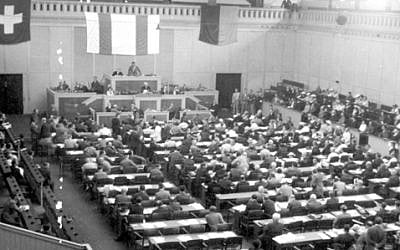
For Europe’s Jews, despair was mounting. Earlier that summer, Stefan Lux, a Czechoslovak Jewish journalist, committed suicide before the assembly of the League of Nations in Geneva to warn the world of the grave dangers of Nazi Germany’s authoritarianism, expansionism, and antisemitism. His warning—like so many others—went unanswered.
The world preferred to look away. That same summer, Nazi Germany hosted the Olympic Games and turned them into a propaganda triumph, presenting the image of a prosperous, orderly country of happy and hard-working citizens.
It was against this backdrop that Jewish leaders such as Stephen Wise and Nahum Goldmann, alarmed by the dangers facing millions of Jews in Central and Eastern Europe, and appeasement by great powers, resolved to unify the voice of the Jewish people.
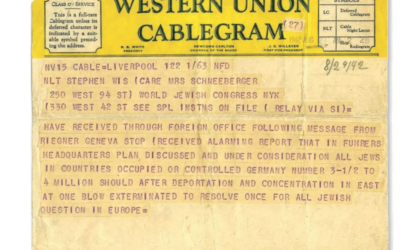
The body they founded would outlive them all, growing into a confederation of Jewish communities that today spans more than 100 countries. Gerhard Riegner, then a young employee and for many decades the WJC’s Secretary-General, recalled that “there in Geneva in 1936 the assembly created a structure that was unique in the vastness of its tasks and its ambitions, encompassing the problems of the entirety of the Jewish people in the whole world.” It was Riegner who, in 1942, sent the telegram that gave Western governments their first authoritative warning of the Nazis’ plan to systematically exterminate European Jewry.
In the nine decades since, much has changed. The Jewish world the founders fought to save was all but destroyed. Six million Jews were murdered. Yet out of catastrophe came rebirth. The State of Israel was established in 1948, and Jewish life was revived on every continent. In essence, the despair of 1936 gave way to decades in which Jews could believe that the hatreds of the past had been consigned to history.
Today, and in recent years, that belief has been shattered. As the WJC turns ninety, the parallels to its founding moment are painful to draw. A recent survey of the seven largest Diaspora Jewish communities found that 2025 was the deadliest year for antisemitic attacks on Jews outside Israel in more than three decades. Twenty Jews were murdered, among them worshippers at a Hanukkah celebration near Sydney, young embassy aides in Washington, and marchers for the hostages in Colorado. Once again, Jews are compelled to warn the world of a rising tide of hatred—and once again, too many of those warnings go unheeded.
But unlike in 1936, the Jewish people today have a voice. As WJC President Ronald S. Lauder said, “Our mission has not changed. It is the same today as it was then: to give the Jewish people a voice in the international arena, to protect Jews against antisemitism and violence, to defend Jewish values and interests anywhere and everywhere in the world, and—since 1948—to support and defend the Jewish state of Israel against its enemies and detractors.”
And nowhere does that voice matter more than in Geneva itself. The city where Stefan Lux’s sacrifice failed to stir the League of Nations is today the seat of the UN Human Rights Council—the only UN body with a permanent agenda item, Item 7, reserved for a single country. That country is Israel, condemned at the Council each year in more resolutions than the world’s most repressive regimes. Amid the city’s UN agencies, 180 diplomatic missions, and countless NGOs, the WJC meets regularly with ambassadors, officials, and faith leaders—fighting antisemitism, safeguarding the memory of the Holocaust, fostering Jewish life, and standing up for the Jewish state.
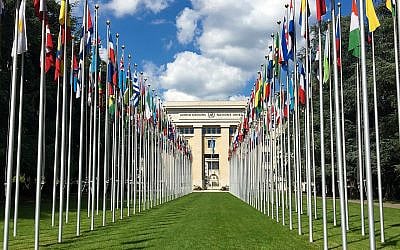
The lesson of 1936, and of the years since, is that we cannot abandon such forums. We must stand in them and speak, so that the Jewish voice is heard in the very rooms where it once was not.
There are signs the message is being heard. This past May, envoys charged with combating antisemitism from more than two dozen countries gathered in Geneva at the WJC’s initiative and jointly declared that “there is no place for antisemitism, there can be no excuse for antisemitism.”
The founders of the World Jewish Congress could not stop the catastrophe already brewing in 1936. But what they built outlasted it, and it serves to this day as the voice of a people who learned, at unbearable cost, the price of standing alone. Ninety years on, as old hatreds resurge in new forms, that is why the World Jewish Congress still matters—and why the work begun in Geneva in the summer of 1936 remains unfinished.
Related Topics
Related Posts