War and Peace
On Thursday June 12th, over 100 Israeli peace activists flew on a chartered flight from Ben-Gurion Airport in Tel Aviv to Charles De Gaule airport in Paris to participate in the Paris Call for the Two-State Solution, Regional Peace and Security Conference. The flight was delayed from morning until the evening, so we only landed in Paris at around midnight. By the time I reached my room it was 1:30 in the morning of June 13th. Around 2:00 Paris time, 3:00 Israel time, I began to see messages from my family that Israel had attacked Iran. My family was reporting alerts and sirens. Sirens went off even on Kibbutz Ketura, my home, which is usually out of range of most missile attacks.
Sleep was elusive that night but the next morning, I joined 380 Palestinian and Israeli peace activists from civil society at the Paris Economic, Social and Environmental Council where the conference was being held. In the shadow of a military conflict which had the potential to erupt into World War III, we convened a conference in Paris meant to prevent war. The irony was not lost on anyone but our determination to carve out a different future for the Middle East kept our eyes on our goal to amplify the voice of civil society in international discourse. Lessons learned from previous attempts at reaching a peace agreement between Israelis and Palestinians has taught that a peace process is not effective if it is only top-down without a parallel bottom-up process. Peace is built both between nations and between peoples. Palestinian and Israeli civil society came to Paris to create a road map for decision makers to empower civil society as a full partner in peacebuilding towards the Two-State Solution.
As missiles were fired at Israel and bombs fell in Iran, working groups met in Paris to discuss how a sovereign Palestinian state would exist side by side in peace and security with an Israeli state. Other topics included discussions on security for Palestinians and Israelis, how to change the narrative from hate to peace, and the economic viability of a Palestinian state. My colleague, Hanan Alsanah, from Itach Ma’aki, and I chaired a session called Humanitarian Action and Reconstruction. Our working group consisting of about 30 Palestinians and Israelis from civil society focused on practical steps to provide humanitarian aid as well as a long-term vision of the rehabilitation of Gaza. Central to the practical steps which must be taken to enable Gaza to become a habitable and flourishing society is the need to empower Gazans and to create a political horizon which connects Gaza to the West Bank as a sovereign Palestinian state. Only if Palestinians have equal and national rights will they be able to integrate into a sustainable, peaceful, and just Middle East. While both Israelis and Palestinians expressed the pain of the last 18 months of war, all agreed that an end to the war, the release of hostages, and a political horizon which leads to a sovereign Palestinian state alongside Israel can begin the healing process and the real work of reconstruction.
Following the working group meetings the working group chairs had the opportunity to interact over a teleconference call with their counterparts in the diplomatic working groups at the United Nations preparing for the planned the International Conference for the Peaceful Settlement of the Palestinian Question and the Implementation of the Two-State Solution, co-chaired by France and Saudi Arabia scheduled for the following week. Unfortunately, due to the Iran-Israel war, the conference has been postponed but it was an exciting opportunity to engage with the diplomats and know that civil society voices were being heard on the world stage.
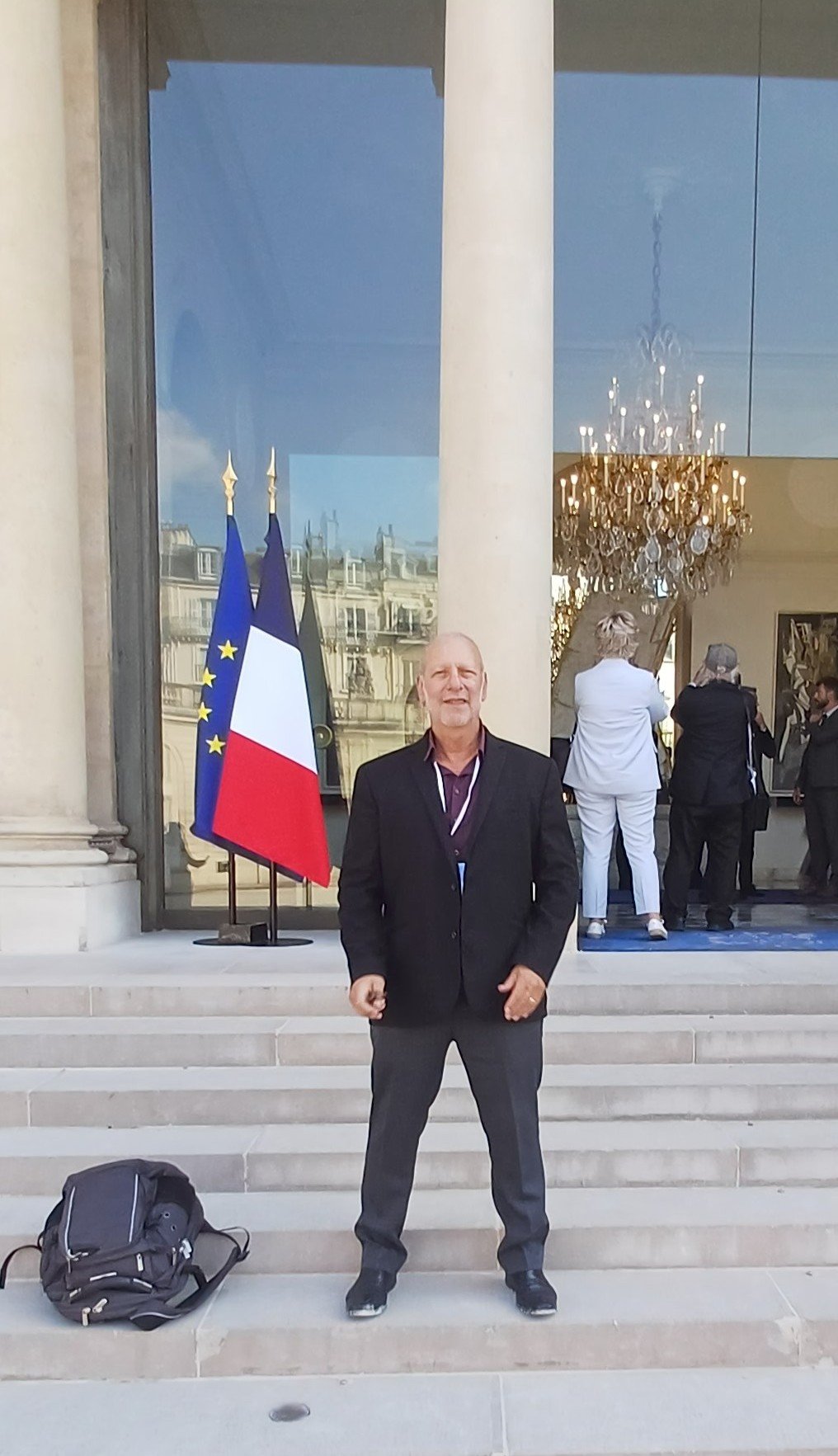
The most exciting event on Friday was an impromptu invitation by French President Emmanuel Macron to join him at the Palais de l’Élysée. While waiting for President Macron to finish a press conference, in the luxurious but suffocatingly hot palace, we reflected on both the achievements of the conference and worries over the armed conflict that had erupted between Israel and Iran and the safety of families back home. The uncertainty of how we would get home also weighed heavily on many. Following the press conference, President Macron, joined us on the veranda of the palace overlooking the beautiful gardens. President Macron stated that France was ready to recognize the Palestinian State, in conjunction with an end to the war in Gaza, the release of the hostages, and the integration of Israel into the Middle East. Following his formal statements and much to our surprise and delight, and to the consternation of his security detail, the French president removed his jacket and joined the crowd of peacemakers, shaking hands, posing for selfies and receiving hugs and opinions. It felt like a US style campaign rally.
Throughout the 3-day event in Paris, starting Thursday night and ending on Saturday, the Alliance for Middle East Peace (ALLMEP) staff who had organized the logistics of Palestinian and Israeli civil society participation in the conference maintained their poise and calm as unanticipated challenges arose. From the courageous decision to continue to hold the conference as scheduled despite the outbreak of armed conflict between Israel and Iran on the opening night of the conference to managing the logistics behind housing the Israeli delegation stuck in Paris after their return flights to Israel were cancelled, and looking for alternative pathways to return to Israel, the ALLMEP team proved creative, agile, and compassionate. We are all deeply grateful for their leadership.