The views expressed herein are solely mine.
War as Distraction: Tehran Eyes Israel
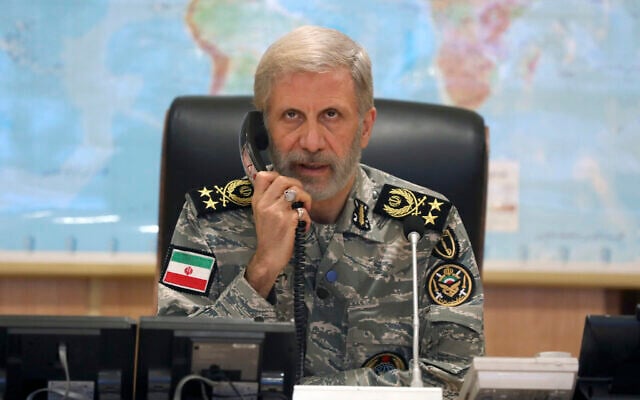
In this photo released on June 23, 2025, Iran's army commander-in-chief Gen. Amir Hatami attends a meeting in Zolfaghar central headquarters, Iran. (Iranian Army Press Service via AP)
Iran’s rulers are cornered—and cornered regimes reach for war. When economic legitimacy collapses, regimes do not reform; they externalize. What we are watching unfold in Tehran is not ideological bravado or spontaneous escalation but a classic authoritarian survival maneuver: manufacture an external existential threat to suppress an internal one.
The Islamic Republic is confronting its most dangerous domestic moment in years. Inflation has pulverized purchasing power, the rial has lost much of its real value, electricity and fuel shortages persist, and living standards have deteriorated across both urban and provincial Iran.
Concurrently, protest activity—though violently repressed—has remained persistent and geographically dispersed. This is not episodic unrest. It is systemic pressure. The regime is running out of economic explanations and political patience.
That context makes recent rhetoric from Tehran’s security establishment especially revealing. Statements from Iran’s senior security bodies have explicitly linked domestic unrest to foreign enemies, warning of “decisive responses” to US and Israeli interference and framing internal dissent as an extension of external warfare.
Certainly, this is not deterrence messaging. It is narrative conditioning. The regime is preparing the population—and its own security apparatus—for escalation by redefining protest as treason and hardship as siege.
This is the authoritarian playbook in its purest form. When bread disappears, regimes manufacture enemies. When legitimacy erodes, they weaponize nationalism. The language of “Big Satan” and “Little Satan” is not meant for Washington or Jerusalem; it is aimed inward, at a population increasingly unconvinced that the clerical elite can govern competently, let alone justly.
The data reinforces the political logic. Iran’s economy remains structurally constrained by sanctions, chronic mismanagement, corruption, and capital flight. Youth unemployment remains high, underemployment is widespread, and state subsidies—long the regime’s pressure valve—are increasingly unsustainable (even though the regime now will give $7 a month to every citizen; a total joke!). The social contract has thinned to coercion.
Thence, in that environment, foreign confrontation becomes not a risk but a tool.
Accordingly, escalation against Israel offers the regime multiple survival advantages. It reframes internal anger as a patriotic duty. It rallies regime loyalists, the IRGC, and security services around a tangible external enemy. It justifies sweeping repression under the banner of national defense. And critically, it shifts both domestic and international focus away from Iran’s internal failures and toward regional instability—terrain on which Tehran believes it can endure longer than its own population can protest.
Importantly, this strategy does not require military victory. It does not even require sustained war. It requires spectacle—missiles, mobilization, headlines. Military heightening sharp enough to dominate attention, reorder priorities, and force citizens into a binary choice: rally or be labeled collaborators. In this calculus, Israel is not the strategic objective; it is the instrument.
Hence, the real battlefield is not across borders. It is in Tehran, Isfahan, Mashhad, and the provincial towns where economic reality has collided with regime mythmaking. Foreign confrontation is designed to pull protesters off the streets, push fear back into private spaces, and reassert control through emergency logic.
This is why escalation is tempting—and why it is dangerous. History shows that regimes that gamble on war to save themselves often lose control of the fire they ignite. But for the Ayatollahs, boxed in by economic decay and social defiance, confrontation may look less like recklessness and more like necessity.
Nevertheless, history is unforgiving to governments that mistake distraction for strategy. Yet history is also clear: when autocracies feel the ground shifting beneath them, they reach outward to survive inward.
Thus, Tehran’s rhetoric suggests it may be approaching that moment—where attacking Israel becomes a means of holding the Ayatollah’s dictatorship together.
Related Topics
Related Posts