
War on the Jews, Part III: Israel, The Alfred Dreyfus of Nations
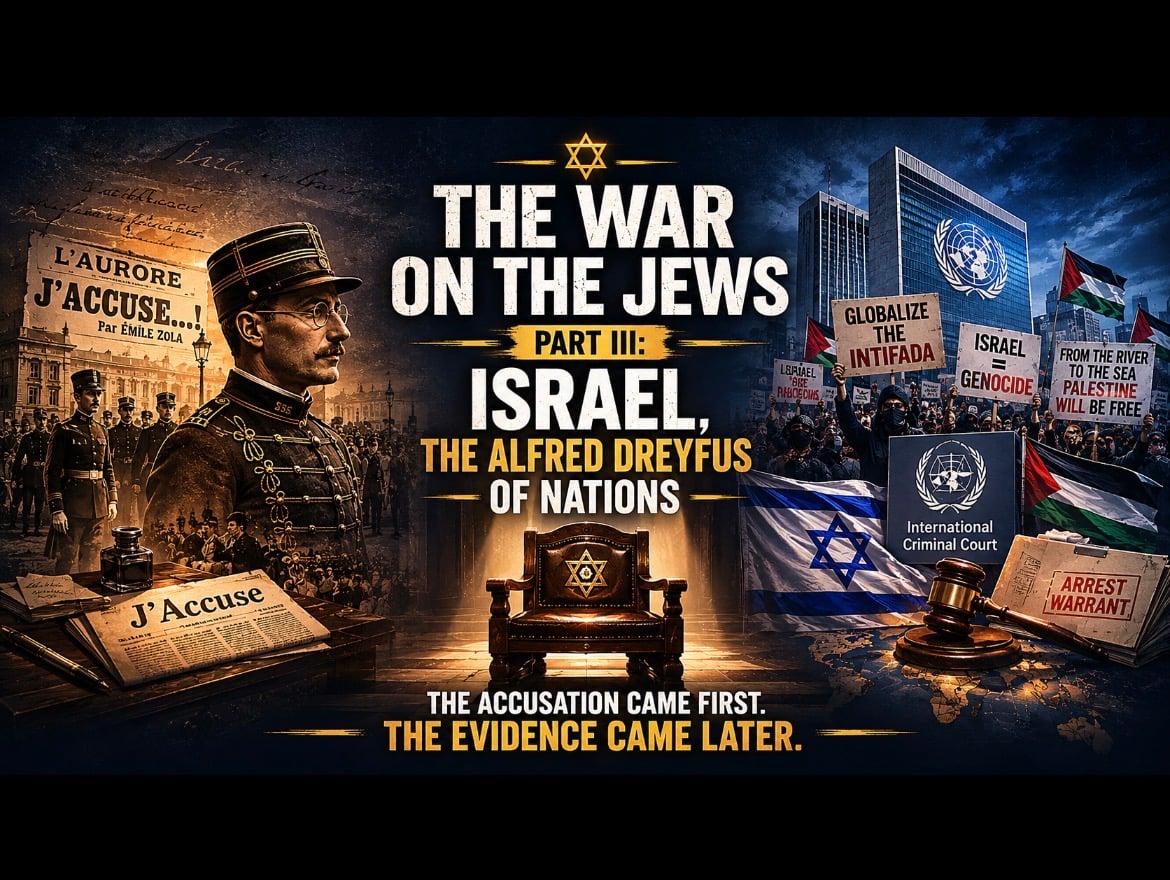
An allegation. A public verdict. An institutionally protected narrative. Only later come the questions. It happened in 1894, and it is happening again now.
In 1894, Captain Alfred Dreyfus, a Jewish officer in the French army, was accused of treason. The charge spread rapidly through the press, the public, and the institutions of the French Republic. Only later did the contradictions surface: forged documents, suppressed evidence, and competing explanations. Even as proof mounted that Dreyfus had been framed, the machinery of accusation kept turning. The pardon and eventual exoneration came slowly.
What made the Dreyfus Affair historic was not merely the false charge. It was the institutional refusal to correct course once the truth emerged.
Among those watching Dreyfus’s public degradation was a young journalist named Theodor Herzl. The lesson he drew was devastating: if a loyal, assimilated Jewish officer could be publicly sacrificed despite the facts, then Jewish security could never depend entirely upon the goodwill of others. Modern Zionism emerged from that realization.
The irony today is difficult to ignore.
The state born, in part, from the lessons of Dreyfus increasingly finds itself cast in Dreyfus’s role.
Not because Israel is literally Alfred Dreyfus, but because the sequence repeats with striking consistency: accusation, assumption of guilt, institutional amplification, followed, too late or too quietly, by contradictory evidence and resistance to reevaluation.
October 7, 2023 should have been a moral clarifying moment. The largest massacre of Jews since the Holocaust was livestreamed by the perpetrators. Families were slaughtered in their homes. Women were raped and mutilated. Children were murdered. Hostages were dragged into Gaza.
Yet within hours, much of the international conversation pivoted from the crime to Israel’s response.
Then came the international hesitation over evidence of systematic sexual violence against Israeli women and girls. Institutions and activists who routinely champion victims of gender-based violence were slow, skeptical, or silent. Many Jews asked a painful question:
Would the response have differed if the victims were not Jewish?
Later UN findings established reasonable grounds to believe rape and gang rape occurred at multiple locations during the October 7 attacks. Yet for many, the initial reluctance left a lasting scar.
The Al-Ahli Hospital explosion followed.
Within hours, major media outlets, governments, activists, and international organizations declared Israeli guilt as fact. Global protests erupted. Only later did American, British, French, and Canadian assessments, along with independent analyses, conclude that the evidence pointed elsewhere.
The accusation traveled at light speed. The correction never matched its velocity.
Then came casualty reporting controversies. Again and again, figures originating from Hamas-controlled authorities were repeated globally before independent verification.
Then came the famine allegations.
Predictions of catastrophic death tolls and mass starvation dominated headlines. Subsequent disputes emerged regarding methodology, assumptions, projections, aid calculations, and evidentiary thresholds. Serious humanitarian suffering existed, but many critics argued that some of the most dramatic claims raced ahead of what the underlying evidence could support.
The issue was not merely that projections were disputed. The issue was that the accusation arrived first and the scrutiny arrived later. Again.
Then came UNRWA.
For years, watchdog organizations, researchers, and critics raised concerns regarding Hamas infiltration, extremist educational materials, staff conduct, and institutional vulnerabilities. Again and again, those concerns were minimized, dismissed, or treated as secondary.
Then October 7 happened.
Subsequent investigations revealed that multiple UNRWA employees participated in the attacks. Additional reports raised broader concerns regarding terror affiliations within the organization.
How many warnings were required before people were willing to look? How many contradictions were ignored because they interfered with the preferred narrative?
For years, critics including Hillel Neuer of UN Watch documented concerns regarding UNRWA, UN bias, and the disproportionate treatment of Israel within international institutions. The question is not whether every criticism proved correct. The question is how many warnings had to be ignored before institutions reconsidered their assumptions.
The pattern has now reached institutionalization on steroids.
UN bodies issue reports and resolutions that critics argue apply standards to Israel that are not demanded elsewhere. International law is increasingly invoked selectively. The International Criminal Court has pursued historic actions against Israeli leaders amid ongoing controversies surrounding evidence, procedure, and credibility.
Legal analysts such as Natasha Hausdorff have argued that allegations against Israel are frequently presented as settled legal conclusions long before evidentiary and jurisdictional questions have been fully examined.
Recent reports alleging that Qatar offered to “look after” ICC Prosecutor Karim Khan if he pursued actions against Israeli leaders, claims that remain “disputed”, have only deepened concerns about politicization and institutional credibility.
This is the deeper lesson of the Dreyfus Affair. False accusations are ancient. What matters is what institutions do when evidence challenges the narrative.
In Dreyfus’s case, they doubled down.
Today, many Jews watching the treatment of Israel have reached a conclusion that once seemed unthinkable: the modern Dreyfus Affair is no longer about one Jewish officer.
It is centered on the Jewish state itself. Israel has become the Alfred Dreyfus of nations.
France eventually learned that the greatest threat to justice was not Dreyfus’s alleged treason. It was the willingness of institutions to preserve a false narrative after evidence challenged it.
The question facing the West today is whether it has learned that lesson because the Dreyfus Affair did not begin with hatred.
It began with alleged certainty.