
Was 2024 India’s Third Strategic Loss in Bangladesh?
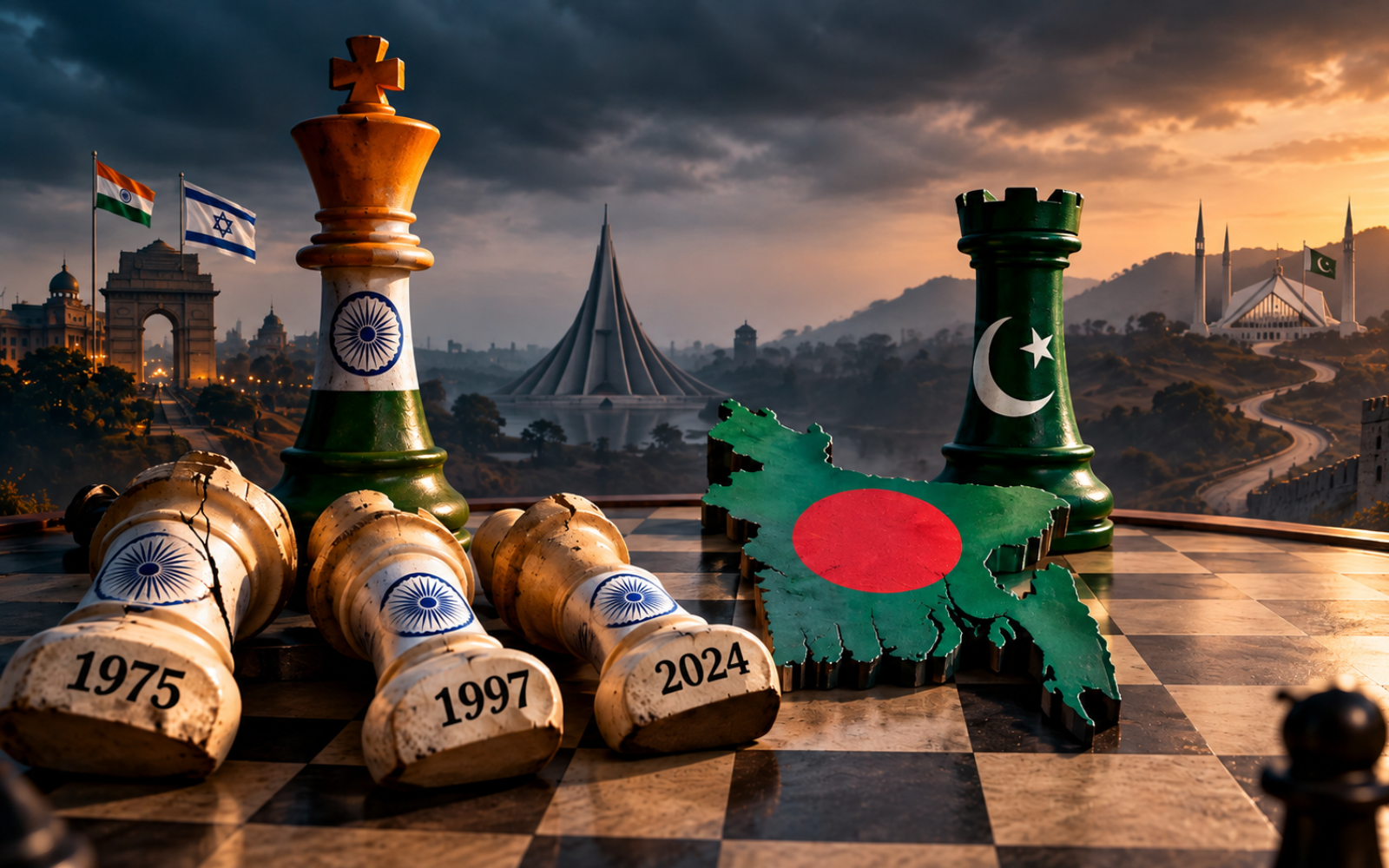
India may have suffered three major strategic setbacks in Bangladesh since helping the country win independence in 1971. The first came in 1975, when Sheikh Mujibur Rahman was assassinated and the political order closest to New Delhi collapsed. The second developed after the 1997 Chittagong Hill Tracts Accord failed to become the fully implemented and durable settlement many had hoped for. The third may have arrived on August 5, 2024, when Sheikh Hasina fled Dhaka for India.
None of this means Bangladesh belonged to India, nor does it prove that Pakistan secretly engineered every reversal. “Loss” here means loss of strategic advantage. The history of India-Bangladesh relations suggests a recurring problem: India has repeatedly gained exceptional influence in Bangladesh, but struggled to make that influence survive political change.
If Pakistan gains greater strategic space in Bangladesh while harder-line Islamist forces gain political room, the consequences may eventually matter to Israel as well.
India won the war, but not the argument
India’s role in Bangladesh’s liberation was decisive. It sheltered millions of refugees, supported the Mukti Bahini and entered the war against Pakistan in December 1971. The new state developed close relations with New Delhi, symbolized by the 25-year friendship treaty signed in 1972.
But independence created a difficult question: how close was too close to India?
The new Bangladesh Army had to integrate freedom-fighter officers with Bengali officers repatriated from Pakistan. Research describes friction over rank and seniority. Some returnees came from a military institution that regarded India as its principal adversary, while some freedom-fighter officers also became suspicious of India.
The deeper contest was over sovereignty: was India the indispensable friend that made independence possible, or could dependence on India eventually compromise that independence?
The first loss: 1975
Mujib’s assassination on August 15, 1975 shattered the political order that followed India’s 1971 victory. BNP did not yet exist, so blaming the party for the assassination would be historically wrong. Khondaker Mostaq Ahmed became president, and his government issued the Indemnity Ordinance protecting those involved from prosecution.
Ziaur Rahman later became president and founded BNP in 1978. His “Bangladeshi nationalism” placed greater emphasis on territorial sovereignty and the country’s Muslim-majority identity. Religious political forces regained space, while relations with Pakistan, China and the wider Muslim world improved.
Zia himself was a Liberation War commander, so the post-1975 shift cannot be reduced to freedom fighters versus Pakistan loyalists. It represented a Bangladesh more suspicious of India and more willing to balance New Delhi through Pakistan, China and the Muslim world.
For Pakistan, that was strategically useful without requiring control over Dhaka. Islamabad only needed Bangladesh to become less closely aligned with India.
The second loss: an unfinished CHT settlement
India appeared to gain another strategic opportunity in 1997. The Chittagong Hill Tracts Accord formally ended the armed conflict between the Bangladesh government and the PCJSS. For CHT Indigenous peoples, it offered a political route toward resolving land, displacement, local governance and security. For India, a durable settlement promised greater stability beside its sensitive northeastern frontier.
But signing a peace agreement is not the same as making peace durable.
Nearly three decades later, major disputes over land, devolution of authority, displaced communities and the security structure remain unresolved. The Accord survives, but many important provisions remain unimplemented. It therefore never became the complete political settlement many Indigenous communities expected.
When an armed movement accepts negotiation and enters constitutional politics, the state must show that compromise produces results. Otherwise, those who chose negotiation may conclude that abandoning armed struggle brought neither rights nor security.
Indigenous communities bear the first cost, but there is also a geopolitical cost. A state can control territory militarily while still failing to achieve political peace. For India, the incomplete Chittagong Hill Tracts Accord meant that a potential source of stability beside its Northeast never became durable.
There was no single day on which India “lost” the CHT. The setback was gradual. I examined that question in greater detail in my earlier Times of Israel article, “Did Pakistan Defeat India in the Chittagong Hill Tracts?”
Hasina rebuilt India’s advantage
When Hasina returned to power in 2009, India-Bangladesh relations entered one of their deepest periods of security cooperation since independence. Dhaka acted against insurgent networks threatening India’s Northeast, security cooperation deepened, connectivity expanded and extradition and border-security arrangements grew stronger.
But India’s interests became closely identified with one political leadership. As Hasina’s government became more centralized and opposition space narrowed, many opponents increasingly saw India as the outside power most invested in her continuation.
India had built an exceptionally strong relationship with a government. It was less clear that it had built an equally resilient relationship with Bangladesh’s wider political society.
The third loss: 2024
The uprising that removed Hasina grew from domestic anger, political frustration, repression and state violence. It should not be rewritten as a Pakistani operation. Reuters reported that senior commanders decided troops would not open fire on civilians to enforce the curfew. Once Hasina no longer had the military support required to preserve her government, her position became untenable. On August 5, 2024, she fled to India.
For New Delhi, this was more than losing one friendly prime minister. The political structure around which India had built fifteen years of security cooperation suddenly collapsed.
Since then, Bangladesh-Pakistan relations have expanded. In May 2026, twelve senior Bangladeshi civil servants attended a structured training programme in Pakistan, the first such senior-level exchange since the early 1970s, according to bdnews24. That does not mean Pakistan controls Bangladesh. But Pakistan’s influence in Bangladesh has gained new room to grow.
Why some Awami League voices look to India
The post-2024 fear is visible in parts of the displaced Awami League camp. In August 2026, Sajeeb Wazed Joy warned that Bangladesh was becoming “another Pakistan” on India’s eastern side. India Today reported his allegation that Pakistan’s ISI and Islamist extremist forces had gained greater freedom after Hasina’s fall.
Other Awami League-linked voices have gone further. According to reports by NPB News and Asia Post, Dr. Mohammad Ali Manik, a US Awami League leader, argued that India made a mistake by not intervening after Mujib’s assassination in 1975 and should not repeat that mistake. These are not official party positions.
The reasoning is revealing. Such voices fear not merely losing power, but a strategic reversal of 1971: a Bangladesh created by breaking from Pakistan moving closer again to Pakistan’s strategic orbit while harder-line Islamist forces gain influence.
Bangladesh is not becoming part of Pakistan in any literal sense. Yet the rhetoric creates a striking symmetry: after both 1975 and 2024, the collapse of a political order close to India was followed by fears that Bangladesh could drift back toward Pakistan.
Why Israel should care
For Israel, this is not simply an Indian neighbourhood problem. India is an important Israeli strategic partner, while Pakistan is a nuclear-armed state that does not recognize Israel. The question of Israel and Bangladesh becomes more relevant if Dhaka’s strategic balance shifts toward Islamabad.
Bangladesh supports the Palestinian cause and has no diplomatic relations with Israel. In April 2025, the Associated Press estimated that around 100,000 people gathered in Dhaka for the March for Gaza. Protest imagery targeted Benjamin Netanyahu, Donald Trump and Narendra Modi together.
Supporting Palestinian rights or criticizing Israeli policy is not extremism. But placing India and Israel inside the same religious-geopolitical narrative is different. Anti-India politics has traditionally focused on sovereignty and fears of domination, while opposition to Israel centred mainly on Palestine. When these narratives merge into a story of common enemies of Muslims, the political meaning changes.
Closer Bangladesh-Pakistan relations would not automatically make Bangladesh an anti-Israel security threat. The concern is narrower: if Pakistan-oriented geopolitics, anti-India nationalism and ideological hostility toward Israel reinforce one another, political space could widen for forces that see Israel not merely as a state whose policies they oppose, but as an ideological enemy.
The larger lesson
Across all three episodes, the pattern is clear. After 1971, India gained extraordinary influence but could not make the Mujib-era order survive. In 1997, the Chittagong Hill Tracts Accord offered another opportunity for durable stability, but core Indigenous political questions remained unfinished. After 2009, Hasina gave India perhaps its deepest security partnership with Bangladesh, yet much of that success again depended on one leader and one political order.
Pakistan did not need to mastermind these reversals. It only needed to benefit when arrangements favourable to India weakened.
That is the central geopolitical lesson: India’s recurring problem in Bangladesh may not be its inability to win influence. It may be its inability to make that influence durable.
For CHT Indigenous peoples, political peace cannot be replaced indefinitely by territorial control. For India, influence over leaders is not the same as influence that survives them. For Israel, the concern is who will occupy the strategic space created when Indian influence weakens.
Was 2024 therefore India’s third strategic loss in Bangladesh? Perhaps the harder question is why New Delhi keeps winning influence there without finding a way to make it last and who will fill the space when it cannot.
September 6, 2026
Tokyo, Japan