
Did Pakistan Defeat India in the Chittagong Hill Tracts?
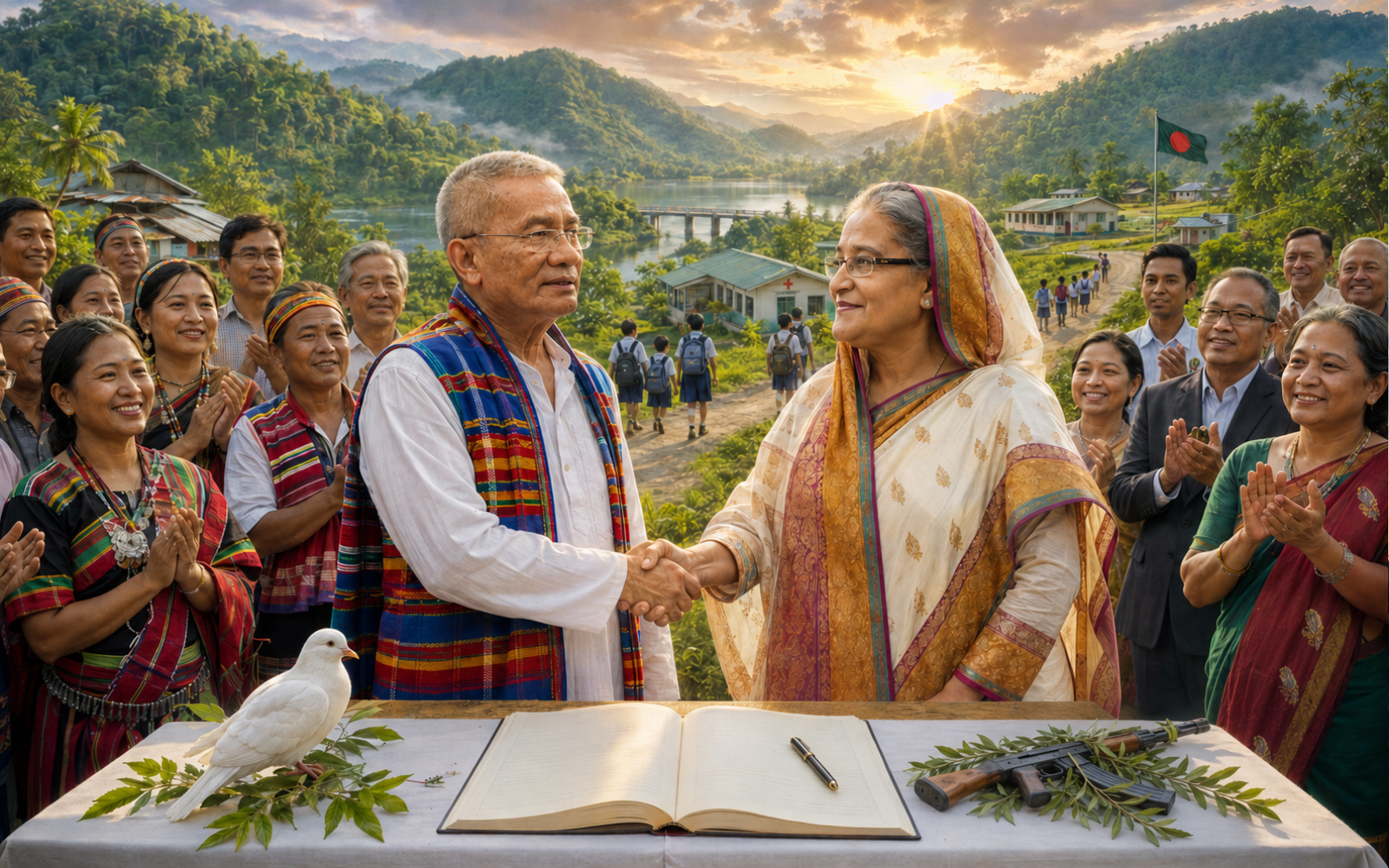
In December 1997, India appeared to secure an important political success without firing a shot. The Bangladesh government and the Parbatya Chattagram Jana Samhati Samiti, or PCJSS, signed the Chittagong Hill Tracts Accord, ending more than two decades of armed conflict.
PCJSS had historical ties with India. During the conflict, India sheltered Indigenous refugees and gave political space to people connected with the movement. A successful Accord could therefore have stabilized India’s eastern frontier and strengthened New Delhi’s influence in a sensitive border region.
Nearly three decades later, that success looks less certain. The Accord remains substantially unimplemented. PCJSS has been weakened, Indigenous politics has been divided, military influence remains powerful, and Bangladesh is considering closer strategic cooperation with Pakistan.
This raises a difficult question: Did Pakistan begin undermining India’s apparent victory even before the CHT Accord was signed?
This article presents a theory, not a proven intelligence finding. No reliable public evidence establishes that Pakistani intelligence recruited Indigenous activists who opposed the Accord, or that clearly defined pro-India and pro-Pakistan factions existed within the Bangladesh Army. Yet the chronology, political relationships and strategic outcome create a pattern that deserves investigation. A theory should not be accepted simply because it sounds possible, but neither should it be dismissed merely because relevant files remain secret.
PCJSS chose peace
The most important fact is often forgotten: PCJSS chose peace. Its armed wing, the Shanti Bahini, surrendered its weapons, returned to civilian life and trusted the Bangladesh state. PCJSS accepted compromise because it believed peace could protect its people better than another generation of war.
The Accord promised stronger hill district councils, a regional council, settlement of land disputes, rehabilitation of refugees and the withdrawal of temporary military camps. These promises formed the political foundation on which PCJSS ended its armed struggle.
PCJSS took the greater risk. The state retained its Army, intelligence agencies and administrative power; PCJSS depended on the government’s word.
The Accord’s failure does not mean PCJSS chose the wrong path. It shows that powerful political and institutional interests were unwilling to complete the peace process.
India had reason to support the settlement. The CHT borders Tripura and Mizoram and lies near other sensitive parts of northeastern India. Peace would reduce armed activity, refugee movements and instability along India’s frontier.
Pakistan could have made the opposite calculation. A successful relationship between PCJSS and the Awami League government would give India a friendly Indigenous partner in a critical borderland. Pakistan would not need to control the CHT; it would need only to prevent the peace process from succeeding.
The opposition began before the Accord
UPDF was formally established on December 26, 1998, more than a year after the Accord. But the anti-Accord movement did not begin with the formal creation of UPDF.
Indigenous student politics had already divided over the expected agreement before December 2, 1997. One section supported PCJSS and the peace process, while an anti-Accord section criticized the negotiations and demanded full autonomy as the final agreement was still being prepared.
This chronology is central to the theory. The opposition did not arise only after activists read the signed Accord and became disappointed. It was already being organized while the agreement was under negotiation.
That does not mean the anti-Accord students had no genuine concerns. The Accord did not provide full autonomy, constitutional recognition or protection against every future threat. Young activists could sincerely believe that PCJSS was accepting too little.
But genuine dissatisfaction and outside manipulation can exist at the same time.
The theory is that Pakistani strategic actors anticipated the agreement and understood what its success could mean for India. Bangladeshi intellectual or political intermediaries may then have encouraged ambitious Indigenous students to reject the emerging agreement and begin a new movement for full autonomy.
The students may have been told that PCJSS was surrendering Jumma rights. They may also have been promised that a new movement would make them important leaders and that Indigenous people would eventually follow them.
If this happened, only a small leadership circle and selected intermediaries would have needed to understand the wider purpose. Ordinary activists could honestly believe they were fighting for Indigenous rights while their movement also served someone else’s strategic objective.
The result was a lasting division. PCJSS had surrendered its weapons, but the Indigenous population did not become united behind implementation of the Accord. Energy that could have been used to pressure the government was redirected into conflict between Indigenous organizations.
The political environment around the movement
The BNP, then the main opposition party, denounced the Accord as a surrender of sovereignty and depicted Sheikh Hasina as dangerously close to India. Four years later, its alliance defeated the Awami League in the 2001 election. The Accord alone cannot explain that result, but it had become a powerful electoral weapon and a liability for the government that signed it. After the change of power, implementation lost momentum. Pakistan did not need to appear openly; Bangladesh’s internal politics could perform the task.
Badruddin Umar, then one of Bangladesh’s leading Marxist intellectuals, opposed the Accord and headed the Ganatantrik Biplobi Jote, or Democratic Revolutionary Alliance. The Chittagong Hill Tracts Commission later recorded that PCJSS accused Umar’s alliance of fully supporting UPDF. This establishes political alignment, not Pakistani recruitment. Public sources do not give the alliance a stable membership or undisputed present-day leader; it fragmented, and associated figures later appeared in other left-wing platforms, including the Jatiya Mukti Council.
Karam Elahi served as Pakistan’s High Commissioner in Dhaka from 1995 to 1999, covering the negotiations, signing and the period before UPDF’s creation. No reliable public record shows that he met future UPDF leaders, directed an operation or had an operational relationship with Umar. The chronology is background, not proof.
Salahuddin Quader Chowdhury was a sitting MP when the Accord was signed, was re-elected in 2001 and later served as parliamentary affairs adviser to Prime Minister Khaleda Zia. Known for hostility toward India, he was the son of Fazlul Quader Chowdhury, a senior Pakistani politician who opposed Bangladesh’s liberation.
Salahuddin’s name was later associated with the 2004 seizure in Chittagong of ten truckloads of weapons reportedly intended for the United Liberation Front of Asom, an armed organization fighting India. He was not tried in that case, and several defendants were subsequently acquitted; it therefore proves no Pakistani operation involving him. Nor does a reported extended family connection by marriage with Umar prove political cooperation. His position does show that influential anti-India politics existed near Parliament and government while opposition to the Accord developed.
None of these connections proves the theory. Together, they show that the anti-Accord movement developed where opposition to India, resistance to the Accord and sympathy for Pakistan could overlap. The unanswered question is whether this happened naturally or was quietly cultivated.
Why preserve the Indigenous division?
The Bangladesh Army should not be described as one political mind. Different officers could have held very different views about the Accord.
Some may have believed that equal citizenship, regional institutions and a political settlement would produce a stronger Bangladesh. Others may have considered permanent military control necessary for sovereignty and security.
These differences are better described as political-settlement and hard-line security approaches, not simply as pro-India and pro-Pakistan factions.
For the hard-line establishment, a divided Indigenous movement offered clear advantages. Conflict between PCJSS and UPDF weakened demands for implementation of the Accord. Armed rivalry justified continued camps and security operations. No Indigenous organization could negotiate from a position of unity.
The UPDF peace initiative makes this question more important. In 2022, UPDF submitted a 66-page proposal through retired Major Emdadul Islam, who acted as mediator. The document contained 87 demands arranged in eight sections.
References to an “87-point proposal” and a “66-page document” therefore appear to describe the demands and length of the same initiative.
UPDF representatives said discussions with government representatives had continued since 2019. Yet the government said it had not formally received the proposal, and the initiative produced no settlement.
This does not prove that the Army prevented peace. But it raises a fair question: if an Army-linked mediator could facilitate the proposal, why did the process never become formal negotiations?
A settlement among the government, PCJSS and anti-Accord forces could reduce the justification for permanent military control. Continued division preserves it.
Hasina, the military and Aynaghar
Sheikh Hasina appears to have sincerely wanted the Accord to succeed. She signed it despite considerable political risk and continued to describe it as one of her government’s greatest achievements.
But goodwill at the top was not enough. She could not, or would not, overcome every military, bureaucratic and political interest that benefited from the existing security system in the CHT.
Recognizing Hasina’s contribution to peace does not require romanticizing her rule. Her government also presided over repression, enforced disappearances and secret detention. The same government that promised to implement the Accord depended on institutions accused of serious abuses.
The Army’s role in Hasina’s fall in August 2024 must also be discussed carefully. The July uprising grew from genuine domestic anger, state violence and opposition to her increasingly authoritarian government. It was not primarily a CHT event or a Pakistani operation.
However, the Army’s final decision was decisive. Reuters reported that senior commanders refused to enforce a curfew by firing on protesters. Once the Army withdrew its support, Hasina could no longer remain in power.
Her fall did not prove the proxy-war theory. But it changed the political balance. Forces historically more sympathetic to Pakistan gained greater space, while the government that had signed the Accord disappeared.
The secret detention system known as Aynaghar explains why discussion of these issues remains dangerous.
UPDF organizer Michael Chakma disappeared on April 9, 2019. He emerged alive after Hasina’s fall and described years of secret imprisonment.
Former military officer Abdullahil Amaan Azmi and lawyer Mir Ahmad Bin Quasem, also known as Arman, were also released after years of disappearance. Survivors and human-rights organizations connected such detention facilities with state security agencies.
These cases do not identify which officers supported or opposed the CHT Accord. But they show that people could be removed from public life and held beyond the reach of families and courts.
Mithun Chakma, a prominent UPDF organizer, was shot dead in Khagrachhari on January 3, 2018. UPDF blamed the newly formed UPDF-Democratic faction, while other accounts made different allegations. Responsibility remains disputed.
His killing cannot be used as proof that he knew about Pakistani involvement. It does show the human cost of a political division that became armed, secretive and deadly.
Christians, East Timor and Israel
The Indigenous peoples of the CHT include Buddhists, Christians, Hindus and followers of traditional faiths. Their movement concerned land, identity, autonomy and survival—not Israel or a wider Muslim geopolitical struggle. Since the CHT became part of Pakistan in 1947, Indigenous communities have experienced displacement, land loss, militarization and repeated violence. Responsibility belongs to institutions, policies and perpetrators, not all Muslims.
Against this history, alleged persecution of Indigenous Christians by anti-Accord activists deserves attention.
Local Christian histories remember 2000 and 2006 as particularly severe years. They describe churches being burned or demolished and Christian converts being assaulted, excluded from villages or pressured to return to Buddhism. The accounts mention Brajamohan Para, Tapita Para and Tarabon Bethlehem Church.
These records allege UPDF participation, but the accusations have not all been tested in court.
In December 2010, international Christian media reported that UPDF members prevented Christmas services at seven churches in Khagrachhari. The reports mentioned Kalapani Bethlehem Church, Choto Panchhari Baptist Church and a church in Shuknachhari.
Christian accounts identify Arun Kanti Chakma as a pastor who was taken away and shot dead on July 13, 2013. National reporting confirmed his killing without conclusively identifying the attackers; local witnesses and church records attributed it to UPDF members. That remains community testimony, not a court-established conclusion, and deserves investigation.
These incidents do not prove Pakistani intelligence involvement. They may have resulted from local religious tension, social control or an effort to impose one ideology within Indigenous society.
East Timor was also being invoked at the time.
Indonesia occupied East Timor in 1975. Its people voted for independence in a UN-backed referendum in 1999, and Timor-Leste became independent in 2002.
During that period, I personally remember seeing East Timor signboards in Khagrachhari town and along the Khagrachhari–Rangamati road. They appeared to warn that Christian conversion, foreign organizations and Indigenous demands could turn the CHT into another East Timor.
This is my eyewitness recollection, not independently verified evidence. Yet the apparent message was clear: Christianity and international attention were being associated with separatism.
Who produced, financed or authorized those signs? Why did that message appear in such a strategically sensitive area? These questions remain unanswered.
There is also a later connection with Gaza.
In May 2018, Bangladeshi media reported that the Pahari Chhatra Parishad, Hill Women’s Federation and Democratic Youth Forum organized a protest in Khagrachhari against Israel’s actions in Gaza. These organizations belonged to the wider UPDF political current.
Protesting civilian deaths does not mean supporting Hamas, hating Israel or serving Pakistan. The question is whether this was ordinary left-wing solidarity or an attempt by some leaders to connect the Indigenous movement with wider Pakistan-sympathetic and anti-Israel networks. Ordinary activists may have believed they were defending human rights without knowing of any wider purpose.
Did India lose without recognizing the battlefield?
India was not militarily defeated by Pakistan in the CHT. No declared India–Pakistan war was fought there.
But states can lose political and intelligence contests without losing territory or troops.
India supported the conditions that produced the Accord. PCJSS accepted compromise and surrendered its weapons. New Delhi apparently believed peace would stabilize the region and protect its northeastern frontier.
Instead, the Accord remained unfinished. PCJSS was weakened, Indigenous politics divided into hostile factions, military control continued, and political forces more comfortable with Pakistan gained influence in Bangladesh.
If Pakistani strategists anticipated these results and encouraged the original division, they achieved a major objective at little cost.
Pakistan would not have needed every UPDF activist to know the plan or follow its instructions. It only needed the anti-Accord movement to prevent the peace process from producing a united and politically powerful Indigenous partner friendly to India.
India’s failure, in that case, was treating the signing of the Accord as the end of the strategic contest. New Delhi helped PCJSS reach peace but did not ensure that the political conditions supporting that peace survived.
Pakistan may have understood that an unimplemented agreement could become more useful than a defeated insurgency.
The Makkah Pact reveals the possible result
The Makkah Joint Defence Agreement makes this older theory newly relevant. I have examined the pact in earlier Times of Israel articles; the point here is narrower.
Bangladesh has not joined, but it has expressed interest. If it eventually entered a Pakistan-linked military framework, India would have to consider whether Pakistani personnel, intelligence cooperation or joint planning could gain easier access near its eastern frontier.
Membership would not automatically create Pakistani bases in Bangladesh, and no public document establishes such an outcome. But it would reveal how far Bangladesh’s strategic balance had shifted since 1997—precisely the possible long-term result examined here.
The CHT is not Ukraine, and Bangladesh is not preparing for conventional war with India. But an unfinished peace agreement, divided local organizations, militarized territory, rival external interests and a sensitive border could gradually turn a domestic conflict into a proxy theatre. Indigenous people would again pay the greatest price.
The truth may be known only at the top
Public evidence does not prove that Pakistan created or directed the anti-Accord movement, or that every connection discussed here belonged to one coordinated operation. But the theory is coherent.
Opposition began before the Accord was signed. It divided Indigenous politics after PCJSS accepted peace. The division helped preserve military control. The Accord was used to portray Hasina as an Indian agent. PCJSS became weaker while Pakistan-friendly political space expanded.
The complete truth, if such an operation existed, may be known only to former intelligence officials, military officers, political intermediaries and a small number of Indigenous leaders who were present at the beginning. Ordinary activists should not be blamed for information they may never have possessed.
An independent investigation should examine political interference surrounding the Accord, the origins and financing of the anti-Accord movement, alleged religious persecution, enforced disappearances and failed peace initiatives. Witnesses must be protected and secret archives eventually opened.
Most importantly, Bangladesh must implement the Accord. PCJSS chose peace and surrendered its weapons on the understanding that the state would keep its promises. India must also examine its own failure: supporting the signing ceremony was not enough. Peace required long-term political protection and implementation.
If Pakistan intentionally encouraged a division that prevented those outcomes, it may have achieved one of its quietest strategic victories over India.
The battlefield was not marked on a military map. It was hidden inside an unfinished peace agreement.
September 5, 2026
Tokyo, Japan