Was Kristallnacht the Beginning of the Holocaust?
As the anniversary of Kristallnacht approaches, we’re reminded of a question that still resists easy answers: When did the Holocaust begin? Identifying an “official” beginning to the Holocaust has long been debated by scholars and historians. Was it the Treaty of Versailles at the end of World War I, which stripped Germany of territory and imposed crushing reparations? Perhaps it was when Hitler was appointed chancellor in 1933? When the Nuremberg Laws were enacted in 1935? Maybe it was September 1, 1939, when Nazi Germany invaded Poland. Or perhaps with the implementation of the “Final Solution” in 1942. Answering this question touches the very essence of what we even mean when we say “the Holocaust”.
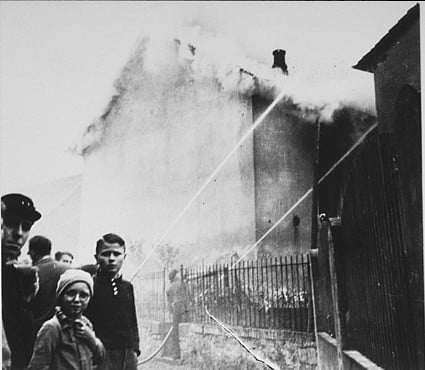
Some scholars argue that the Holocaust cannot be traced to a single moment of inception, viewing it instead as an evolving storm — the culmination of countless interconnected events and forces over many years, rather than a single “big bang” moment. Regardless of where one falls in that debate, November 9–10, 1938, marked an unmistakable turning point in the destruction of European Jewry. Over 30,000 Jews were arrested and sent to concentration camps, roughly half of whom would never return. More than 90 Jews were murdered, over 900 synagogues were burned, and nearly 7,000 Jewish-owned businesses were destroyed. This night of terror became known as Kristallnacht — the “Night of Broken Glass.”
It’s rightfully viewed as a watershed moment because of the scale and scope of the terror, but beyond the staggering numbers, a closer look at Kristallnacht and its direct aftermath, reveals several important dimensions and inflection points in the unfolding of the Holocaust itself.
Kristallnacht made it unmistakably clear to the Jews of Germany that they had no future there. They needed to leave — but had nowhere to go. Many of the destinations that had once offered refuge to German Jews — North Africa, South America, China, Australia, New Zealand — were no longer viable options by the late 1930s. It’s hard to overstate how the world’s refusal to provide safe haven had devastating consequences for German Jewry and eventually all of European Jewry.
To be clear, the international response to Kristallnacht was one of condemnation. But as Holocaust historian Laurence Rees notes, “compassionate words did not lead to compassionate action.” A proposal in the U.S. Congress in 1939 to allow 20,000 additional Jewish children into America was rejected. In fact, immigration to the United States became increasingly difficult as the refugee crisis worsened. According to the United States Holocaust Memorial Museum, President Franklin D. Roosevelt warned that even Jewish refugees could pose a potential threat by aiding Nazi Germany in exchange for the safety of loved ones held hostage in Europe. “Not all of them are voluntary spies,” Roosevelt said. Of all the major powers, only Britain significantly increased its intake of Jewish refugees through the Kindertransport. Beginning in May 1939, however, the British Parliament sharply restricted Jewish immigration to Palestine.
While the Nazis would ultimately become infamous for their systematic murder of the Jews, their original plan for addressing the so-called “Jewish question” focused on removing Jews from Germany in order to preserve their ideology of racial purity and superiority. The Nazi campaign to expel Jews from Germany was the first domino that ultimately led to Kristallnacht. In late October 1938, the Nazis deported roughly 17,000 Polish Jews living in Germany (many who were born in Germany) and its annexed territories, attempting to force them across the Polish border just two days before a new Polish law was set to strip citizens living abroad of their Polish nationality. The result was a humiliating catastrophe as these Jews were rounded up in the middle of the night and thrown into trains. According to the historian Howard Sachar, “…these doubly unwanted families were shunted into makeshift frontier holding pens, where they faced exposure and starvation.”
Among those deported were Zyndel and Ryfka Grynszpan. When their son, Herschel, who was living in Paris at the time, learned of his family’s expulsion, he sought revenge. On November 7, 1938, he went to the German Embassy in Paris and shot Ernst vom Rath, a German diplomat, who later died of his wounds. The assassination served as a key pretext for the Nazis’ violent assault on German Jews on the night of November 9, 1938 (Kristallnacht). Once again, Jewish movement or, more precisely, the inability to move — played a pivotal role. This pattern would prove decisive as the Holocaust unfolded.
The Nazis are often remembered for the precision and systematic nature of their violence against the Jews. Yet at this stage, it’s clear they were far less deliberate and organized than history often assumes. Just days after Kristallnacht, during a high-level Nazi meeting to assess the aftermath of the pogrom, records reveal that even senior officials had not considered the practical consequences of their actions — such as Jews filing insurance claims for their destroyed property to non-Jewish German insurance companies. Hitler eventually demanded that “the Jewish question…once and for all be coordinated or solved in one way or another.” From this point emerged some of the earliest Nazi policies including the marking of Jews with an insignia and the creation of ghettos.
Whether Kristallnacht marked the official beginning of the Holocaust is still open to debate. But one thing is certain: it foreshadowed much of what was to come — both in the evolution of Nazi policy and in the world’s abdication of responsibility toward the Jewish people.