
Author, Illustrator
Featured Post
Was the shofar born in silence?
The sound of the ram's horn we blow on Rosh Hashana is not only a ringing summons but also a way to call out when words fail us
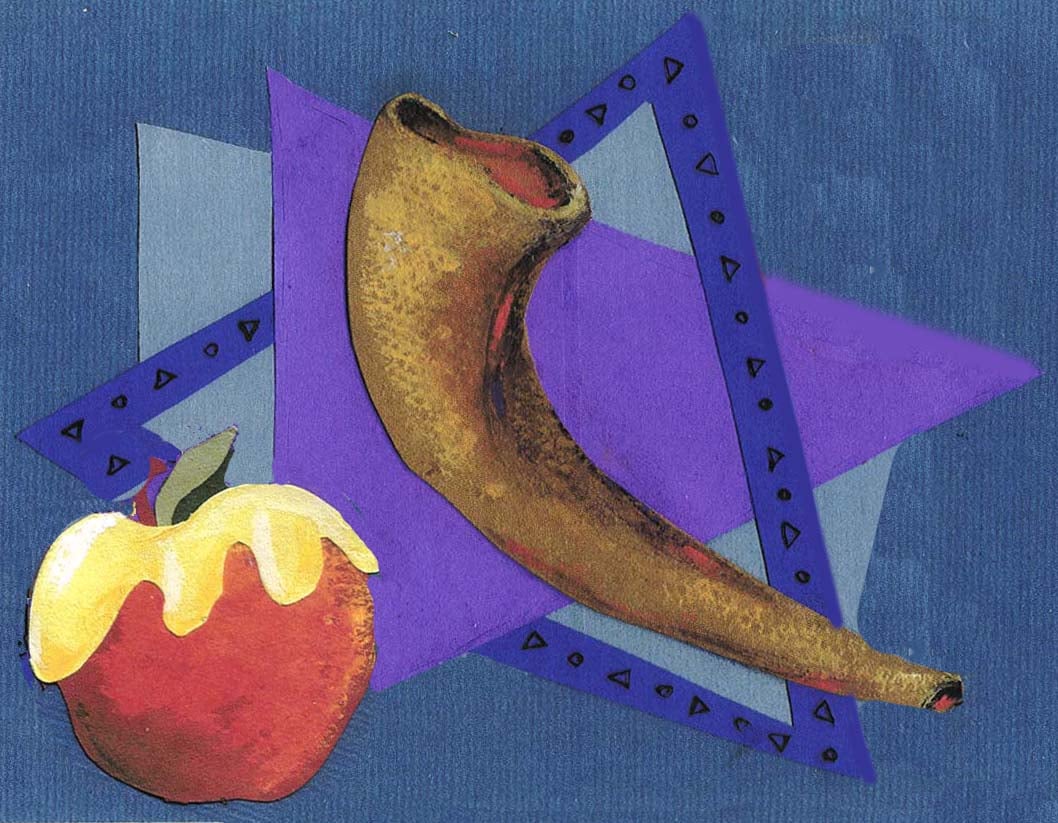
Art by Ann Diament Koffsky
“Ashrei Ha’am Yodei Teruah”
“Praised are the people who truly understand the message of the shofar.”
On Rosh Hashanah, we read the story of Akeidat Yitzchak and how Hashem commanded Avraham to sacrifice his and Sarah’s only child, Yitzchak.
Why this story? Why not a story of kindness, like Rivkah giving water to camels? Wouldn’t kindness be the emotion we want to evoke on these Days of Judgement?
One answer that many of us learned back in our day-school days was because of the ram and the horns on its head: the shofar. We blow the shofar on Rosh Hashanah, so naturally, we read a story that includes one. Obviously, that answer is shared in grade school for a reason: it’s simplistic. There has to be more.
And there is. Many have explored the Akedah more deeply, including Dr. Joel Wolowelsky in his recent article, Rereading the Akedah Story (Lehrhaus, July 12, 2026). There he states that, “Abraham is presented with what should be an obviously unethical demand. It is an opportunity for him to protest: “Could the Judge of all the earth demand what is morally indefensible?”
Put more simply, Avraham in this tale should be asking: Hashem, are you really be asking me to do THIS?!
The question is even sharper in context. Just a couple of chapters earlier (Bereishit 18:22–33), when Hashem tells Avraham of his plans to destroy Sodom, Avraham rises to the occasion. He protests! Argues. Negotiates. In contrast, when he is asked to sacrifice his beloved son, what is Avraham’s response? Silence.
Dr. Wolowelsky continues, “…How, then, are we to understand Abraham’s response?… His silence becomes its own language: not submission, but quiet defiance.” Or, put more colloquially: Avraham is so upset that he gives Hashem the Silent Treatment.
But that begs the question. Why is Avraham so upset?
Perhaps it is as Bible scholar Dr. Avivah Gottlieb Zornberg says in her reflection on the Akedah, “The Satan whispers in Abraham’s ear, ‘What are you doing? Will you destroy your son?!’” According to her reading, Avraham is silently furious that Hashem has asked him to murder his beloved child.
And indeed, from that moment forward, Avraham and Hashem never speak to each other again.
Before the Akeidah? They spoke many times. About Sarah. Yishmael. Sodom. And more.
After the Akedah? Their relationship is irrevocably impacted. The Akedah is a step too far. They never again talk as they once did. The silence endures.
Into that silence comes the ram and the shofar.
The Talmud describes the shofar’s cry as being like the piercing sound that Sisera’s mother made when she heard her son had been killed. At the Akedah, the tragedy of a lost child was averted, but for Sisera’s mother, it becomes reality. With that tragedy comes her painful wail.
Rabbi Aaron Goldscheider explains, “As someone who has experienced the painful loss of a child, I cannot help but find it striking that the Sages have attached the shofar blasts to the cry of a bereaved parent. It indicates an awareness on the part of our spiritual masters that child loss epitomizes a loss of deep pain, a lingering wound, an enduring cry.”
The Talmud also describes the shofar’s sound as echoing the sounds of a woman in labor. Rabbanit Alissa Thomas-Newborn describes, “The voice of the shofar awakens a primal yearning within us to devote ourselves to that cry for life. We stand before God praying that we will be written in the Book of Life, and the sound of the shofar elevates and contextualizes our cries [both] within those of Sisera’s mother and the woman in labor.”
So when the lamb and the shofar atop its head appear at the akedah, they are not an afterthought. They are the message of the story.
By gifting a shofar to Avraham, perhaps Hashem is acknowledging the trauma that has happened, and providing another way to communicate. Perhaps Hashem is saying, “Yes, our relationship has been irrevocably altered — we can no longer speak with words. But here, take this shofar. It’s an instrument of wordless communication. You can still connect to me this way. Through two desperate sounds: the sound of a mother who has lost a child (as you almost did, Avraham), and through the sound of a mother in labor who is hoping for new life to be born.”
Through emotion, music and heartfelt connection, the shofar gives voice to what words no longer can.
In his poem, A Mission of Summoning, Rav Kook ties the shofar to these themes of life and death as well:
And blow the great shofar
tekiah, teruah, shevarim
and pound with your foot,
and so the graves will quake.
And these sounds will ascend through passage
To the very roots of the souls
And those who roll will be set into motion
– Excerpt from Hashofar: A mission of Summoning by Rav Kook, circa 1912
For Rav Kook, the shofar’s sounds are not only cries of pain and hope, but also of a shattering of the silence of death itself. He imagines that its cry not only provides us with a new language through which we can connect with Hashem, but that it can also awaken souls and return them to life!
This may be the true message of this tale. The shofar’s sounds of desperation, despair and hope are not merely here to remind us of the ram that saved Yitzchak; they are Hashem’s response to the trauma and silence that followed.
Perhaps this is why the story of the shofar is indeed the ideal tale for Rosh Hashanah. It gives voice to our grief, hope, fear and longing when words fail us.
May Hashem hear its cries and answer our prayers for life and peace in the coming year.
–
In memory of my daughter, Adira Rose Koffsky, a’h. May her neshama have an aliyah.
Related Topics
Related Posts