
Watching Arsenal (while dodging Iran’s arsenal)
This isn’t my usual fare. Readers of my blogs and op-eds over the years know my usual topics – Israel, politics, antisemitism, etc. This is both more personal, and on a completely different topic: football (“soccer” for North American readers.) Not so much about the game itself but rather what it has meant for me this year, that my team, Arsenal, won the English Premier League for the first time in 22 years.
If you’re not familiar with English football, or with Arsenal, it’s one of the best supported clubs in the world, with literally millions of fans taking to the streets to celebrate the championship win, not just in the vicinity of the stadium in North London but around the world, as far afield as Kenya and Vietnam. Here in Israel, where there is a widely followed domestic league, genuinely fervent support for foreign teams is less common, but there is an indigenous Arsenal Supporters Club, and even a Hebrew-language Arsenal podcast. (And I recently learned of an Israeli Arsenal fan – Israeli-born, not a British ex-pat like me – who lives in a small community in the north of the country and has had an Arsenal flag flying from the roof of his house for the past week. His wife told me he’s supported Arsenal since 1989. For any Arsenal fans reading this, that will make perfect sense.)
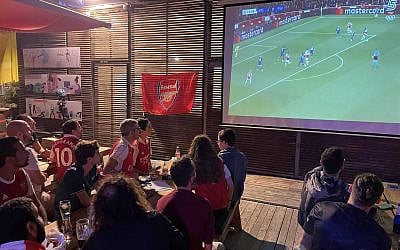
Being a committed fan of a sports team is to live part of your life in an alternate reality, where something that makes no difference in the real world, genuinely feels of enormous consequence. Football, because of its global reach and the devotion of so many of its fans (there’s a reason the word “fan” is derived from “fanatic”…), has a particular ability to create this alternate world; so much so that it has frequently impacted politics and society in several countries. (At least two excellent books have been written on the role football has played in national and international politics.). A legendary manager of Liverpool, Bill Shankly famously said: “Football is not a matter of life and death. It’s more important than that.” He was wrong of course, and I much prefer a lesser known remark by a far more recent Liverpool manager, Jurgen Klopp, who called football “the most important of the least important things”.
And these past 12 months or so, it’s been really important to me.
For everyone in Israel, it’s been a stressful period. The June 2025 war with Iran had us scrambling to bomb shelters for 12 days. Little did we know that was just the prequel (notwithstanding both Netanyahu’s and Trump’s triumphalism at its conclusion); we’d return to a much longer period of hostilities in February to April of this year.
I make no claim to have been among the hardest hit by these wars. Not even close. I’m not serving in the army and have no loved ones serving. I don’t live in the areas in the north of Israel, still under bombardment from Hezbollah. And no one close to me was among the dozens killed, or thousands injured. However, I am one of the millions of Israelis with young children. And that has meant weeks of no school and stir-crazy kids; and it meant dragging my nine-year old twins out of bed in the middle of the night while the siren blared, taking them to our building’s bomb shelter night after night. Someone in the child psychology field will someday write a truly terrifying report on what these experiences (coming shortly after two years of war with Hamas) have done to our children.
In addition to the national situation, I had to contend with news of a serious health issue in my immediate family, starting in July last year. (I’m happy to report that the prognosis is looking much better than it did at one point.)
Enter Arsenal. The team I’ve supported since I was a young boy, educated / indoctrinated by my father. If I’m honest, for much of my adult life I was not quite as emotionally invested in the team as I had been as a child, teenager, or even into my twenties. It could be because the team was not doing so well – there was less to get excited about – but also because life was filled with so many dramatic and important moments which just took priority: moving to Israel and trying to make a life and career here; meeting my wife and getting married; having three children. So while I can easily recall Arsenal’s famously dramatic victory against Liverpool to win the league when I was 10 years old (the 1989 reference above); or the last minute-goal that saw us win the FA Cup four years later; or our first championship victory of the Arsene Wenger era that I celebrated at a bar as a university student while at university, climbing on the table and roaring in drunken delight; it’s actually harder for me to cast my mind back to big games that I watched just 5 or 10 years ago.
But the last few years, and this season more than ever, something changed. I was back to my younger days of utter elation or heart-sinking dejection as Arsenal’s pursuit of that elusive league championship took multiple twists and turns over the course of the season. And I’m convinced it’s because of what I mentioned earlier. For 90+ minutes, I could forget about Hamas, Hezbollah and Iran; about just how tense my life had become. Instead of agonizing over my family’s health, or my children’s panic at the siren, I could stress about what defeat in this game would mean in the race for the championship. For that defined window of time, I could live as though the most important thing in the world was that the 11 men in red and white scored more goals than the 11 men in blue. Zero consequences in the real world; but massive emotional impact.
And it’s paid off. For a few weeks it looked like the team had run aground. Defeat to our main rivals Manchester City and other disappointing results plunged me into despondency. But we turned it around. A dramatic win against West Ham – featuring the most consequential VAR (video assistant referee) call in history, followed by Manchester City failing to win at Bournemouth, and the title was ours. I watched that game at a friend’s apartment with my elder daughter (successfully educated/indoctrinated by me). We drove home just before midnight, belting out Queen’s “We Are The Champions” (apologies to any residents of the Baka neighborhood of Jerusalem who heard our raucous rendition).
And the celebrations may get even bigger tomorrow night, with Arsenal contesting the final of the European Champions League, the most prestigious tournament in club football. If we win, apologies in advance to any Jerusalem residents within earshot of me on my way home. And if you’re reading this as an Israeli, or as someone who identifies with Israel, you really should be supporting Arsenal in this game. Our opponents are the French champions, Paris St. Germain, who are literally owned by Qatar. (Not unlike certain apparatchiks in the Prime Minister’s Office, perhaps?)
Anyway, I want to thank Arsenal, their brilliant young manager Mikel Arteta, and all the players, for giving me and so many millions of people something to smile about. And more specifically, for giving so many of us dealing with arsenals of a different sort an escape route to a different kind of drama and excitement, where the only rockets are 20-yard volleys into the opponent’s net.