
CFO | Empower Society for Good I Author
Water and the Test of Responsibility
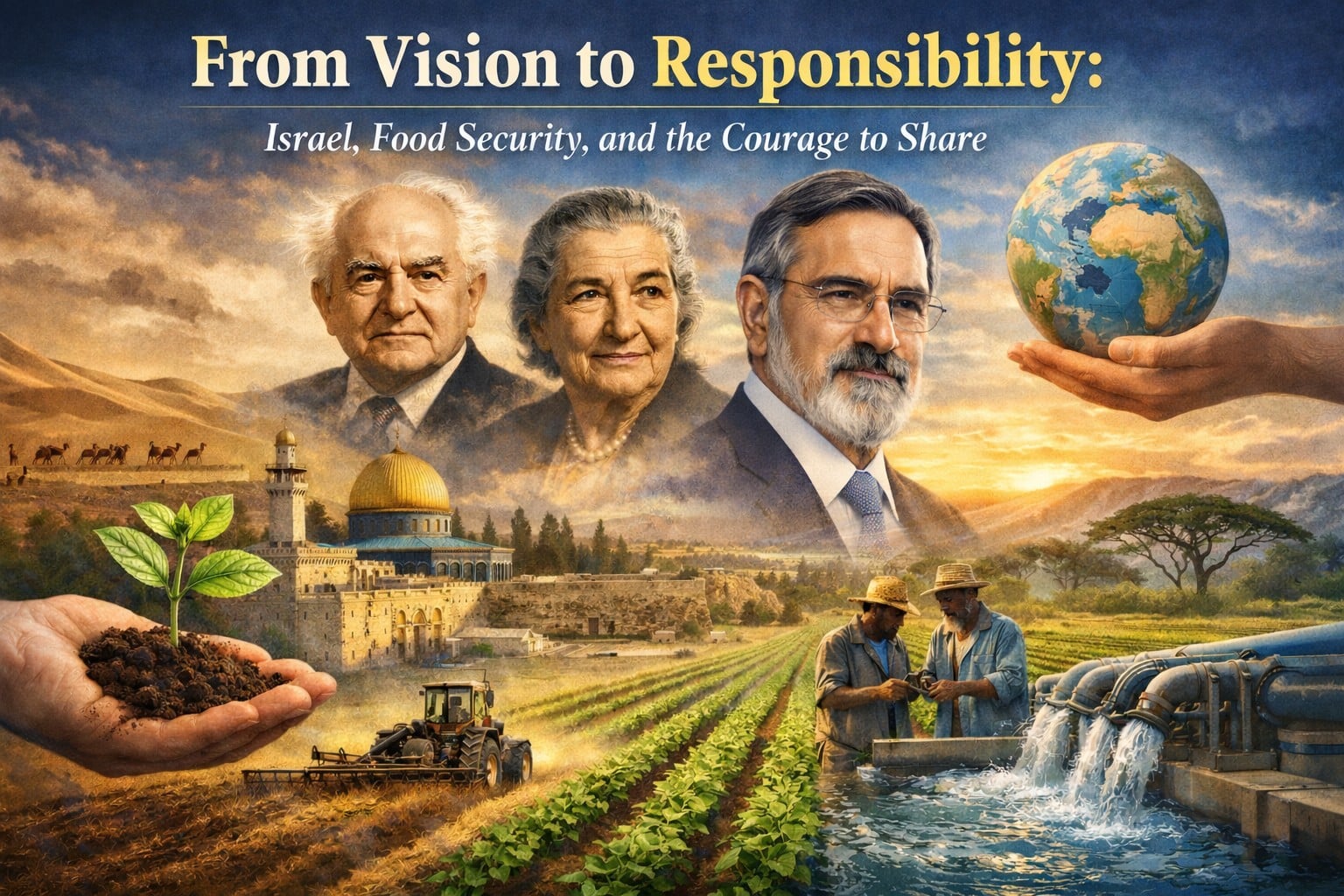
Tu Bishvat Reflections on Scarcity, Food Inflation, and Responsibility
Tu Bishvat, the New Year for Trees, is rooted in Jewish law in the Mishnah (Rosh Hashanah 1:1), which establishes the fifteenth of Shevat as the point from which the agricultural year for fruit trees is counted. At its core, this date introduced a framework of accountability — reminding us that growth takes time, that results are measured over seasons rather than moments, and that stewardship of the land carries responsibility across generations.
Over time, Tu Bishvat has come to represent something broader and deeply human: a pause to reflect on growth, roots, water, and the natural systems that sustain life. In Israel, the day is marked in practical ways — children bring home seedlings from gan, schools and youth movements go on nature hikes, communities plant trees, and families eat fruits together. Around the world, Jews mark the day by eating fruit — especially the Seven Species associated with the Land of Israel — and in recent generations a Tu Bishvat Seder has taken root, offering a structured way to reflect on nature, renewal, and responsibility, linking ancient tradition with contemporary concerns about land, sustainability, food, and water.
It is therefore fitting to share this two-part series on Tu Bishvat, which this year begins on Sunday night, 1 February, and continues into Monday. These reflections use Tu Bishvat as a lens through which to examine some of the defining challenges of our time: water scarcity, food insecurity, rising food prices, and the way resource stress undermines social and political stability.
Part 1 explores the challenge itself — the realities of desert life, water scarcity, and food inflation — and ends with David Ben-Gurion’s vision of the Negev as a moral and national test.
Part 2 moves from challenge to responsibility, exploring how Israel translated scarcity into resilience through the deliberate building of water systems, cooperative agricultural models, technological innovation, and a culture of shared knowledge. It traces this responsibility across generations — from Golda Meir’s commitment to sharing Israel’s agricultural experience with developing nations, to Booky Oren’s work in transforming practical water expertise into a global knowledge-to-implementation platform, and ultimately to the moral framework articulated by Rabbi Jonathan Sacks, who taught that a good society is built not on power or success alone, but on shared responsibility for the wellbeing of others.
This mini-series is not about slogans or image-building. It is about responsibility — how ancient values, modern innovation, and lived experience can together guide action in an age of scarcity, and how growth, like the trees we mark on Tu Bishvat, demands patience, care, and commitment long before fruit appears.
Tu Bishvat Begins with Water
Tu Bishvat is often celebrated as the New Year for Trees, a festival of fruit, renewal, and growth. But trees do not begin with fruit. They begin with water. Without water, there are no roots. Without roots, there is no resilience. And without resilience, growth is an illusion.
In lands blessed with rain, water is invisible. In desert regions, water is never abstract. It shapes settlement patterns, agricultural systems, food prices, political stability, and national survival.
On Tu Bishvat, it is therefore fitting to step back from symbolism and confront reality: water scarcity is one of the defining challenges of our age.
The Desert Reality: A Permanent Condition, Not a Passing Crisis
Much of the Middle East, North Africa, and large parts of Africa live under conditions of permanent aridity. Rainfall is low, unpredictable, and increasingly volatile. Evaporation is high. Rivers are overstretched. Aquifers are being depleted faster than they can recharge.
This is not a cyclical drought problem. It is a structural imbalance between demand and supply.
Israel itself sits squarely within this reality. More than 60% of the country is desert or semi-desert, dominated by the Negev. Water scarcity is not a future threat or a theoretical risk; it is a daily operating condition.
This reality forces a hard question that many nations postpone:
How do you build a viable society where nature offers no margin for error?
Water Scarcity Is a Systems Failure, Not Only Climate Change
Climate change amplifies water stress, but it does not explain it fully. In many regions, scarcity is the result of human systems failing under pressure.
Common patterns include:
- Over-extraction of groundwater treated as an infinite reserve
- Aging infrastructure leaking massive volumes of water before it reaches users
- Politically subsidized water pricing that encourages waste
- Agricultural practices mismatched to climate reality
Groundwater depletion is especially dangerous because it happens quietly. Aquifers collapse underground. Land subsides. Storage capacity is permanently lost. By the time shortages become visible, recovery is often impossible.
Water mismanagement is rarely dramatic — until it becomes catastrophic.
From Water Scarcity to Food Inflation
Water scarcity does not remain confined to rivers, reservoirs, or technical discussions. It travels directly into food prices.
When water becomes unreliable:
- Crop yields decline or fluctuate
- Farmers face rising energy and pumping costs
- Fertilizer efficiency drops
- Food imports increase
This is where water scarcity becomes an economic problem — and then a political one.
Food inflation hits the poorest households hardest. In many regions, food represents a significant share of household spending. Rising prices strain family budgets, force governments into unsustainable subsidies, and fuel social anger.
Food inflation is therefore not merely a monetary issue. In water-stressed regions, it is a resource shock — one that destabilizes societies long before it appears in macroeconomic statistics.
Water, Food, and Political Fragility
History shows a consistent pattern:
- Water stress reduces food production
- Food price spikes follow
- Social unrest escalates
- State capacity weakens
This dynamic was visible during the Arab Spring, where food price inflation acted as an accelerant rather than a root cause. The underlying vulnerability was already present — water scarcity simply exposed it.
Water scarcity rarely causes conflict alone. But it magnifies every existing weakness: inequality, corruption, poor governance, and fragile institutions.
Drying Lakes and Transboundary Water: When Scarcity Crosses Borders
Water does not respect national boundaries. Rivers, aquifers, and lake systems flow across borders, turning water scarcity from a technical challenge into a geopolitical one.
Across the world, lakes are drying up, not as isolated environmental events but as warning signals of systemic failure. The collapse of the Aral Sea in Central Asia, once one of the world’s largest lakes, reshaped an entire region after decades of misguided water diversion for agriculture. Lake Chad, located in West–Central Africa and shared by Nigeria, Niger, Chad, and Cameroon, has shrunk dramatically, undermining livelihoods for millions and intensifying poverty, migration, and instability across an already fragile region.
In the Middle East, Lake Urmia in north-western Iran offers a stark example of how internal mismanagement can devastate an entire ecosystem. Once the largest lake in the region, it has largely dried up due to dam construction, groundwater over-extraction, and poorly aligned agricultural policies, leaving behind salt storms, health risks, economic damage, and growing social unrest. Iran’s broader water crisis — collapsing aquifers, sinking land, and repeated protests — shows how water scarcity can destabilise societies even without crossing borders.
The Dead Sea, shared by Israel and Jordan, continues to recede rapidly as water from the Jordan River is diverted upstream. Sinkholes now threaten infrastructure and tourism, illustrating how shared water systems demand shared responsibility — or suffer shared loss.
Beyond desert regions, South Africa provides a cautionary lesson. Despite having more rainfall than much of the Middle East, years of infrastructure decay, unequal distribution, and governance failures led to severe water restrictions, most famously during Cape Town’s “Day Zero” crisis. South Africa’s experience shows that water scarcity is not only a function of climate, but of management, planning, and political will.
Even advanced economies are not immune. Lake Mead in the south-western United States, the largest reservoir on the Colorado River, has reached historically low levels due to prolonged drought and chronic over-allocation, forcing difficult negotiations between states and exposing the limits of existing water governance frameworks.
These cases reveal a shared pattern: water systems are overdrawn, natural buffers collapse, and the consequences quickly move from environmental stress to food insecurity, migration pressure, social unrest, and weakened sovereignty.
The Nile Basin illustrates how scarcity becomes existential. Egypt’s near-total dependence on Nile water means that upstream developments are viewed not as engineering decisions, but as matters of national survival. Similar dynamics exist across the Middle East and Africa, where shared water systems become flashpoints during periods of stress.
Jordan, one of the most water-scarce countries in the world, depends heavily on cross-border arrangements — including water supplied by Israel under peace agreements — making cooperation a quiet but essential pillar of stability rather than a political choice.
In all these contexts, water scarcity becomes:
- a diplomatic challenge, as states negotiate access and allocation
- a security concern, as shortages fuel unrest and instability
- a constraint on sovereignty, as dependence limits national autonomy
When water security weakens, political independence weakens with it.
As lakes dry up across the world and water scarcity increasingly ignores borders, the lesson is clear: if countries can put aside hostility, conflict, and politics, Israel’s hard-won water innovation and shared knowledge represent a real opportunity for cooperation, stability, peace, and human betterment.
Food Security Is National Security
Food security is often discussed as a humanitarian concern. In reality, it is a strategic necessity.
A country that cannot feed itself at predictable prices becomes vulnerable to:
- External pressure
- Currency shocks
- Social unrest
- Fiscal collapse through subsidies
Water scarcity undermines food security. Food insecurity drives inflation. Inflation erodes trust in institutions. The chain is relentless.
Food security, therefore, is not an agricultural side issue. It is a core pillar of national resilience.
Ben-Gurion and the Negev: Vision Before Technology
David Ben-Gurion understood these truths long before modern water technologies existed.
For Ben-Gurion, the Negev was not an inconvenience or a peripheral problem. It was the central test of Zionism. A nation that could not sustain life in its harshest geography, he believed, could not claim long-term sovereignty.
When Ben-Gurion left office to live in Sde Boker, it was not a symbolic gesture. It was a strategic statement. The desert demanded:
- Discipline instead of entitlement
- Planning instead of improvisation
- Cooperation instead of individualism
- Responsibility instead of blame
Ben-Gurion did not romanticize the desert. He respected it. He understood that survival in scarcity shapes national character.
He left no technological roadmap. But he left a moral and strategic challenge:
Master scarcity — or be mastered by it.
The Unfinished Question
Today, water scarcity, food inflation, and political instability are converging across regions. The desert is no longer confined to geography; it is becoming a global condition.
Tu Bishvat reminds us that growth begins with roots. But roots only survive when water is respected, managed, and shared responsibly.
Ben-Gurion’s vision was not merely about Israel’s survival. It was about whether a society could turn scarcity into responsibility — and whether that responsibility could ultimately extend beyond its borders.
Part 2 will explore how Israel answered that challenge — through innovation, cooperation, and the deliberate sharing of knowledge — and what this might mean for a world facing its own desert moment.
Related Topics